
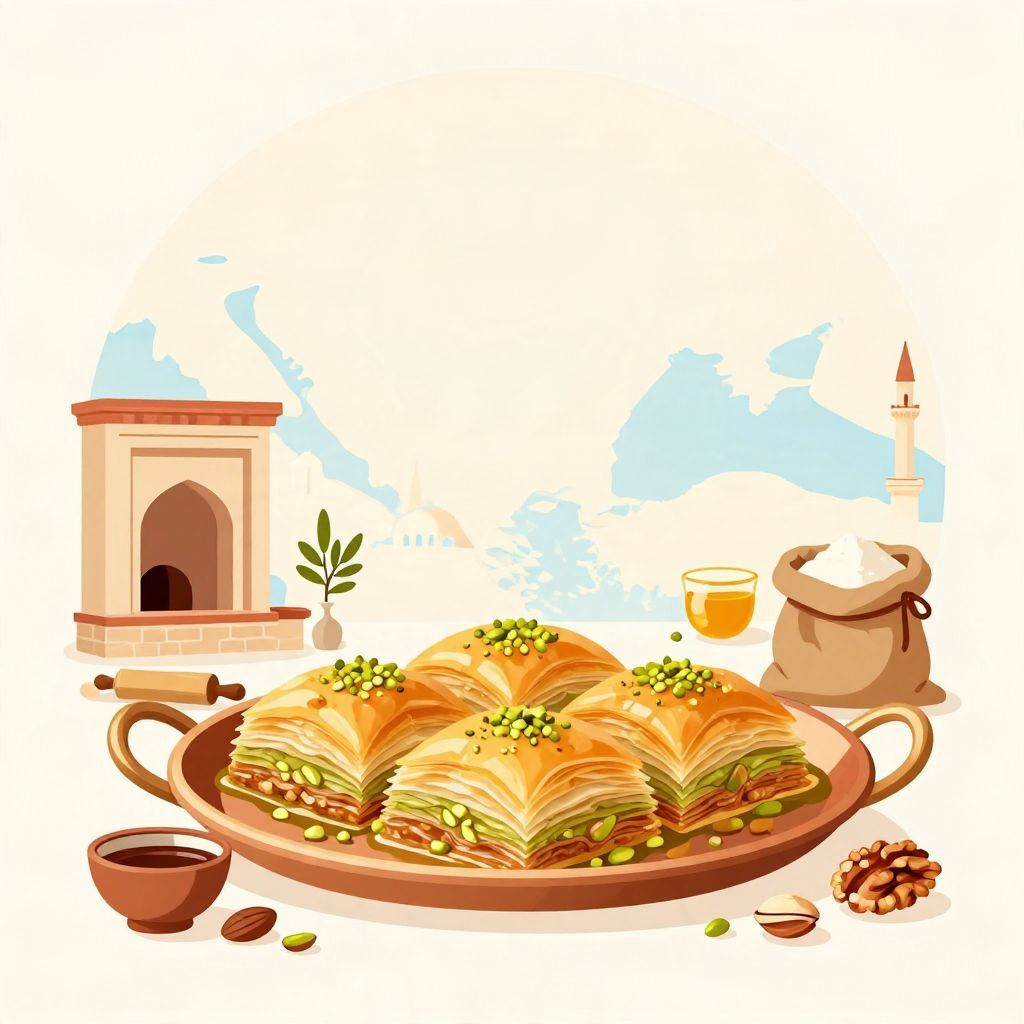
Baklava is one of the most famous pastries in the world, but its origin is more complicated than a single country or a single inventor. The short answer is that baklava developed in the eastern Mediterranean and the Islamic Middle East, then was refined and popularized in the kitchens of the Ottoman Empire.
So when people ask, “Where did baklava originate?” the most accurate answer is that it has multiple historical roots, with strong claims tied to the Ottoman court, earlier Byzantine and Middle Eastern pastry traditions, and likely even older layered-dough desserts from Central Asia.
Where Did Baklava Originate?
Baklava most likely emerged through a long culinary evolution in the eastern Mediterranean and West Asia, rather than at one exact place and date. Its best-documented form was developed and spread under the Ottoman Empire, especially in imperial kitchens in Constantinople, but it drew on earlier traditions of layered dough, nuts, and syrup found across the region.
The Historical Background of Baklava
To understand baklava’s origin, it helps to separate the dessert’s deeper ancestry from the version people recognize today. Thin sheets of dough, sweeteners such as honey or syrup, and fillings made from nuts were all known in ancient and medieval food cultures around the Mediterranean and Near East. Baklava did not appear out of nowhere; it was the result of centuries of experimentation with pastry-making.
Ancient and medieval pastry traditions
Long before baklava had its modern name, cooks in the ancient world were making sweet layered or filled pastries. The Greeks, Romans, Persians, and later Byzantine and Arab cooks all used combinations of flour, fat, nuts, and honey. These were not baklava in the strict modern sense, but they show that the basic idea of rich sweet pastry had deep regional roots.
Some historians point to ancient Greek and Roman desserts as distant ancestors because they included flattened doughs, honey, and nuts. Others emphasize Persian and Central Asian influences, where layered breads and filled pastries were also common. What is clear is that baklava belongs to a broad culinary family that developed across trade routes, empires, and mobile food traditions.
The Ottoman contribution
The strongest historical evidence for baklava’s direct development comes from the Ottoman Empire. By the 15th and 16th centuries, baklava had become associated with elite Ottoman cuisine, especially in Constantinople, the imperial capital. The Ottoman palace kitchens helped standardize and elevate the pastry, turning it into a prestigious dessert served at court and during major celebrations.
One of the most important technical developments was the use of extremely thin dough sheets, later known as yufka or similar regional forms. This technique made it possible to create many delicate layers, which became a defining feature of baklava. The pastry’s refinement was not just about taste; it also reflected the resources, labor, and culinary skill available in an imperial setting.
Was Baklava Greek, Turkish, or Middle Eastern?
Baklava is claimed by several cultures because it spread across a wide region and was adapted locally over time. It is most accurate to describe it as a shared eastern Mediterranean and Middle Eastern dessert whose most famous classical form was shaped in the Ottoman world. Modern national claims often reflect later cultural identity, not a single original birthplace.
Why the origin is disputed
Food history is often difficult because recipes rarely survive in one fixed form. Dishes change as they move across borders, languages, and social classes. Baklava is a perfect example: Greeks, Turks, Arabs, Armenians, Persians, and others all have versions of layered nut pastries, and many societies consider the dessert part of their own heritage.
The dispute is also shaped by modern nationalism. In the 19th and 20th centuries, as empires broke apart and nation-states formed, foods became symbols of identity. Baklava was then claimed as “Greek,” “Turkish,” or “Arab” in ways that often reflected modern politics more than medieval history.
Greek connections
Greek culinary traditions are often linked to baklava because the dessert became deeply embedded in the food culture of the Greek-speaking world, especially under Ottoman rule and afterward. Some popular stories trace baklava to ancient Greece, but those claims are hard to prove in a direct line. What can be said with confidence is that Greek cooks preserved and adapted the dessert, making it a major part of modern Greek cuisine.
Turkish and Ottoman connections
Turkey has one of the strongest historical claims because baklava was highly developed in Ottoman palace cuisine and became a signature dessert in Ottoman territories. The city of Gaziantep, in particular, is famous today for its baklava tradition, and Turkish baklava is widely recognized for its fine layers and pistachio filling. Still, the Ottoman Empire was multiethnic, so the pastry should not be reduced to one modern nationality alone.
Middle Eastern and broader regional connections
Baklava also belongs to a wider Middle Eastern dessert tradition. Variations appear in Arab cuisine and in other regional foodways that use nuts, syrup, and thin pastry. This broader context matters because it shows baklava as part of a shared culinary landscape shaped by commerce, migration, and imperial rule.
What Is the Earliest Evidence for Baklava?
There is no universally accepted “first baklava” recipe from antiquity. The earliest clearly recognizable baklava-like pastries appear in medieval sources and become more visible in Ottoman records. Because recipes were often transmitted orally or adapted in household practice, the historical trail is incomplete. That makes certainty impossible, but the Ottoman period is the safest point for baklava’s documented rise.
Medieval manuscripts and court cuisine
Medieval cookbooks from the Islamic world and Byzantium show a growing interest in layered sweets, nut fillings, and syrup-based desserts. These sources do not always describe baklava exactly as we know it, but they demonstrate the culinary environment from which it emerged. By the time of the Ottoman court, similar techniques were being used in a more elaborate and standardized way.
Imperial kitchens and social prestige
Baklava’s status rose because it was labor-intensive. Making many thin sheets of dough required skill and time, which made the dessert suitable for courts, feasts, and special occasions. In imperial settings, food often signaled wealth and power, and baklava fit that role perfectly. Its association with celebration helped spread it beyond palace walls.
How Baklava Spread Across the Ottoman World
As the Ottoman Empire expanded across Southeast Europe, Anatolia, the Levant, North Africa, and the eastern Mediterranean, baklava traveled with it. Soldiers, merchants, artisans, and administrators carried recipes between cities and regions. Local ingredients then shaped new versions, producing the many baklava styles known today.
Regional adaptations
- Anatolia: often uses pistachios or walnuts, with very fine layers and syrup.
- Greece: commonly features walnuts, cinnamon, and honey syrup in many modern versions.
- Levant and Arab regions: may use rosewater, orange blossom water, or different nut combinations.
- Balkans: developed local styles influenced by Ottoman baking traditions.
These differences matter because they show that baklava was never a frozen recipe. It was a flexible dessert that adapted to local tastes and available ingredients while retaining its core identity: thin pastry, nuts, fat, and sweet syrup.
Popular Legends About Baklava’s Origin
Baklava has inspired many origin stories, but not all are equally reliable. Some legends claim it was invented by one ancient people or one famous cook. Others say it was created in a single palace kitchen and then copied everywhere. Such stories are appealing, but they oversimplify how food history actually works.
Why legends persist
Food traditions often become part of national pride, which encourages neat origin stories. A dish as beloved as baklava naturally attracts myths. Yet the historical record suggests gradual development instead of a single invention. The most responsible answer is therefore less dramatic, but more accurate: baklava emerged from centuries of shared culinary practice in a region where cultures constantly influenced one another.
So, Where Should We Place Baklava on the Historical Map?
If you want one location most closely associated with baklava’s rise to fame, Ottoman Constantinople is the best answer. If you want the deeper cultural setting, it belongs to the broader eastern Mediterranean and Middle Eastern world. If you want the earliest ancestry, you have to look even farther back, to ancient and medieval pastry traditions across Greece, Persia, Byzantium, and neighboring regions.
That layered history is fitting, because baklava itself is layered. Its origin is not a single point on a map but a long process of borrowing, refinement, and regional exchange. The dessert’s history reflects the movement of peoples and tastes across empires, which is exactly why it became so widely loved.
In the end, baklava originated in a shared culinary world rather than one isolated nation, with its most recognizable form shaped under the Ottoman Empire. For readers interested in the wider historical setting, you may also enjoy learning what Greece is known for and how long the Ottoman Empire lasted.