
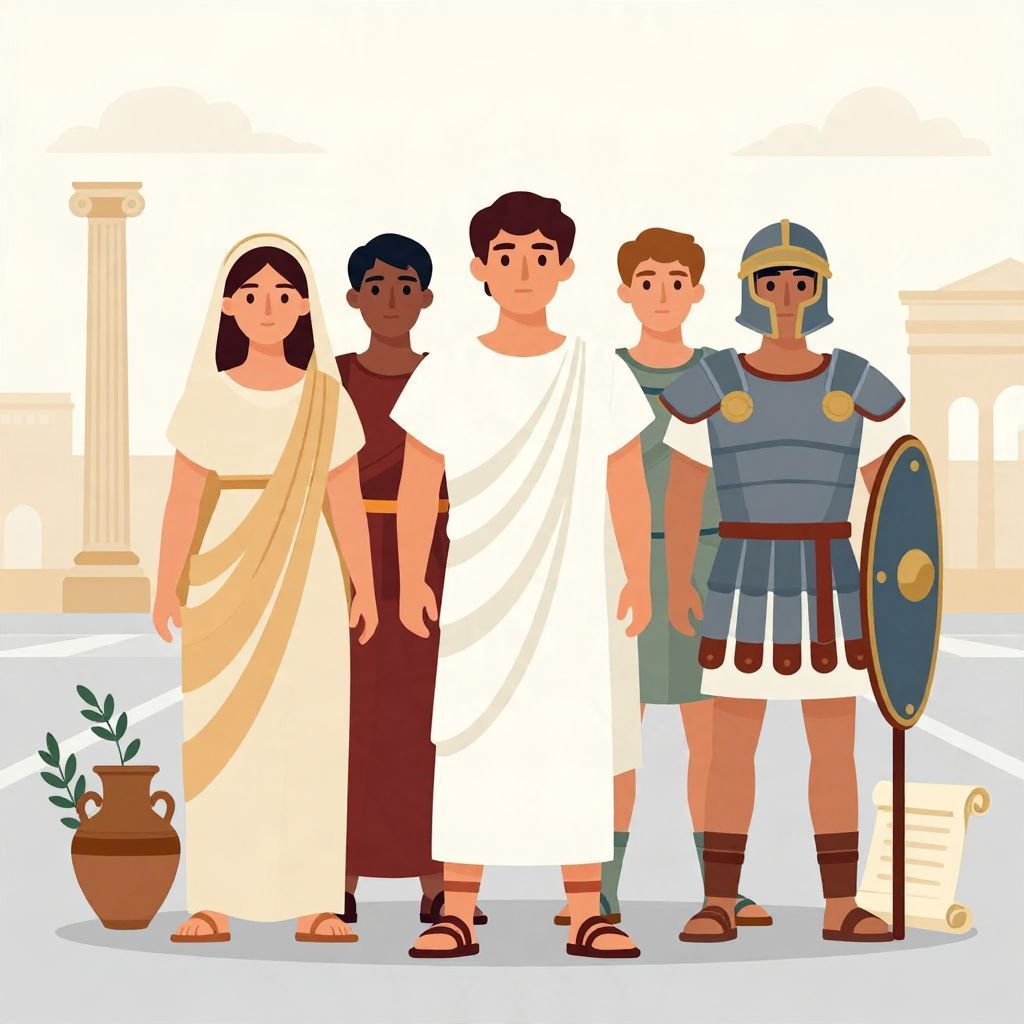
What did Romans look like? The short answer is that there was no single “Roman look.” Ancient Rome was a multiethnic empire, so Romans could have varied widely in skin tone, hair texture, facial features, height, and clothing depending on where they lived, their ancestry, social class, and period in history.
Still, we can say a great deal from statues, portraits, skeletons, mosaics, coins, and written descriptions. Romans in Italy and across the empire usually shared the dress, grooming, and cultural habits of Roman society, even when their physical appearance reflected local backgrounds from North Africa, the Near East, Greece, Gaul, Iberia, or beyond.
What Did Romans Look Like?
Romans did not have one fixed physical appearance. In the city of Rome and throughout the empire, people came from many regions and ethnic backgrounds, so “Roman” was primarily a political and cultural identity, not a single race or phenotype. Most Romans wore tunics, and elite men and women often styled hair, clothing, and accessories to signal status more than ancestry.
Why There Was No Single Roman Appearance
The Roman world stretched from Britain to Egypt and from the Atlantic to Mesopotamia at its greatest extent. As citizenship expanded, especially after 212 CE under Emperor Caracalla, more people across the empire became Roman in law. That meant Romans included Italians, provincials, freedpeople, soldiers, merchants, and migrants with many different physical traits.
Rome as a multicultural society
Rome absorbed people through conquest, trade, slavery, military service, and migration. Enslaved people from different regions were brought into Italy, while veterans and administrators settled far from their original homes. Over time, intermarriage and local blending made the population even more diverse. A Roman in North Africa might look different from a Roman in Syria or Gaul, yet both could be fully Roman in language, law, and identity.
What “Roman” meant in practice
In the ancient world, identity was often defined by citizenship, legal status, language, city, and custom. A person could be physically local to one region but socially Roman if they adopted Roman dress, names, religion, and civic habits. This is why asking what Romans looked like is partly a question about culture, not only biology.
How We Know What Romans Looked Like
Historians reconstruct Roman appearance from several kinds of evidence, each with limits. Art can idealize or stylize, while bones reveal physical traits but not clothing or grooming. The best picture comes from combining sources rather than trusting any single image.
Statues, busts, and coins
Roman portraits are among the most famous images from antiquity. Marble busts and coin portraits often show hairstyles, beards, wrinkles, and facial structure. But they were not always realistic in a modern sense. Imperial portraits could be carefully designed to project authority, youth, piety, or military strength. A ruler might be shown more idealized than he really looked.
Mosaics, frescoes, and everyday art
Wall paintings and mosaics from Pompeii, Herculaneum, and elsewhere give a livelier sense of clothing, hair, and color. These images often show ordinary people, servants, athletes, and women in domestic settings. They are especially useful because they reflect daily life rather than official propaganda.
Skeletal and burial evidence
Archaeology adds another layer. Human remains can tell us about average height, diet, disease, and sometimes ancestry patterns. For example, many Romans were shorter than modern people on average, though nutrition varied by class and region. Skeletal evidence also confirms that the empire’s population was mixed, especially in major urban centers.
What Roman Men Typically Looked Like
Roman men were not all clean-shaven, muscular, or stern-faced, despite modern movie stereotypes. Their appearance changed over time, and fashion mattered as much as physique. Elite men often wore short hair in the Republic and early Empire, though beards became fashionable again in some later periods.
Hair and grooming
In the Roman Republic, many elite men preferred a clean-shaven face, associating it with discipline and civic respectability. Beards became more common in the imperial period, especially after the second century CE, when emperors such as Hadrian popularized them. Haircuts were usually practical and neat, though styles varied by era and class.
Build and posture
Romans worked physically, especially in agriculture, the military, construction, and crafts. Many men would have had lean, labor-hardened bodies rather than the broad, gym-trained look often shown in modern films. Soldiers, of course, were selected and trained for endurance, but even they came from diverse backgrounds and were not all physically identical.
Clothing
The standard garment for Roman men was the tunica, a knee-length or calf-length shirt-like piece of clothing. Citizens could wear the toga, though it was cumbersome and reserved for formal or symbolic occasions. Most men did not wear togas every day. Sandals were common, but footwear varied with climate, occupation, and wealth.
What Roman Women Typically Looked Like
Roman women also displayed wide variation in appearance, but literary and artistic evidence show strong patterns in hairstyle, clothing, jewelry, and presentation. Elite women were often portrayed as elegant and carefully groomed, while working women are shown in simpler dress suited to labor and movement.
Hair as a marker of status
Roman women’s hairstyles changed dramatically across centuries. In the early Empire, elaborate curls, braids, and high arrangements were fashionable among elite women. Some styles were so complex that they likely required professional assistance. Hair was not just decoration; it signaled wealth, refinement, and connection to imperial fashion.
Dress and accessories
Women commonly wore a tunic and, in many cases, the stola, a long outer garment associated with respectable married women. Belts, pins, earrings, bracelets, and rings could indicate family status and personal taste. Cosmetics were also used, though not always universally admired by moral writers, who sometimes criticized vanity.
Beauty ideals versus reality
Roman authors often described idealized female beauty in terms of pale skin, bright eyes, healthy hair, and graceful posture. But these ideals reflected elite tastes, not the full reality of Roman women’s lives. Women who worked outdoors, in markets, or in households would have looked more weathered and practical than polished portraits suggest.
How Class Changed Roman Appearance
Social rank strongly shaped how Romans looked in public. Clothing, grooming, jewelry, and even skin condition could reveal whether someone was wealthy, enslaved, freed, or elite. Appearance was one of the clearest ways Romans expressed hierarchy.
Elite Romans
Wealthy Romans had access to better clothing, perfumes, hair care, and imported goods. Their garments were often made from finer wool or linen, and some could afford dyed fabrics, though purple remained especially associated with prestige and authority. Elite portraits also tended to emphasize dignity, ancestry, and control.
Ordinary Romans
Most Romans lived simply. Their clothing was functional, often plain, and adapted to work. Farmers, laborers, shopkeepers, and soldiers needed durable garments rather than fashionable ones. Their appearance would have been shaped by sun exposure, manual labor, and limited access to luxury items.
Enslaved and freed people
Enslaved people came from many regions and often wore practical clothing determined by their labor. Freedpeople could adopt Roman names and customs, but their appearance and dress might still reflect their previous status or origin. In a society where status mattered so much, clothing could be a powerful sign of transformation or exclusion.
Did Romans Look “Italian”?
Some Romans looked like people from Italy today, but many did not. Ancient Rome was not a nation-state with a single ethnic profile. Even in Italy, centuries of migration and mixing had already produced a diverse population by the late Republic and Empire. It is therefore misleading to imagine all Romans as one modern ethnic type.
Regional diversity inside the empire
Romans in Britain, Egypt, Syria, North Africa, and the Balkans would often have looked different from one another in ancestry and complexion, though Roman culture linked them. Local populations also retained older traditions alongside Roman ones. The empire was unified by administration and power, not by uniform appearance.
The danger of modern stereotypes
Popular images sometimes portray Romans as uniformly pale, dark-haired, and Mediterranean. That image fits some ancient Italians, but it erases the empire’s diversity. Roman identity was broad enough to include people of many backgrounds, and ancient art itself shows a range of facial features and skin tones.
How Roman Appearance Changed Over Time
Romans from the early Republic did not look exactly like those of the late Empire. Fashion, political culture, and contact with other peoples all influenced appearance. The most visible changes were in hairstyle, facial hair, clothing style, and the increasing diversity of the population.
- Early Republic: practical dress, strong emphasis on civic discipline, and more conservative grooming among elites.
- Late Republic: greater wealth and contact with the wider Mediterranean brought more luxury and fashion.
- Early Empire: imperial portraiture shaped elite style, and short hair for men remained common.
- Second century CE: beards became more fashionable among emperors and elites.
- Late Empire: clothing and portrait styles became more varied and often more symbolic than realistic.
What Roman Art Can Mislead Us About
Roman art is invaluable, but it can distort reality. Sculptors often smoothed skin, idealized noses or jaws, and followed artistic conventions. Coins were tiny and stylized. Even realistic portraits could exaggerate age or virtue for political effect. So while Roman images help us understand appearance, they should not be read as photographs.
Idealization in imperial portraiture
Emperors were often shown as eternally youthful or exceptionally authoritative, even when they were older or less imposing in real life. The goal was not exact likeness but public message. Portraits communicated legitimacy, military power, and divine favor as much as physical features.
Everyday realism in private art
Private tomb reliefs, graffiti, and domestic art can be more candid. These sources sometimes show ordinary hairstyles, working bodies, and mixed family backgrounds. They are especially valuable because they preserve the look of people outside the imperial elite.
So, What Did Romans Really Look Like?
Romans looked like a diverse ancient Mediterranean people shaped by region, class, and history. Some had features similar to modern Italians or other southern Europeans; others came from Africa, the Near East, or northern provinces and looked different. What united them was not a single face, but Roman citizenship, culture, and shared institutions.
In the end, the most accurate answer is that Romans looked like the empire they built: varied, mixed, and changing over time. If you want to explore Roman identity further, you may also be interested in what language Romans spoke and how many Roman emperors there were.