
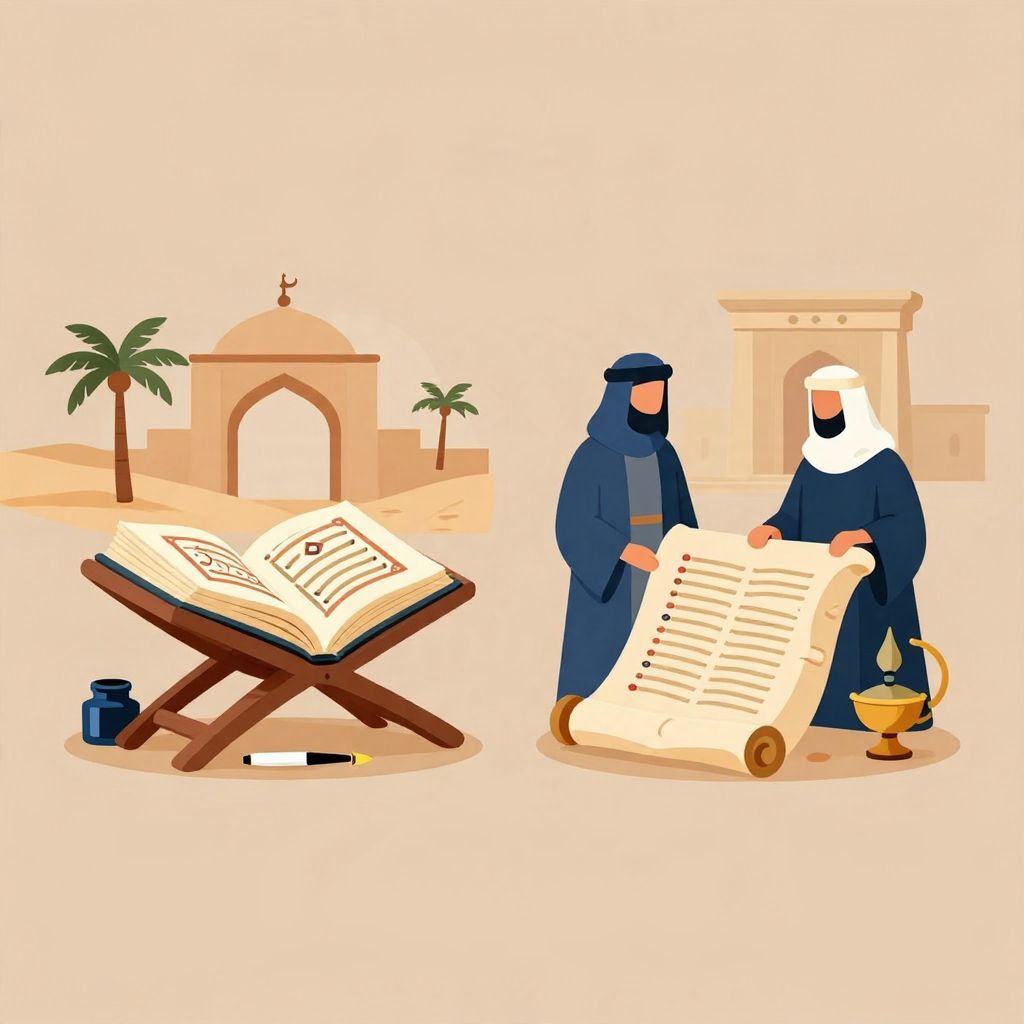
Is the Quran older than the Bible? In historical terms, the answer is no. The Bible is a collection of texts written over many centuries, with some parts dating back far earlier than the 7th century CE, when the Quran was revealed to the Prophet Muhammad in Arabia.
The comparison is still useful, because both books are central to major world religions and both have complex textual histories. The key is to ask which part of the Bible, and what “older” means: the earliest biblical writings, the final compiled form, or the religious tradition itself.
Is the Quran older than the Bible?
No. The Quran is generally dated to the early 7th century CE, while the Bible contains texts composed much earlier, especially the Hebrew Bible or Old Testament, some of which originated in the first millennium BCE. The New Testament is younger than the Hebrew Bible, but still predates the Quran by several centuries.
Why the answer depends on what you mean by “the Bible”
The Bible is not one single book written at one moment. It is a library of texts with different origins, languages, and dates. When people ask whether the Quran is older than the Bible, they often mean the whole Christian Bible. Historically, that is not the best comparison, because the Bible developed over a long period.
The Bible as a collection
In broad terms, the Bible includes the Hebrew Bible, also called the Old Testament by Christians, and the New Testament. The Hebrew Bible contains texts that were composed, edited, and compiled over many centuries, beginning long before Christianity. The New Testament was written in the 1st century CE, after the life of Jesus.
Different dates for different books
Some biblical traditions are much older than the surviving written forms. Oral traditions may have circulated before being written down. Scholars usually date parts of the Hebrew Bible to the monarchic period, the Babylonian exile, and the Persian period, roughly between the 10th and 5th centuries BCE, though exact dates are debated.
When was the Quran revealed?
The Quran is traditionally understood by Muslims as the revelation given to Muhammad between about 610 and 632 CE. That places its origin more than 1,200 years after the earliest biblical traditions and several centuries after the latest books of the Hebrew Bible. Its text was later collected into a standardized written form in the decades after Muhammad’s death.
The historical setting of the Quran
The Quran emerged in western Arabia during the early 7th century, in a region shaped by trade, tribal society, and contact with Jewish and Christian communities. The text reflects theological debates of Late Antiquity, including themes already present in earlier monotheistic traditions, but that does not make the Quran older than those traditions.
How old is the Bible, historically?
The Bible’s age depends on which part you mean. Some of its earliest traditions are ancient, but the final form of the Christian Bible is much later. The Hebrew Bible was not written all at once, and the New Testament was composed in the decades after Jesus’ death, before being canonized over time.
Approximate timeline of biblical development
- c. 1200–1000 BCE: Early Israelite traditions begin to form in oral and perhaps written form.
- c. 1000–500 BCE: Many texts associated with the Hebrew Bible are composed, edited, and preserved.
- 6th–5th centuries BCE: Exile and return shape major biblical writings and compilations.
- 1st century CE: The New Testament is written.
- 2nd–4th centuries CE: Christian communities gradually define which texts belong in the canon.
This timeline shows why the Bible cannot be treated as a single-date text. Its earliest layers are far older than the Quran, while its youngest books are still older than the Quran by about six centuries.
What scholars mean by “older” in religious history
In historical studies, “older” can refer to the age of a tradition, the date of a text’s composition, the age of surviving manuscripts, or the date when a canon was finalized. These are not the same thing. A religion can preserve ancient teachings in a later written form, and a later scripture can draw on earlier traditions without being older than them.
Composition versus canon
The Hebrew Bible’s books were composed over a long period, but the Jewish canon was still being shaped in the centuries before and after the start of the Common Era. The Christian Bible, meanwhile, includes the New Testament, which was written later and accepted gradually by Christian communities. The Quran’s canon was standardized relatively early in Islamic history.
Manuscripts are not the same as origins
Sometimes people ask which book has the oldest surviving manuscript. That is a different question from which text is older. The oldest surviving manuscripts of biblical and Quranic texts come from later copyists, because ancient writing materials rarely survive intact. Manuscript evidence helps historians, but it does not determine the original date of composition by itself.
The Bible and the Quran share some historical connections
The Quran did not appear in isolation. It emerged in a world already familiar with biblical stories, prophetic traditions, and monotheistic ideas. Many figures appear in both scriptures, though often in different forms and with different theological meanings. This shared background can make the texts feel closely related, even though they belong to different historical periods.
Shared figures and themes
Both scriptures refer to figures such as Abraham, Moses, Mary, and Jesus, though their roles are not identical in each tradition. The Quran presents itself as confirming and correcting earlier revelations, while the Bible presents a longer narrative arc across multiple books and covenants. These similarities reflect historical contact, not chronological priority for the Quran.
Late Antiquity as the common setting
The Quran belongs to Late Antiquity, a period when Jewish, Christian, and other religious communities were active across the Near East. The Bible, however, includes texts from much earlier historical settings as well as later ones. So the Quran is younger than the Bible, but it is also part of the same broad religious world in which biblical traditions remained influential.
Why people sometimes think the Quran might be older
Confusion often comes from mixing up the age of a religion with the age of its scripture. Islam as a religion began in the 7th century CE, but it presents itself as a restoration of the original monotheism of earlier prophets. Because the Quran speaks about earlier revelation, some readers assume it must be the older text. Historically, that is not the case.
Common sources of confusion
- People compare the Quran to the final compiled Bible rather than to the oldest biblical writings.
- Some assume a scripture is as old as the faith it represents, which is not always true.
- Others confuse the age of a story with the age of the written text that preserves it.
These misunderstandings are common because sacred texts are both historical documents and living religious authorities. Their spiritual importance can make chronology seem less important, but historians still need to separate belief from dating evidence.
So which is older: the Quran or the Bible?
The Bible is older, if by “Bible” you mean the full scriptural tradition that includes the Hebrew Bible and the New Testament. The earliest biblical texts are centuries older than the Quran. The Quran, by contrast, belongs to the 7th century CE and is therefore historically younger than both the Hebrew Bible and the New Testament.
A simple comparison
- Earliest biblical traditions: likely begin in the ancient Near East, well before 500 BCE.
- New Testament: written in the 1st century CE.
- Quran: revealed in the early 7th century CE.
That said, if someone asks about the final canon of the Bible, the answer becomes more nuanced. The Bible was assembled over time, and different Jewish and Christian communities recognized different collections of books. Even so, the Quran still comes later than the biblical texts themselves.
Why this timeline matters
Understanding the chronology helps explain how religions developed across centuries. Judaism, Christianity, and Islam are historically connected, but they are not interchangeable, and their scriptures did not emerge at the same time. The Bible reflects a long and layered history of ancient Israelite, Jewish, and Christian communities. The Quran reflects the religious and cultural world of 7th-century Arabia and Late Antiquity.
That historical sequence matters because it shows how later faiths can engage earlier scriptures, reinterpret them, and build new communities around them. It also helps prevent oversimplified claims that one holy book is “older” than another without defining the term carefully.
For readers interested in the biblical timeline itself, see when the Bible was written. If you want to explore another major ancient landmark from a different historical context, you may also like when the Colosseum in Rome was built. The historical takeaway is clear: the Quran is not older than the Bible; it is a later scripture that emerged in a world already shaped by biblical traditions.