
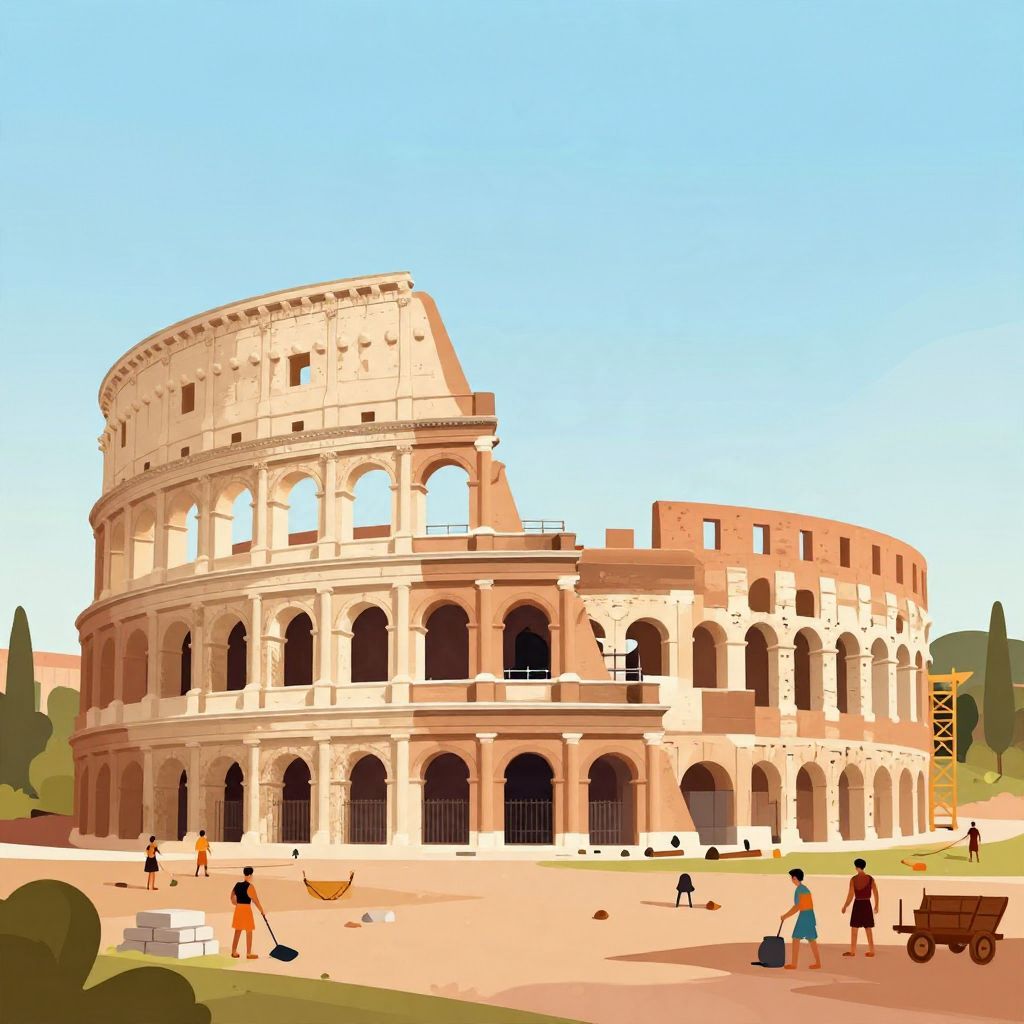
When was the Colosseum in Rome built? The short answer is that construction began in AD 72 under Emperor Vespasian and was largely completed by AD 80 under his son Titus.
That makes the Colosseum one of the most famous building projects of ancient Rome, created during the Flavian dynasty as a symbol of imperial power, public spectacle, and political renewal after civil war.
When Was the Colosseum in Rome Built?
The Colosseum was built in the late 1st century AD, with work beginning around AD 72 and the amphitheater opening in AD 80. Ancient sources and archaeological evidence support this general timeline, though finishing touches and later modifications continued after the opening.
The Historical Background: Why It Was Built
The Colosseum did not appear in a vacuum. It was commissioned after the chaos of the Year of the Four Emperors (AD 69), when Rome had suffered civil conflict and unstable leadership. Vespasian, who founded the Flavian dynasty, used the project to present his rule as restoring order and generosity to the Roman people.
The site itself also mattered. The amphitheater was built on land that had belonged to Nero’s Domus Aurea, the lavish palace complex associated with imperial excess. By replacing a private palace with a public entertainment venue, Vespasian made a powerful political statement: the emperor’s resources would now serve the people of Rome, at least symbolically.
The Flavian Dynasty and Imperial Messaging
The Colosseum was originally known as the Flavian Amphitheater, reflecting the dynasty that built it. The name “Colosseum” came later, likely because of the huge statue of Nero—the “Colossus”—that stood nearby. The building therefore combined architecture, politics, and memory in a way that made it more than just a sports arena.
A Simple Timeline of the Colosseum’s Construction
The exact day construction began is not known, but historians generally place the start in AD 72. The main structure was ready for use by AD 80, and additional work likely continued into the early reign of Domitian, Vespasian’s younger son.
- AD 69 – Civil war ends; Vespasian rises to power.
- AD 72 – Construction of the amphitheater begins.
- AD 80 – Titus inaugurates the Colosseum with games.
- AD 81 and after – Domitian adds or completes some underground and support features.
This timeline is important because it shows that the Colosseum was not built all at once in a modern sense. Romans worked in stages, and large imperial projects often evolved as emperors changed, budgets shifted, and practical needs emerged.
How Long Did It Take to Build?
In broad terms, the Colosseum took about eight years to reach its opening in AD 80, though the full construction and finishing process may have extended a little longer. That is remarkably fast for a structure of its size, especially considering the engineering challenges of Roman concrete, stonework, foundations, and seating tiers.
It is worth noting that “built” can mean different things. If you mean the main arena and superstructure, the answer is mostly AD 72 to AD 80. If you mean all later additions and refinements, the story stretches beyond Titus’s inauguration and into the reign of Domitian.
What Was Built First?
Archaeological study suggests that the Romans first prepared the site and foundations, then raised the outer walls and seating structure, and finally completed interior systems such as corridors, stairways, and the arena floor. The underground spaces, known as the hypogeum, were expanded later, likely under Domitian, to improve stagecraft for games and animal spectacles.
Materials and Engineering
The Colosseum was built using a combination of travertine stone, brick, concrete, and tufa. Iron clamps held many blocks together, and the design included arches, vaults, and passageways that allowed large crowds to move efficiently. These features were not just decorative; they were essential to making a massive public venue function safely.
The structure could hold tens of thousands of spectators, though exact capacity estimates vary. Its scale and complexity make it one of the clearest examples of Roman architectural ambition at its peak.
Who Ordered the Colosseum to Be Built?
Emperor Vespasian ordered the Colosseum’s construction. He ruled from AD 69 to AD 79 and was the first emperor of the Flavian dynasty. After his death, his son Titus completed and opened the building. Titus’s brother Domitian later made further changes.
Because the emperor’s name appears in ancient accounts and the building’s historical context fits the Flavian restoration of Rome, scholars are confident about this attribution. There is no serious dispute that the Colosseum was a Flavian imperial project.
When Was the Colosseum Officially Opened?
The Colosseum was officially inaugurated in AD 80 by Emperor Titus. Ancient writers describe elaborate games held to celebrate the opening, including gladiatorial contests, animal hunts, and other public entertainments. These events helped establish the amphitheater as a central stage for Roman civic life.
The opening mattered politically as well as culturally. Public games were a way for emperors to display generosity, legitimacy, and control. In Rome, architecture and spectacle often worked together to reinforce imperial authority.
Historical Facts About the Colosseum’s Early Years
Several well-established facts help explain the Colosseum’s early history:
- It was built on the site of Nero’s former palace grounds.
- It was commissioned by Vespasian and completed under Titus.
- Its original purpose was public entertainment, especially gladiatorial games and animal hunts.
- It became one of the most important amphitheaters in the Roman world.
- Its later history included damage from earthquakes, stone robbing, and reuse in medieval Rome.
These facts show that the Colosseum was both a practical venue and a political monument. Its construction was a statement about what kind of empire Rome claimed to be after civil war: stable, generous, and powerful.
Why the Colosseum Still Matters
The Colosseum remains important because it captures several themes of Roman history at once: imperial propaganda, urban development, engineering skill, and mass entertainment. It also helps historians understand how emperors used public building to shape their image and their relationship with the Roman people.
Even after nearly two thousand years, the building’s scale still communicates the ambition of the Roman Empire. Its survival also reminds us that ancient monuments are not frozen in time; they are shaped by use, repair, destruction, and memory across centuries.
Conclusion
The Colosseum in Rome was built beginning in AD 72 and opened in AD 80, making it a late 1st-century Roman monument of the Flavian era. It was commissioned by Vespasian, completed by Titus, and later modified under Domitian. If you want to explore more, see how old the Colosseum is and how long it took to build the Colosseum.