
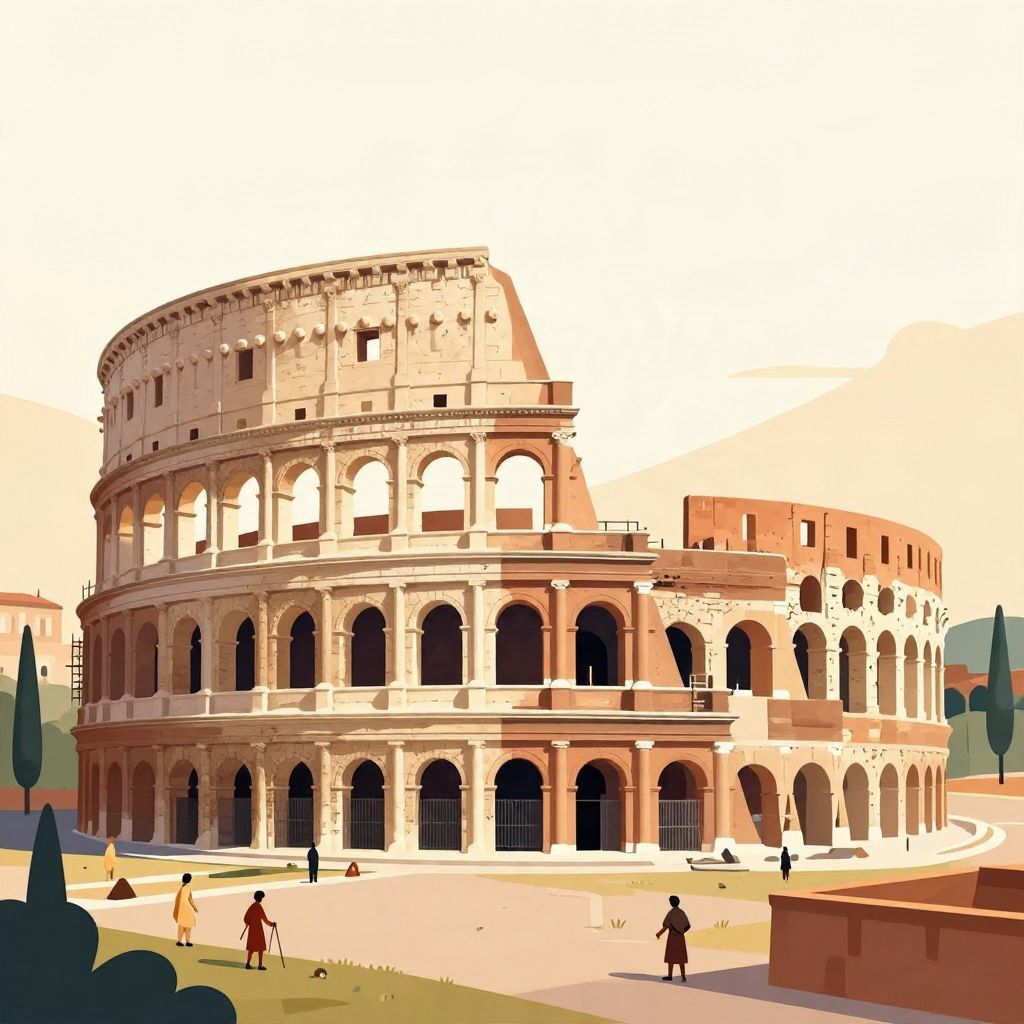
The Colosseum is one of the most famous monuments of the ancient world, and its age is often asked because it still dominates Rome’s skyline. The short answer is that it is nearly 2,000 years old, with construction beginning in the late 1st century CE and the building opening in 80 CE.
Its long survival makes it feel timeless, but the Colosseum belongs very specifically to the Roman Empire, especially the reigns of the emperors Vespasian and Titus. Understanding its age means looking not just at when it was built, but also at how it was constructed, used, damaged, and preserved over nearly two millennia.
How old is the Colosseum?
The Colosseum is about 1,945 years old in 2026 if counted from its opening in 80 CE, though construction likely began around 72 CE. That means the monument is not just ancient in a general sense: it is a surviving structure from the early Roman Empire, built almost two thousand years ago and still standing today.
When was the Colosseum built?
The Colosseum was built during the reign of the Flavian emperors. Construction began under Vespasian around 72 CE and was completed enough for public games to begin under his son Titus in 80 CE. Later additions and repairs continued under Domitian, Titus’s brother, in the years that followed.
A simple timeline
- 64 CE – The Great Fire of Rome destroys large parts of the city.
- 70 CE – Rome defeats Judea; the Flavian dynasty consolidates power.
- 72 CE – Construction of the Colosseum begins.
- 80 CE – The amphitheater is inaugurated with games.
- 81–96 CE – Domitian completes and modifies parts of the structure.
- Later centuries – Earthquakes, neglect, and stone removal change its appearance.
Why was the Colosseum built?
The Colosseum was built partly as a statement of political power. The emperor Vespasian began the project after the chaotic rule of Nero, and the site chosen had once been part of Nero’s private palace complex. By turning that land into a public amphitheater, the Flavian emperors signaled a return of the city to the Roman people and advertised their legitimacy.
The building also served a practical purpose. It provided a huge venue for public entertainment, including gladiatorial combat, animal hunts, executions, and staged spectacles. In Roman society, such events were not just amusement; they were part of politics, religion, and imperial display.
What does “age” mean for the Colosseum?
When people ask how old the Colosseum is, they may mean different things. The most common meaning is the date it first opened to the public, which is 80 CE. But historians may also refer to the start of construction around 72 CE. Both dates are important, and the difference matters because ancient buildings often took years to complete and were altered over time.
Built, opened, and modified
The Colosseum was not a single moment frozen in time. It was a major building project that evolved through several phases:
- Construction phase: begun under Vespasian.
- Opening phase: inaugurated under Titus with games lasting many days.
- Completion phase: further work under Domitian, including underground structures.
- Long afterlife: repairs, reuse, and damage across the medieval and modern periods.
How the Colosseum changed over time
The Colosseum’s age is not only measured by its original construction date, but also by the long history of change that followed. Earthquakes damaged it several times, especially in the medieval period. Parts of the outer wall collapsed, and much of its stone was later reused in other Roman buildings, churches, and palaces.
For centuries, the Colosseum was not treated as a protected monument in the modern sense. It was mined for materials, adapted for different uses, and gradually transformed from a functioning arena into a ruin. That is one reason it looks so different today from how it appeared in antiquity.
From arena to ruin
In the Roman period, the Colosseum could hold tens of thousands of spectators and was engineered with remarkable sophistication. It had seating divided by social rank, complex entrances, and a system for moving people quickly in and out. Over time, however, the loss of imperial support and repeated natural disasters weakened the structure.
By the Middle Ages, the building had become part fortress, part quarry, and part symbolic ruin. Later, in the modern era, preservation efforts began to stabilize what remained. Today, the Colosseum is one of the best-known archaeological monuments in the world.
How old is the Colosseum compared with other ancient monuments?
At nearly 2,000 years old, the Colosseum is younger than some famous ancient structures such as the Great Pyramid of Giza, but it is still extraordinarily old by the standards of surviving architecture. What makes it especially remarkable is not just its age, but the fact that a large part of the structure still stands and remains identifiable as the same monument described in ancient sources.
Many Roman buildings survive only in fragments, foundations, or inscriptions. The Colosseum remains instantly recognizable because of its massive scale and distinctive elliptical shape, even though its original exterior was more complete and more ornate than what visitors see today.
Why is the Colosseum so famous today?
The Colosseum is famous because it combines age, scale, and historical symbolism. It represents the power of ancient Rome, the spectacle culture of the empire, and the endurance of a monument that has outlived the civilization that built it. It is also one of the most visited archaeological sites in the world, making it a living part of historical memory rather than a forgotten ruin.
Its fame has grown in the modern era through art, literature, tourism, and preservation. The Colosseum has become a global symbol of Rome itself, often standing for the Roman Empire as a whole. That symbolism can sometimes blur historical detail, but the basic facts remain clear: it was built in the first century CE and has survived for almost two millennia.
What historians know for sure, and what is less certain
Some details about the Colosseum’s age are well established, while others are approximate. Historians are confident about the broad chronology: construction began under Vespasian around 72 CE, and the amphitheater opened under Titus in 80 CE. The exact day construction started is not known with certainty, and the building’s completion was a process rather than a single event.
Likewise, the Colosseum’s later history includes periods that are documented unevenly. Earthquakes, repairs, and reuse of materials are well supported, but the precise sequence of every alteration is not always clear. That is normal for a structure with such a long and complicated life.
The Colosseum’s historical significance
The Colosseum matters because it reveals how the Roman Empire presented itself to its citizens. It was a place of spectacle, but also of social order, imperial generosity, and public control. Its construction after the turmoil of Nero’s reign and the civil wars of the 1st century CE was a political act as much as an architectural one.
Its survival also tells a broader story about the ancient world. Buildings can outlast empires, and monuments can change meaning over time. The Colosseum began as a venue for imperial entertainment and became, centuries later, a ruin admired for its history, engineering, and endurance.
So, how old is the Colosseum? In the clearest historical sense, it is about 2,000 years old, with construction beginning around 72 CE and public use starting in 80 CE. Its age is not just a number; it is the story of Rome itself, from imperial power to archaeological landmark.