
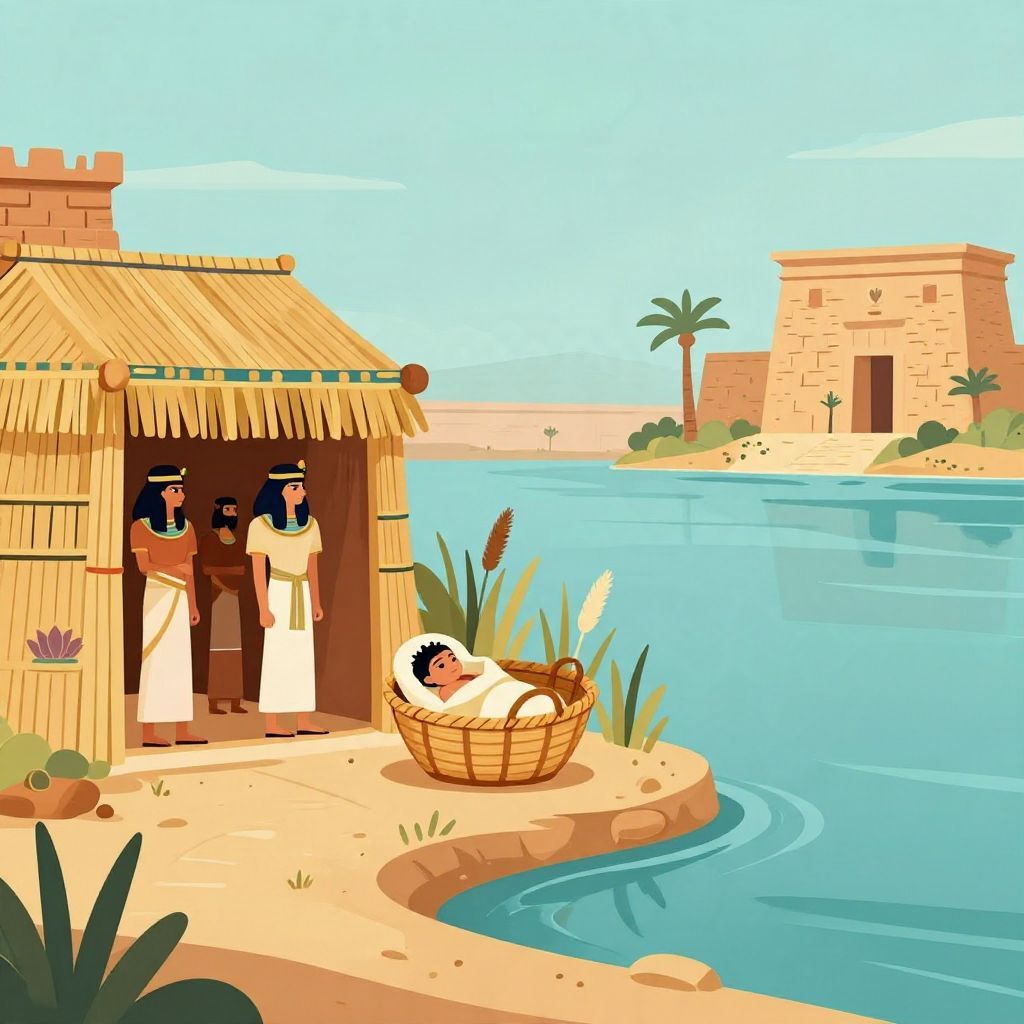
Where was Moses born? The traditional answer is that Moses was born in Egypt, during the period when the Israelites were living there under oppression. In the biblical account, he was born to Hebrew parents in a time of danger, then hidden as an infant and eventually placed in the Nile River.
Because Moses is a central figure in Jewish, Christian, and Islamic tradition, his birth story has been preserved more as sacred history than as independently verifiable biography. Even so, the location of his birth is usually understood within the wider setting of ancient Egypt and the Hebrew presence there.
Where Was Moses Born?
Moses was traditionally born in Egypt, in the region where the Israelites lived as a minority population under Egyptian rule. The Bible does not name a specific city or village for his birth, so the most accurate answer is Egypt broadly, not a precise archaeological site. His birth is linked to the Nile Delta setting of the Exodus narrative.
The Biblical Account of Moses’ Birth
The main source for Moses’ birth is the Book of Exodus. According to that account, a Hebrew woman from the tribe of Levi gave birth to him during a time when Pharaoh had ordered Hebrew baby boys to be killed. To save him, his mother hid him and later placed him in a basket among the reeds of the Nile. Pharaoh’s daughter found him and had him raised in the royal household.
This story explains both Moses’ Hebrew identity and his connection to Egypt. It also sets up one of the central themes of the Exodus narrative: a child born under threat who later becomes the leader of liberation. The text does not identify the exact place of birth, only the broader Egyptian setting.
What the story does and does not say
- It does say Moses was born to Hebrew parents in Egypt.
- It does say he was hidden as an infant because of Pharaoh’s decree.
- It does not say the exact town, palace district, or village where he was born.
- It does not provide an independent historical record outside the biblical narrative.
Historical Background: Hebrews in Ancient Egypt
To understand the birth story, it helps to place it in the larger history of ancient Egypt and the Levant. The biblical narrative reflects a community of Hebrews living in Egypt, likely in the eastern Delta region, where Semitic-speaking peoples had long interacted with Egyptian society through trade, migration, labor, and political change.
Scholars have debated how much of the Exodus story reflects direct memory, later national tradition, or literary shaping. There is no universally accepted external evidence identifying Moses as a historical individual in the way later kings or emperors can sometimes be documented. Still, the setting in Egypt is central to the tradition and is not incidental.
Why Egypt fits the tradition
Egypt was one of the major powers of the ancient Near East, and its northeastern frontier was a zone of movement and settlement. Groups from Canaan and surrounding regions entered Egypt at different times, especially during periods of famine, labor migration, or political instability. The Exodus story places Moses within that world of contact between Egypt and the Semitic populations of the Levant.
The Nile Delta is especially important because it was the part of Egypt most connected to Asia. If the Moses tradition preserves a historical memory, that is the most likely geographic background: not the deep south of Egypt, but the northern frontier region where foreign populations were more common.
Was Moses Born in Goshen, the Nile Delta, or Elsewhere?
Some readers ask whether Moses was born in Goshen, the area in Egypt where the Israelites are said to have lived. That is a reasonable possibility within the biblical framework, but it remains an inference rather than a stated fact. Goshen is usually associated with the eastern Nile Delta, so saying Moses was born there is more specific than the text allows.
Because the Bible does not name the exact birthplace, historians generally avoid claiming a precise site. The safest conclusion is that Moses was born somewhere in Egypt, probably in the Nile Delta region where the Hebrew community is traditionally placed.
Why no exact birthplace is known
- Ancient texts often preserve origin stories without exact geographic detail.
- Moses’ life is narrated theologically, not as a modern birth record.
- No archaeological evidence identifies a specific house, city, or hospital-like setting.
- Later tradition focused more on his role than on his birthplace.
Moses in Jewish, Christian, and Islamic Tradition
Moses is one of the most important figures in world religion. In Judaism, he is the lawgiver and leader of the Exodus. In Christianity, he is a major prophet and a key figure in the background of biblical law. In Islam, Musa is also a prophet, and his early life shares many elements with the biblical tradition, including his rescue as an infant.
Across these traditions, the emphasis is not on a verified birth certificate but on divine preservation and calling. The birthplace matters because it situates Moses within the suffering of his people and the power structure of Egypt. His story begins in a place of danger and then moves toward liberation and covenant.
Birthplace as part of the message
The Egyptian setting is not just background scenery. It reinforces the idea that Moses emerged from the very society that oppressed his people. That contrast—Hebrew by birth, Egyptian by upbringing—becomes essential to the narrative. His early life in Egypt helps explain how he could later confront Pharaoh, navigate court culture, and lead a people out of bondage.
What Historians Can Say with Confidence
From a historical standpoint, the best-supported answer is cautious: Moses is traditionally said to have been born in Egypt, probably in the Nile Delta region, but the exact location is unknown. The story survives in sacred literature and later tradition, not in a contemporary Egyptian birth record or inscription.
Historians distinguish between the traditional account and what can be independently verified. That does not make the tradition meaningless; it simply means the evidence is different from the kind used for modern biography. For Moses, the birthplace belongs to the realm of ancient memory, religious tradition, and historical reconstruction.
Three levels of certainty
- Traditional claim: Moses was born in Egypt.
- Reasonable historical inference: He was likely associated with the Nile Delta/Israelite settlement area.
- Uncertain detail: The exact town or site of his birth is unknown.
Why the Question Still Matters
Asking where Moses was born is not only a search for a place on a map. It opens a window into ancient migration, identity, memory, and the making of sacred history. Moses’ birth in Egypt symbolizes the tension between captivity and deliverance that shapes the Exodus narrative and much of later biblical thought.
That is why the answer remains both simple and nuanced: Moses was born in Egypt, but the precise location cannot be established. The tradition places his beginnings in the world of the Nile, the Hebrew minority, and the royal power of Pharaoh, where his life story first took shape.
For readers interested in the larger chronology of Moses’ life, see also when Moses was born and how old Moses was. The most grounded historical takeaway is that Moses’ birthplace is traditionally Egypt, while the exact site remains unknown.