
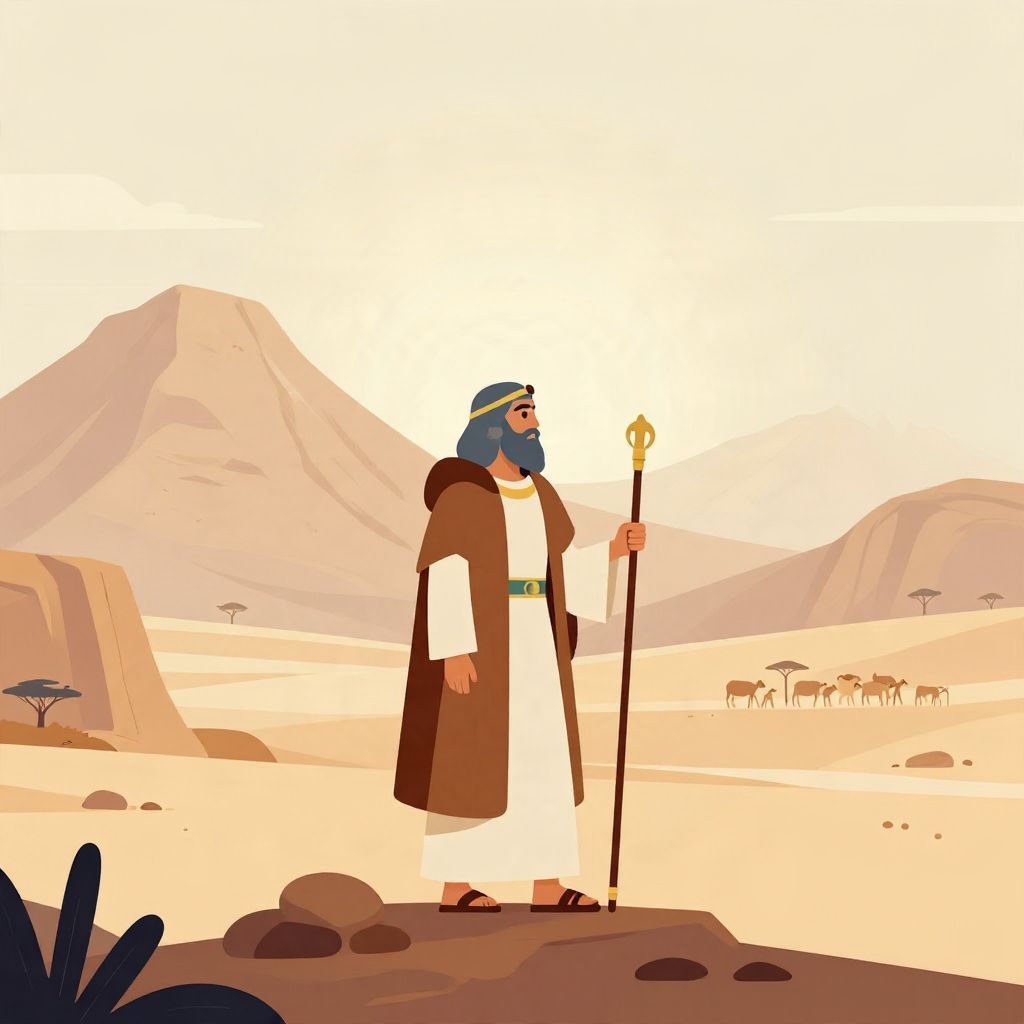
How old was Moses? The short answer is that the Bible says Moses lived to be 120 years old. In the biblical timeline, he spent 40 years in Egypt, 40 years in Midian, and 40 years leading the Israelites in the wilderness.
That number is central to both Jewish and Christian tradition, but historians treat it as part of a religious text rather than a securely dated biography. Because Moses is a figure from the ancient past, his exact birth year cannot be verified with modern historical methods.
How old was Moses?
According to the biblical account, Moses was 120 years old when he died. The Book of Deuteronomy says he died at that age on Mount Nebo, after leading the Israelites out of Egypt and through the wilderness. The same tradition divides his life into three 40-year periods, which gives his story a clear symbolic structure.
The biblical age of Moses and what it means
Three stages of 40 years
The most familiar version of Moses’ age comes from Deuteronomy 34:7, which states that he was 120 years old when he died, “his eye was undimmed, and his vigor unabated.” Earlier in the biblical narrative, Acts 7:23 and Exodus traditions support the idea that Moses’ life unfolded in three major phases: 40 years in Egypt, 40 years in Midian, and 40 years in the wilderness.
This 40-year pattern is likely more than a stopwatch-style chronology. In the ancient world, numbers often carried symbolic weight. Forty appears frequently in the Hebrew Bible as a number associated with testing, transition, or completeness. That does not mean the age is meaningless, but it does suggest that the biblical writers were shaping Moses’ life into a theological story as well as a historical memory.
Was 120 a literal age?
For readers of faith, the biblical age is often taken at face value. For historians, the question is more complicated. Moses belongs to a tradition that was written down and edited over time, long after the events it describes. Because of that, there is no independent archaeological or documentary evidence that can confirm his exact lifespan.
So the best historical answer is this: the Bible presents Moses as living to 120, but modern scholarship cannot verify that number as a precise biographical fact. It is best understood as a traditional and literary claim within the biblical text.
When did Moses live?
The date of Moses’ life is uncertain. The Bible does not give a modern calendar year, and scholars disagree about how to place the Exodus story in absolute chronology. Some proposals place Moses somewhere in the 13th century BCE, while others suggest an earlier setting, possibly the 15th century BCE. Neither date can be proven with certainty.
This uncertainty matters because Moses is tied to the Exodus, one of the most important events in biblical history. Yet the historical evidence for the Exodus itself is debated, and there is no consensus among historians about its exact date or scale. As a result, any birth year for Moses remains approximate at best.
Why historians are cautious
Ancient figures are often difficult to date unless they appear in contemporary inscriptions, royal records, or securely dated archaeological layers. Moses does not appear in such records. The biblical narrative is the main source, and it reflects a long tradition of storytelling, memory, law, and identity formation among the ancient Israelites.
That does not make Moses unimportant. It means that his historical setting must be reconstructed carefully, with attention to the limits of the evidence. Historians can discuss the world in which the Moses tradition developed, but not assign him a precise birth year with confidence.
Moses in the biblical timeline
Early life in Egypt
In the Book of Exodus, Moses is born during a period when Pharaoh orders the killing of Hebrew male infants. His mother places him in a basket on the Nile, and he is found and adopted by Pharaoh’s daughter. This dramatic beginning emphasizes both danger and providence, but it is not independently documented outside the Bible.
The story places Moses within the broader setting of ancient Egypt, where Semitic-speaking peoples lived, worked, migrated, and interacted with Egyptian society. That historical background is plausible, even if the specific narrative details remain part of sacred tradition.
Life in Midian
After killing an Egyptian overseer, Moses flees to Midian, where he lives as a shepherd and marries Zipporah, the daughter of Jethro. This middle phase of his life is often described as 40 years, though that number is not stated in the same direct way as his age at death. It functions as part of the larger biblical pattern that organizes his life into three equal segments.
Midian itself is associated with regions east or southeast of the Sinai Peninsula, though its exact historical geography is debated. The story places Moses outside Egypt before his return as a leader, creating a classic arc of exile, preparation, and calling.
The Exodus and wilderness years
Moses’ final major life stage begins when he returns to Egypt to confront Pharaoh and demand the release of the Israelites. After the plagues, the departure from Egypt, and the crossing of the sea, he leads the people through the wilderness toward the promised land. This is the period most associated with his role as lawgiver and prophet.
The wilderness years are central to Moses’ legacy because they connect liberation with covenant. In biblical tradition, Moses does not merely free the people; he also receives the law, including the Ten Commandments, and helps shape Israel’s identity as a covenant community.
Why the number 120 matters in biblical tradition
The age of 120 has symbolic resonance beyond Moses himself. In Genesis 6:3, 120 years appears in a divine statement about human lifespan, and later Jewish tradition sometimes treats 120 as an ideal or complete human life. Moses’ age therefore fits a larger scriptural pattern of fullness and completion.
In this sense, Moses’ lifespan is not just a biographical detail. It reinforces the idea that his life was complete in a divinely ordered way. The biblical narrative presents him as someone whose mission was finished when he died, even though he did not enter the promised land.
What historians can say with confidence
- The Bible says Moses lived to 120 years old.
- The 40-40-40 structure is a traditional way of organizing his life.
- His exact birth year is unknown and cannot be securely dated.
- The Exodus setting is historically debated, so Moses’ chronology remains approximate.
- Moses is historically significant as a foundational figure in Judaism, Christianity, and Islam, regardless of the limits of external evidence.
Moses as history and tradition
Moses stands at the intersection of history, memory, and faith. For believers, he is a prophet, lawgiver, and liberator whose life was guided by God. For historians, he is a foundational figure in an ancient tradition whose biography cannot be reconstructed with modern certainty. Both perspectives matter, but they answer different questions.
If you are asking “How old was Moses?” the clearest answer is that the biblical tradition says he was 120 years old. If you are asking when he was born, the honest answer is that no exact date is known. The history of Moses is therefore less about a precise birthday than about the long influence of a powerful ancient story.
For more on the tradition behind that timeline, see when Moses was born and how long Moses lived.