
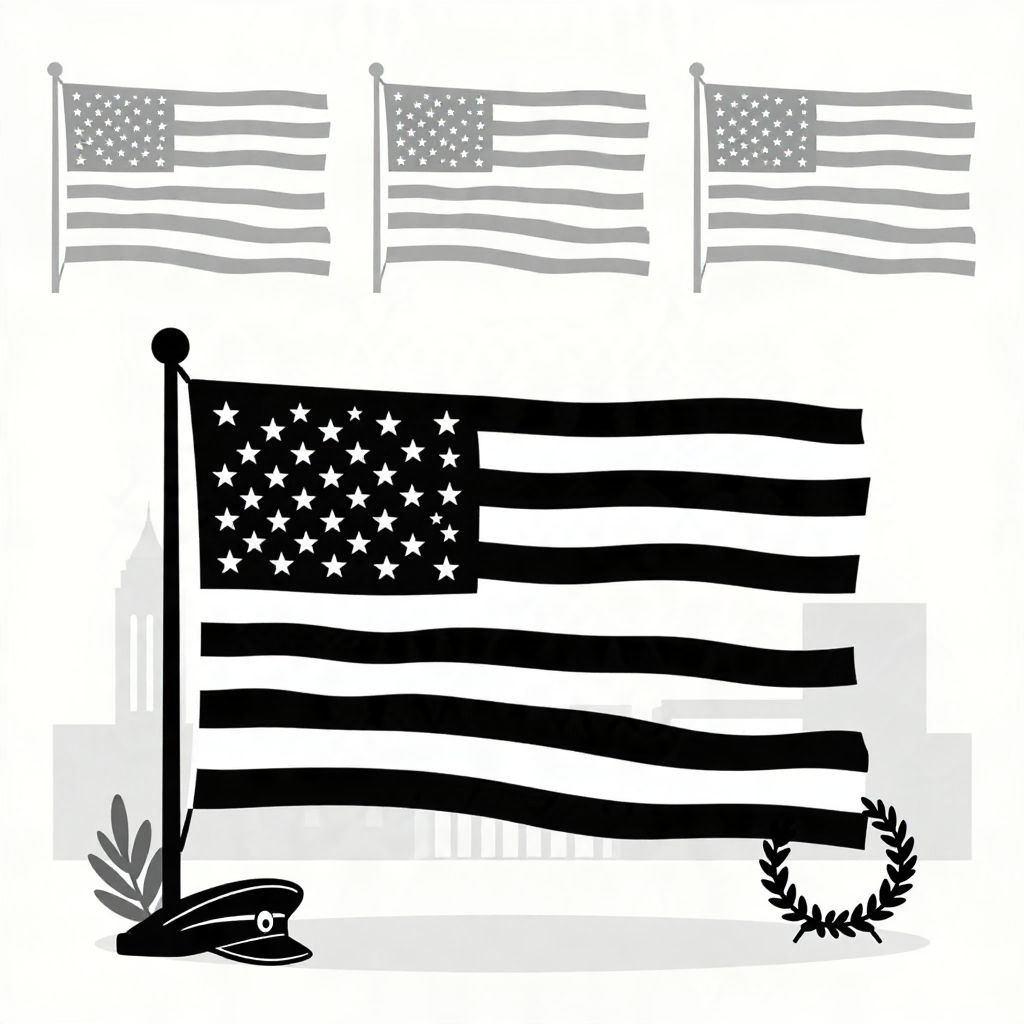
The black-and-white American flag is not an official national flag, but a modern variation of the U.S. flag that has taken on several meanings. Most commonly, it signals mourning, remembrance, or solidarity with a cause. In some contexts, it is also used as a military or tactical symbol, and in others as a political statement.
Its meaning depends heavily on who is displaying it, where, and in what setting. Because of that, the black-and-white flag is best understood as a symbol with evolving uses rather than a single fixed historical meaning.
What does the black and white American flag mean?
The black and white American flag usually means mourning, respect, or protest, but its meaning is context-dependent. It is not an official U.S. government flag. Historically, black-and-white versions of the Stars and Stripes have been used to show grief, honor fallen service members, or express a stripped-down, serious, or defiant political message.
Where did the black-and-white American flag come from?
The black-and-white American flag did not begin as a single official design with one inventor or one date. Instead, it emerged from broader traditions of flag symbolism, especially the use of black for mourning and the adaptation of the U.S. flag for specialized causes. Its modern popularity grew in the late 20th and early 21st centuries through military culture, police and fire memorials, and political activism.
Black as a symbol of mourning
In Western visual culture, black has long been associated with grief, death, and solemn remembrance. That older symbolic tradition helped shape the meaning of black-and-white American flags. When the colors of the national flag are reduced to black, white, and gray, the effect often suggests loss, sacrifice, or a moment of national seriousness.
The American flag as a flexible symbol
The U.S. flag has frequently been adapted for special uses. Over time, Americans have seen altered flags used for wartime service, memorial events, political movements, and public mourning. The black-and-white version belongs to that larger history of modification, where the flag’s familiar shape remains recognizable even as its colors and message change.
Common meanings of the black-and-white American flag
There is no single official meaning, but several interpretations recur. The most common are mourning, support for law enforcement or military personnel, protest, and a stylized “no-color” version of patriotism. The exact message depends on whether the flag is used ceremonially, politically, or decoratively.
1. Mourning and remembrance
One of the oldest and most widely understood uses is mourning. A black-and-white American flag may be displayed after a tragedy, during memorial services, or to honor those who died in military service, public safety work, or national disasters. In this setting, the flag acts as a visual sign of grief and respect.
2. Support for military or first responders
Some people use the black-and-white flag to honor soldiers, police officers, firefighters, and other emergency personnel. In these cases, the subdued color scheme can suggest discipline, sacrifice, and solemn duty. It is often seen on patches, decals, memorial displays, and commemorative items rather than as an official flag flown by the government.
3. Political protest or dissent
In other settings, the black-and-white flag is used as a political statement. Stripping the flag of its red, white, and blue can signal anger, disillusionment, or resistance. Some groups use it to criticize government policy, racial injustice, or social conditions they believe have undermined the ideals associated with the United States.
4. Tactical or law-enforcement styling
Black-and-white flags are also common in tactical and uniform contexts, especially in modern police, military, and survivalist culture. In these settings, the design is less about mourning and more about a subdued, high-contrast emblem that can be printed on gear, clothing, or vehicles. This usage has helped spread the image widely, even when the symbolism is not fully agreed upon.
How the symbol developed over time
The black-and-white American flag is a modern symbol built from older traditions. Its history is not a straight line from one origin point, but a gradual layering of meanings. The timeline below shows how the symbol became recognizable in contemporary culture.
- 18th–19th centuries: The U.S. flag becomes a national emblem, while black remains a common Western color of mourning.
- 19th century: Americans increasingly use flags in memorial and patriotic rituals, especially around war and public sacrifice.
- 20th century: Modified flags appear in military, memorial, and political contexts, though not yet as a standardized black-and-white national symbol.
- Late 20th century: Black-and-white flag imagery spreads through patches, decals, and graphic design tied to law enforcement, military culture, and protest.
- 21st century: The symbol becomes widely visible online, where it is used in memorial posts, activism, and merchandise, often with competing meanings.
Why black and white instead of red, white, and blue?
Removing the traditional colors changes the emotional tone of the flag. Red often suggests sacrifice, valor, or bloodshed; blue can suggest loyalty and unity; white often represents purity or ideals. Black and white simplify the flag into a stark contrast, which can communicate seriousness, loss, or a hard-edged political message more powerfully than the full-color version.
The effect of visual reduction
Design matters in symbolism. A monochrome flag removes the warmth and balance of the original color scheme and turns the image into something more austere. That is why the black-and-white version can feel solemn, militant, or confrontational depending on the setting. The same visual reduction can support very different messages.
Is the black-and-white American flag official?
No. The black-and-white American flag is not an official flag of the United States. The official national flag remains the familiar red, white, and blue design governed by federal custom and law. Black-and-white versions are informal symbolic adaptations, and their use is shaped by culture, not by a single legal standard.
Why that distinction matters
Because it is unofficial, the black-and-white flag can be interpreted in multiple ways. One person may see a memorial symbol; another may see a political statement; a third may view it as a fashion or tactical emblem. That ambiguity is part of its modern history, and it explains why the same image can appear in very different social settings.
How people interpret it today
Today, the black-and-white American flag is best understood as a contested symbol. Its meaning depends on context, audience, and intent. A memorial display at a funeral or anniversary service usually communicates respect and grief. A flag on a protest sign may communicate anger or resistance. A patch on a uniform may suggest service, discipline, or solidarity.
Context is everything
To interpret the symbol accurately, look at where it appears and who is using it. Is it part of a memorial? A political rally? A law-enforcement uniform? A social media post? The surrounding context usually tells you more than the image alone. Without that context, the flag’s meaning can easily be misunderstood.
Historical significance of the black-and-white American flag
The historical significance of the black-and-white American flag lies less in formal state history than in cultural history. It shows how Americans continually reshape national symbols to express grief, loyalty, protest, and identity. Like many modern symbols, it reflects a society that uses visual shorthand to communicate complex feelings about nationhood.
It also reveals a broader pattern in American history: national symbols are not static. They are repeatedly reinterpreted during war, mourning, political conflict, and social change. The black-and-white flag is one example of how a familiar emblem can be turned into a message of sorrow, defiance, or honor without losing its connection to the nation itself.
Bottom line
The black-and-white American flag usually means mourning, remembrance, or a serious political or military statement, but its exact meaning depends on context. It is an unofficial variation of the U.S. flag that developed through modern memorial, tactical, and protest uses rather than through one official origin. For related reading, see what a black American flag means and what an all-black American flag means.