
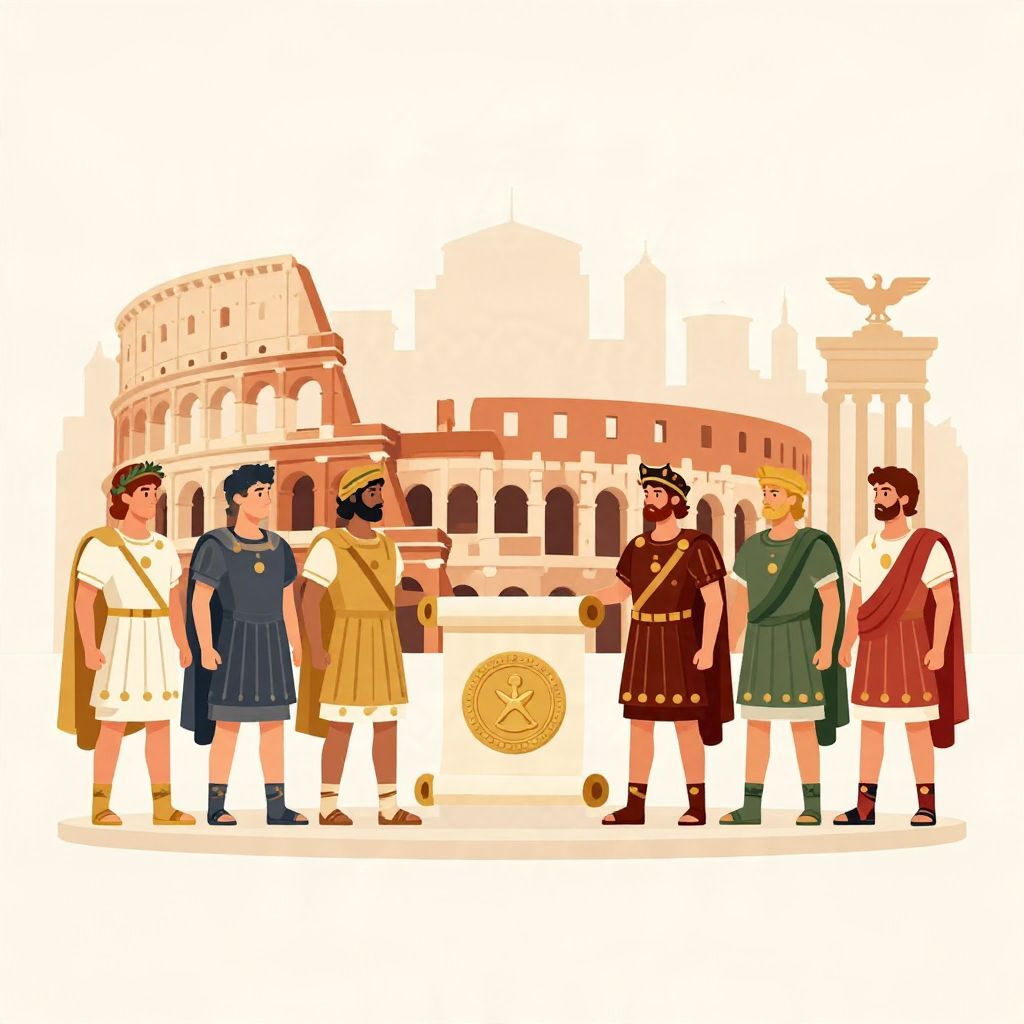
How many Roman emperors were there? The answer depends on what you mean by “Roman Empire” and which rulers you choose to count. If you mean the emperors of the unified Roman Empire from Augustus in 27 BCE to the fall of the Western Empire in 476 CE, the total is usually given as about 70 to 80, depending on how short-lived claimants and co-emperors are counted.
That range may sound imprecise, but Roman imperial history is full of shared rule, rival claimants, and civil war. The number changes because the Romans themselves did not always agree on who counted as emperor, especially during periods of political chaos.
How many Roman emperors were there?
There is no single universally accepted number. If you count the emperors generally recognized by historians from Augustus through Romulus Augustulus, the Western imperial line includes roughly 80 rulers, though the exact total varies by definition. If you include co-emperors, usurpers, and short-lived claimants, the number rises further.
Why the answer is not exact
Roman emperors did not always rule one at a time. The empire often had multiple legitimate emperors at once, especially after the third century. In addition, some men were proclaimed emperor by their troops or by rival factions but ruled only briefly or never controlled much territory. Historians therefore count emperors differently depending on whether they include only widely recognized rulers or every claimant who briefly held imperial power.
Three main ways historians count emperors
- Strict count: only emperors widely recognized as legitimate rulers of the Roman state.
- Broad count: includes co-emperors who shared power officially.
- Very broad count: includes usurpers and short-lived claimants during civil wars.
Because of this, a single number can be misleading. Roman imperial succession was often messy, and legitimacy depended on army support, Senate approval, dynastic ties, and control of territory.
The first Roman emperor and the start of the imperial age
The Roman Empire is usually said to begin with Augustus, who ruled from 27 BCE to 14 CE. He was the adopted heir of Julius Caesar and transformed the Roman Republic into a monarchy in all but name. Augustus did not call himself king; instead, he accumulated powers that made him the dominant figure in Roman politics.
His reign set the pattern for later emperors: supreme military authority, control over provinces, and the ability to shape succession. Even so, Rome still preserved republican institutions in form, which is one reason the title “emperor” is a modern convenience rather than a single ancient office with one fixed definition.
How many emperors ruled the unified Roman Empire?
From Augustus to the final western emperor in 476 CE, historians usually count around 70 to 80 emperors in the unified imperial tradition, depending on whether they include every short reign and every rival claimant. If co-emperors are counted separately, the total can be higher. If only the main recognized rulers are counted, the number is lower.
The variation comes from the way the empire evolved. Early emperors often ruled alone or with an adopted successor. Later emperors increasingly shared power with sons, colleagues, or regional partners. By the late empire, there could be more than one emperor at once, especially after Diocletian’s reforms.
Examples of why the count changes
- Co-emperors: Marcus Aurelius ruled with Lucius Verus for a time.
- Rival rulers: During civil wars, different armies backed different emperors.
- Short reigns: Some emperors ruled for only days or months.
- Regional divisions: The empire was sometimes split into eastern and western courts.
The Roman Empire’s most unstable periods
The number of emperors increased sharply during periods of crisis. The Year of the Four Emperors in 69 CE is a famous example, when Galba, Otho, Vitellius, and Vespasian all claimed the throne in rapid succession. This was not unusual in Roman history; it simply happened to be especially dramatic that year.
Even more chaotic was the third-century crisis, when the empire faced invasions, economic strain, plague, and repeated military rebellions. Between 235 and 284 CE, dozens of men claimed imperial authority, and many ruled only briefly. Some historians call this the age of “soldier emperors” because the army became the main maker and breaker of emperors.
Why emperors changed so often
- The army could proclaim a commander emperor.
- Rival generals could challenge him in different provinces.
- Assassination and coups were common.
- Dynastic succession was never securely established.
This instability means that any attempt to give one exact total must choose between political legitimacy and historical reality. Roman power was often fragmented before the empire formally split.
Did the Eastern Roman Empire have emperors too?
Yes. After the empire became more divided in practice, and especially after the permanent separation of eastern and western administrations, the Eastern Roman Empire continued for nearly a thousand years after the West fell. Its rulers are usually called Byzantine emperors in modern history, but they considered themselves Roman emperors.
If you include the eastern line from the late fourth century to Constantine XI, who died in 1453, the total number of Roman emperors rises dramatically. In that broader sense, there were well over 100 Roman emperors across the full span of Roman imperial history.
Why “Byzantine” can confuse the count
The term “Byzantine Empire” is a later scholarly label. The people of Constantinople called their state the Roman Empire, and their rulers were Roman emperors in their own view. So if someone asks how many Roman emperors there were, the answer depends on whether they mean only ancient Rome in the West or the entire Roman imperial tradition through the Middle Ages.
Famous emperors and brief reigns
Some emperors are well known because they ruled long enough to leave a major mark on history. Others are remembered mainly because their reigns were short or violent. A few examples show how wide the range can be.
Longer-reigning emperors
- Augustus — established the imperial system.
- Trajan — ruled during Rome’s greatest territorial expansion.
- Hadrian — consolidated and defended the empire.
- Marcus Aurelius — associated with Stoic philosophy and frontier wars.
- Constantine the Great — legalized Christianity and reshaped imperial government.
Short-lived or contested emperors
- Otho — ruled only a few months in 69 CE.
- Pertinax — emperor for a short time before being killed by the Praetorian Guard.
- Gordian I and Gordian II — part of a rapid and unstable succession in 238 CE.
- Romulus Augustulus — traditionally considered the last western emperor, though his authority was limited.
These examples show that Roman imperial history is not a neat list of rulers. It is a story of power struggles, military backing, and changing political structures over centuries.
So what is the best answer?
If you want the shortest accurate answer, say this: there were about 70 to 80 Roman emperors in the traditional Western Roman imperial line, but the total changes depending on whether you count co-emperors, usurpers, and the emperors of the Eastern Roman Empire. In the fullest sense, the Roman imperial tradition produced well over 100 emperors.
That is why historians usually avoid a single fixed number unless they define the counting method first. Roman emperors ruled for nearly five centuries in the West and much longer in the East, and the empire’s political flexibility made succession far more complicated than a simple numbered list suggests.
For readers who want more context, it helps to explore how big the Roman Empire was and what language the Romans spoke. Together, these topics show how vast and diverse the Roman world was—and why counting its emperors is more complicated than it first appears.