
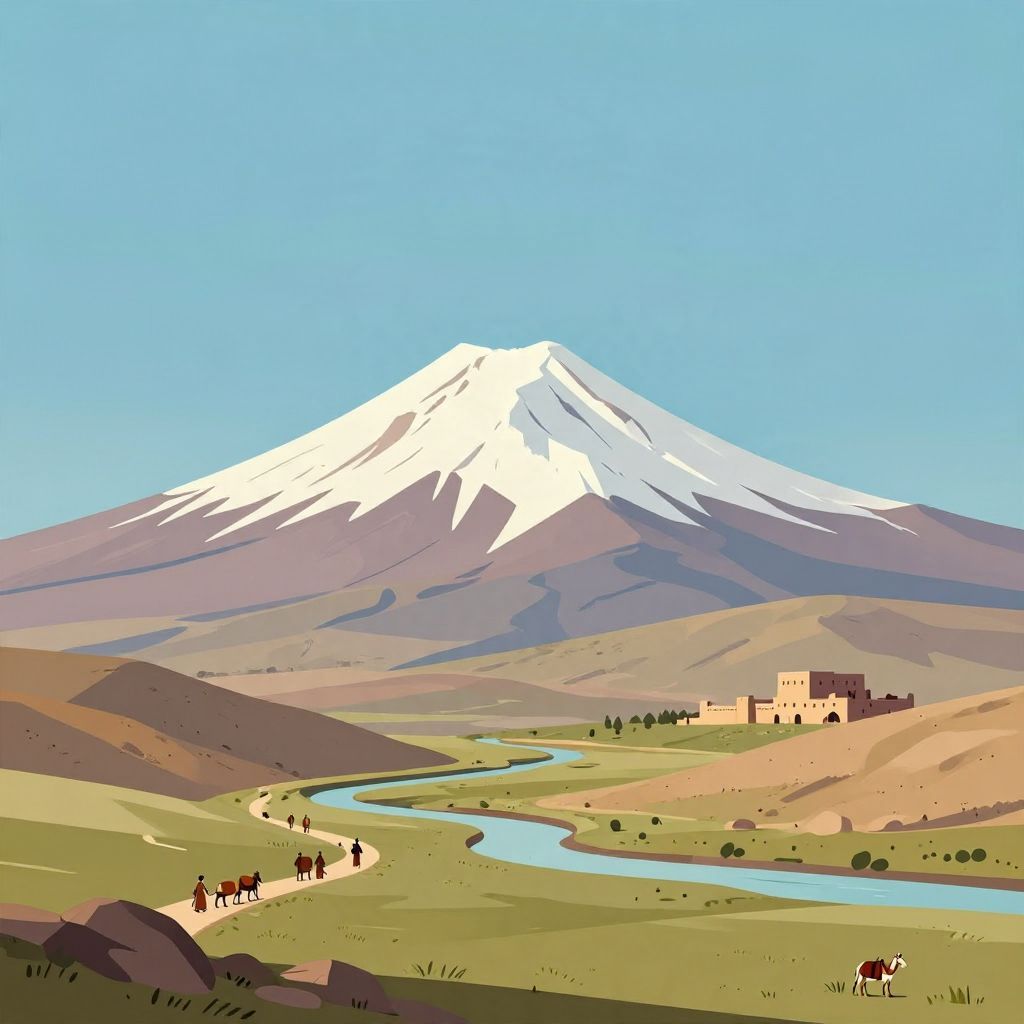
Where is Mount Ararat? The short answer is that it stands in eastern Turkey, near the borders with Armenia, Iran, and the Nakhchivan exclave of Azerbaijan. It is the highest peak in modern Turkey and a major landmark in the South Caucasus region.
Mount Ararat is also one of the most famous mountains in the world because of its place in biblical tradition, Armenian national identity, and centuries of exploration. Its history is a mix of geography, religion, empire, and modern border politics.
Where is Mount Ararat?
Mount Ararat is located in eastern Turkey, in Iğdır Province, close to the Armenian border. It rises in the Armenian Highlands, a volcanic region of the South Caucasus. The mountain has two main summits: Greater Ararat, which is the taller peak, and Lesser Ararat, which lies nearby.
Exact setting and landscape
Greater Ararat reaches about 5,137 meters, or 16,854 feet, making it Turkey’s highest mountain. It is a dormant stratovolcano, not part of a long mountain chain but a massive volcanic cone formed by ancient eruptions. Snow and ice cover its upper slopes for much of the year, and its isolated shape makes it visible from far away on clear days.
The mountain sits in a borderland that has long connected Anatolia, the Caucasus, and the Iranian plateau. Because of this location, it has been known to many peoples under different names and has belonged to different states over time.
Why is Mount Ararat historically important?
Mount Ararat matters historically because it sits at the crossroads of empires and traditions. It has been part of the cultural geography of Armenians for centuries, appears in biblical interpretation as the place where Noah’s Ark came to rest, and became a symbol of identity and loss after the modern borders of the region changed.
Ararat in ancient and medieval history
In antiquity, the region around the mountain was part of the broader Armenian Highlands, an area shaped by Urartian, Armenian, Persian, Roman, Byzantine, Arab, Seljuk, Mongol, and Ottoman influence at different times. The mountain itself was not usually the center of a kingdom, but it stood within a politically contested frontier zone.
For Armenians, Ararat became deeply symbolic. In Armenian tradition and literature, the mountain is associated with the ancient homeland and with endurance. Even though the modern mountain lies outside the Republic of Armenia, it remains a powerful national emblem and appears in Armenian art, poetry, and identity.
How did Mount Ararat become linked to Noah’s Ark?
Mount Ararat is traditionally identified with the mountain where Noah’s Ark came to rest after the Flood, based on the biblical account in Genesis. This association is ancient and influential, but it is a matter of religious tradition rather than historical proof. Different cultures and interpreters have placed the Ark on different mountains in the same general region.
Biblical and later traditions
The Hebrew Bible refers to the Ark resting on the “mountains of Ararat,” which does not necessarily mean the single peak now called Mount Ararat. The phrase likely referred to a broader region known in ancient sources as Urartu or Ararat. Over time, especially in Christian tradition, the name became attached to the prominent mountain that dominates the landscape today.
This is an important distinction. The biblical text does not provide a modern map coordinate, and historians cannot verify the Ark story as a literal event from archaeological evidence. What can be said with confidence is that the mountain’s later fame was strongly shaped by this tradition.
Exploration and search traditions
Because of the biblical association, Mount Ararat attracted explorers, pilgrims, and adventurers for centuries. Reports of sightings and alleged discoveries of Ark remains have circulated in modern times, but none has been accepted as conclusive historical or archaeological evidence. The mountain’s harsh climate, glaciers, and difficult terrain have made investigation challenging.
What is the political history of Mount Ararat?
Mount Ararat has changed political meaning over time because borders in eastern Anatolia and the South Caucasus shifted repeatedly. The mountain is now in Turkey, but it has long been part of the historical and cultural world of Armenia and neighboring peoples. Its modern status reflects the upheavals of the 19th and 20th centuries.
From empire to modern borders
In the early modern period, the region was contested between the Ottoman and Persian empires. In the 19th century, the Russian Empire expanded into the South Caucasus, and the area around the mountain became part of shifting imperial frontiers. After World War I and the collapse of the Russian, Ottoman, and short-lived Transcaucasian political orders, the modern border between Turkey and the Soviet Union was eventually fixed in the 1920s.
That border left Mount Ararat on the Turkish side, while the new Armenian republic—first Soviet Armenia, later the independent Republic of Armenia—ended up just across the frontier. This is one reason the mountain has such strong symbolic weight in Armenian history.
Ararat as a symbol in modern times
Although Mount Ararat is physically in Turkey, it remains visible from parts of Armenia, including the capital, Yerevan, on clear days. This visibility has helped make it a persistent symbol of memory, homeland, and historical continuity. At the same time, its location has sometimes made it a sensitive political symbol in Turkish-Armenian relations.
What kind of mountain is Mount Ararat?
Mount Ararat is a dormant volcano made of lava flows and volcanic rock. It has two main peaks: Greater Ararat, the higher summit, and Lesser Ararat, a smaller cone to the southeast. The mountain’s geology reflects long-term volcanic activity in a region shaped by tectonic movement.
Natural features and climate
The upper mountain is heavily glaciated, and its weather can change quickly. The lower slopes support alpine and subalpine environments, while surrounding lowlands are used for agriculture and settlement. Because of altitude, isolation, and weather, climbing Ararat is physically demanding even though it is not technically among the world’s most complex peaks.
The mountain’s dramatic profile has made it a subject of travel writing, religious imagination, and national art. Its shape is especially striking because it rises steeply from relatively flat surrounding land, unlike many peaks that are hidden within larger ranges.
How has Mount Ararat been understood by historians?
Historians generally treat Mount Ararat as both a real geographic feature and a layered cultural symbol. Its physical location is straightforward, but its meaning has changed over time. Ancient texts, medieval religious traditions, imperial border changes, and modern nationalism have all shaped how people talk about it.
Established fact and tradition
- Established geography: Mount Ararat is in eastern Turkey near the Armenian border.
- Established geology: It is a dormant stratovolcano with two major summits.
- Historical tradition: It has long been associated with Noah’s Ark.
- Contested interpretation: The biblical “mountains of Ararat” do not prove the Ark rested on this exact peak.
- Modern significance: It remains a major Armenian cultural symbol and a prominent feature of Turkish geography.
Why does Mount Ararat still matter today?
Mount Ararat matters today because it sits at the meeting point of geography and memory. It is a natural landmark, a religious symbol, and a reminder of the region’s complicated past. Few mountains carry so many meanings in so many traditions.
For travelers, historians, and readers of the Bible, the answer to “Where is Mount Ararat?” is not only a point on a map. It is a mountain in eastern Turkey whose history reaches far beyond its slopes, into the ancient world, the history of empires, and the enduring power of sacred tradition. For related reading, see where Noah’s Ark is said to have landed and where the Garden of Eden was located.