
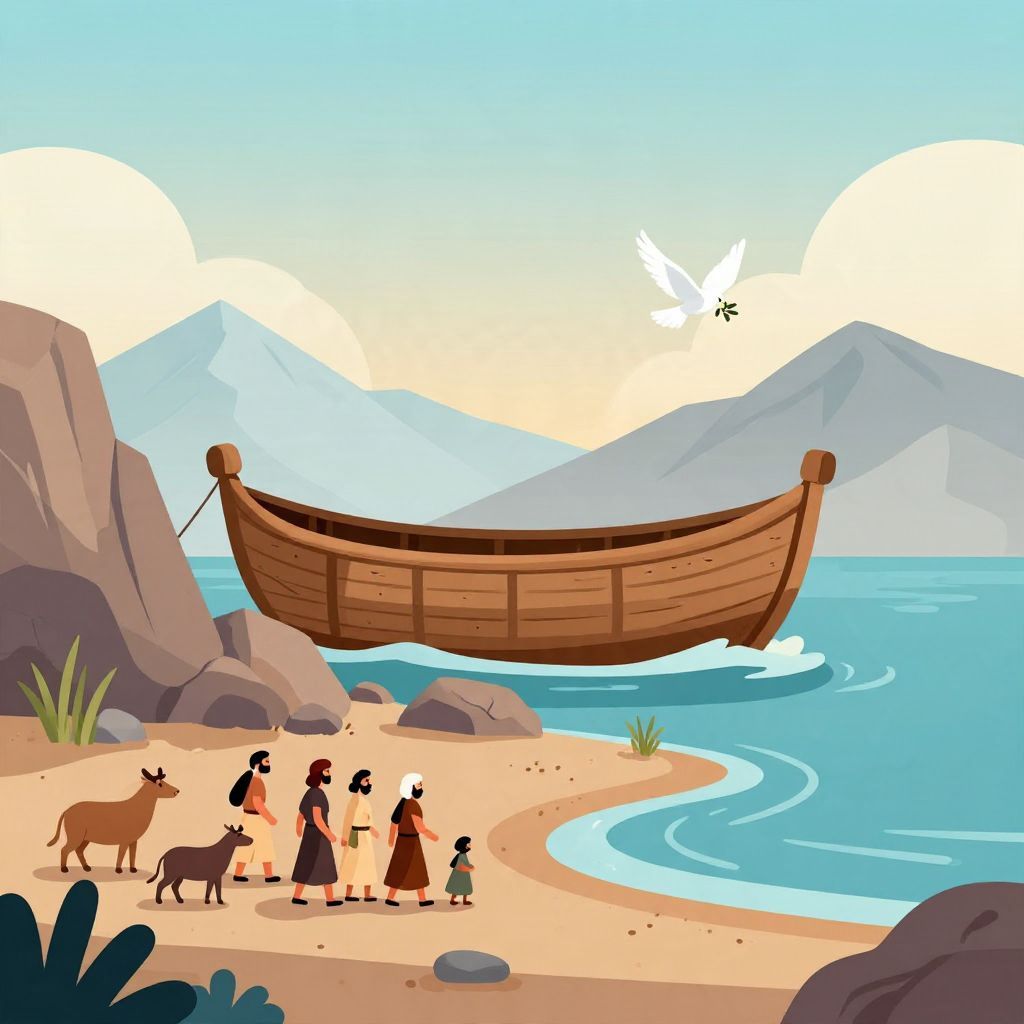
Where did Noah’s Ark land? In the biblical account, the Ark came to rest on the “mountains of Ararat” after the floodwaters receded. That phrase has shaped centuries of religious tradition, travel writing, and speculation, but it does not point to a single, universally agreed modern location.
Historically, the story belongs to the ancient Near East, where flood traditions circulated long before later Jewish, Christian, and Islamic interpretations. The question of the Ark’s landing place is therefore both a matter of scripture and of geography, legend, and scholarly debate.
Where Did Noah’s Ark Land?
The Bible says Noah’s Ark landed on the “mountains of Ararat,” a phrase usually associated with the broader region of ancient Urartu in eastern Anatolia, not necessarily one exact peak. Later tradition strongly identified the site with Mount Ararat in modern Turkey, but that identification is interpretive rather than certain historical proof.
The Biblical Text and What It Actually Says
The key passage is found in Genesis 8:4, which says the Ark came to rest on the mountains of Ararat. The wording is plural, suggesting a mountainous region rather than a single summit. In the ancient world, place names often referred to regions, kingdoms, or broad landscapes rather than precise coordinates.
Ararat, Urartu, and the ancient landscape
Many scholars connect “Ararat” with Urartu, a kingdom that existed in the first millennium BCE in the highlands around Lake Van and eastern Anatolia. This does not prove the Ark story happened there, but it helps explain how the biblical writer may have used a known northern highland region as the setting for the Ark’s resting place.
In later tradition, “Ararat” became associated with the prominent volcanic mountain now called Mount Ararat. Because it dominates the horizon and is visible from far away, it became the most famous candidate. Still, the biblical text itself does not explicitly name that mountain, and the modern identification developed over time.
Why Mount Ararat Became the Best-Known Answer
Mount Ararat’s prominence made it a natural focal point for storytelling, pilgrimage, and speculation. It is the highest peak in modern Turkey and a striking landmark in Armenian cultural memory. Over centuries, religious readers and explorers increasingly treated it as the Ark’s resting place, even though that association is later than the biblical text itself.
Geography and symbolism
High mountains often carry symbolic meaning in ancient literature. They suggest nearness to heaven, survival after chaos, and a new beginning after destruction. For that reason, a mountain landing place fits the story’s theological message even if the precise geography remains uncertain. The mountain is part of the story’s meaning, not just its setting.
Historical Background of the Noah Story
The Noah narrative is part of a wider ancient Near Eastern flood tradition. Similar stories appear in Mesopotamian literature, especially the Epic of Gilgamesh and older flood accounts. These parallels suggest that the biblical flood story emerged in a cultural world where catastrophic flooding was a powerful and familiar image.
A story shaped by ancient memory and theology
Ancient societies lived with the reality of river floods, seasonal disasters, and environmental instability. The Noah account transformed those experiences into a moral and theological narrative about human violence, divine judgment, preservation, and covenant. Its purpose was not to provide a modern geological report, but to explain the relationship between God, humanity, and the world.
Because of that, the Ark’s landing place should be read carefully. The text gives a meaningful destination, but not a map in the modern sense. The story’s power lies in the transition from destruction to renewal, not in a precise archaeological grid reference.
What Scholars Say About the Location
Most historians and biblical scholars treat the Ark’s resting place as a traditional or literary location rather than a verifiable historical site. Some argue that “Ararat” points to the Urartian highlands in general; others note that later readers narrowed the phrase to Mount Ararat specifically. A few popular theories place the Ark elsewhere, but none has been confirmed by accepted archaeological evidence.
Why certainty is difficult
There are several reasons the question remains unresolved:
- The biblical wording is broad and does not identify a single peak.
- Ancient place names often covered regions rather than exact sites.
- The story belongs to a religious tradition, not a documented expedition record.
- Claims of Ark discoveries have repeatedly been disputed or unverified.
As a result, responsible historical writing distinguishes between the biblical tradition, later religious identification, and modern claims of discovery. Those are related, but they are not the same thing.
Religious and Cultural Traditions About the Landing Site
Jewish, Christian, and Islamic traditions all preserve versions of the flood story, though they differ in emphasis. In many Christian and Jewish interpretations, Mount Ararat became the best-known symbolic resting place of the Ark. In Islamic tradition, the Ark also comes to rest after the flood, though later interpretations vary on the exact location.
Ararat in Armenian tradition
Mount Ararat holds special importance in Armenian cultural and religious memory. Even though the mountain lies within modern Turkey, it is deeply embedded in Armenian identity and historical imagination. That association helped make Ararat the dominant popular answer to the question of where Noah’s Ark landed.
This cultural significance does not by itself prove the site, but it explains why the mountain became so central in art, pilgrimage, and national symbolism. A place can become historically important because of what people believe happened there, even when the event itself cannot be verified.
Did the Ark Land on a Specific Peak?
Probably not in the strict modern sense implied by the question. The phrase “mountains of Ararat” is best understood as a mountainous region. Later tradition narrowed that broad description to Mount Ararat, but the original text does not require that reading. In historical terms, the safest answer is that the Ark was said to land somewhere in the Ararat highlands.
Popular claims and why historians are cautious
Over the centuries, explorers and enthusiasts have claimed to find remains of the Ark on or near Mount Ararat. These claims have attracted attention because the story is famous and the mountain is visually dramatic. However, none has produced conclusive evidence accepted by mainstream archaeology or historical scholarship.
That caution matters. Ancient traditions often inspire search narratives, but a compelling story is not the same as verified proof. Historians ask what the earliest texts say, how later readers interpreted them, and what evidence exists beyond tradition.
What the Question Means Historically
Asking where Noah’s Ark landed opens a window into how ancient people understood disaster, survival, and sacred geography. The answer is not only about a mountain. It is also about how a biblical tradition moved through time, how place names changed, and how later communities turned a regional phrase into a powerful symbol.
In that sense, the Ark’s landing place is a good example of the difference between textual tradition and historical certainty. The tradition points to Ararat; the historical evidence supports only a broader regional identification, not a proven exact site.
Bottom Line
Noah’s Ark is said in Genesis to have landed on the mountains of Ararat, most likely meaning the Ararat highlands of ancient Urartu in eastern Anatolia. Later tradition strongly linked that phrase to Mount Ararat in modern Turkey, but that identification remains traditional rather than definitively proven. For more context on the region, see what the Fertile Crescent was and, for another famous biblical geography question, what sea Moses parted.