
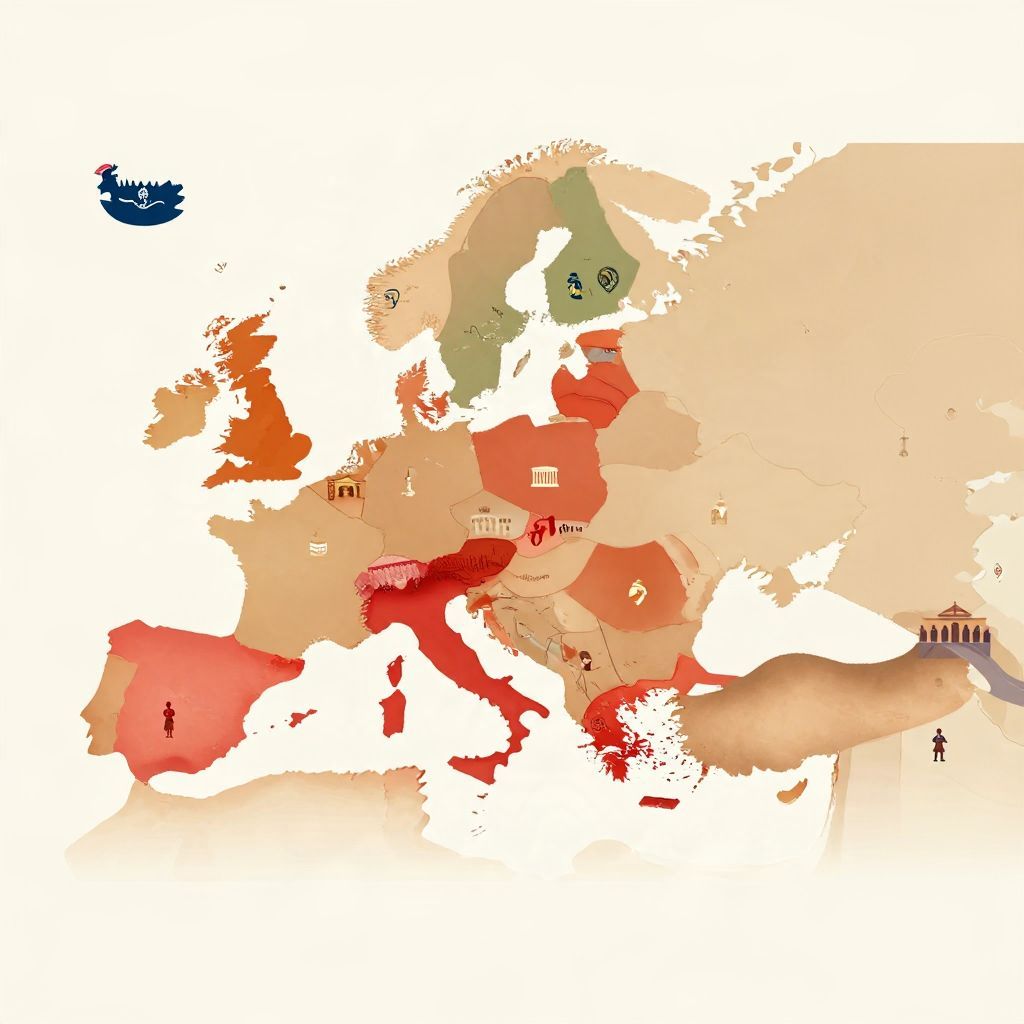
The Roman Empire was enormous for the ancient world, stretching from Britain to the Middle East and from the Rhine and Danube frontiers to North Africa. At its greatest extent under Emperor Trajan in the early 2nd century CE, it covered roughly 5 million square kilometers, though exact figures vary depending on how borders and client territories are counted.
Its size was not just a matter of land. The empire also connected tens of millions of people through roads, armies, taxation, law, trade, and a shared imperial system that lasted for centuries and shaped Europe, the Mediterranean, and parts of the Near East long after Rome itself had declined.
How big was the Roman Empire?
At its height, the Roman Empire covered about 5 million square kilometers, or roughly 1.9 million square miles. That made it one of the largest empires of the ancient world, though not the largest in all history. Its true power came from how effectively it controlled territory, people, and trade across three continents.
What “big” meant in Roman terms
When historians ask how big the Roman Empire was, they usually mean its maximum territorial extent, not just the city of Rome or the Italian peninsula. The empire included provinces directly governed by Rome, along with regions under varying degrees of Roman influence. Because ancient borders were often fluid, any precise number is an estimate rather than an exact measurement.
Roman power also extended beyond formal borders. Client kingdoms, allied rulers, and dependent states sometimes acknowledged Roman supremacy without being fully annexed. So the empire’s practical reach was often wider than the land it directly ruled.
When did the Roman Empire reach its greatest size?
The Roman Empire reached its largest territorial extent under Emperor Trajan around 117 CE. By then Rome had expanded into Dacia, much of the eastern Mediterranean, North Africa, Gaul, Iberia, Britain, and the Balkans. This was the high point of imperial expansion before later emperors chose to defend rather than enlarge the frontier.
Why Trajan’s reign mattered
Trajan’s conquests added territory, prestige, and resources, especially from Dacia, but they also made the empire harder to defend. His successor Hadrian soon reversed some expansion, abandoning certain exposed gains in favor of more manageable borders. In that sense, the empire’s greatest size was also a warning about the limits of overextension.
How the Roman Empire grew from a city-state to a world power
Rome did not begin as an empire. It started as a small city on the Tiber River and gradually expanded through warfare, diplomacy, colonization, and political absorption. Over centuries, Rome transformed from a local power into a Mediterranean superstate.
Key stages in Roman expansion
- Early Republic – Rome consolidated control over central Italy.
- 3rd to 2nd century BCE – Rome defeated Carthage in the Punic Wars and expanded into the western Mediterranean.
- 2nd to 1st century BCE – Rome absorbed Greece, Macedonia, parts of Asia Minor, Gaul, and other regions.
- 1st century BCE to 2nd century CE – The Roman Empire formed under Augustus and expanded under later emperors, reaching its greatest extent under Trajan.
This long process matters because the empire’s size was the result of centuries of incremental conquest, not a single dramatic leap. Rome built its dominance by defeating rivals one by one and then turning conquered lands into provinces.
Which regions were inside the Roman Empire?
The Roman Empire included much of modern-day Italy, Spain, Portugal, France, England and Wales, Belgium, Switzerland, Austria, the Balkans, Greece, Turkey, Syria, Lebanon, Israel, Egypt, Libya, Tunisia, Algeria, and parts of Germany and Romania. It also controlled islands such as Sicily, Sardinia, Corsica, Cyprus, Crete, and much of the Mediterranean coastline.
Three major zones of Roman rule
- Western provinces: Iberia, Gaul, Britain, and North Africa.
- Eastern provinces: Greece, Anatolia, the Levant, and Egypt.
- Frontier regions: areas along the Rhine, Danube, and desert borders, often heavily militarized.
Because Rome ruled around the Mediterranean Sea, it could move armies, grain, taxes, and goods relatively efficiently by water. The sea functioned like a Roman highway, linking distant provinces into a single political and economic system.
How many people lived in the Roman Empire?
Scholars generally estimate that the Roman Empire may have contained around 50 to 60 million people at its peak, though ancient population figures are uncertain. That would have been a very large share of the world’s population at the time. The empire’s cities, farms, and trade networks supported a remarkably dense and interconnected society.
Why population estimates are difficult
Ancient Rome did not conduct modern censuses in the way a contemporary state would. Surviving records are incomplete, and historians must rely on tax data, military recruitment figures, archaeological evidence, and comparisons with later societies. For that reason, population estimates should be treated as informed approximations, not exact counts.
How did Rome govern such a vast empire?
Rome managed its size through a combination of military force, provincial administration, local elites, roads, and a flexible legal system. The emperor stood at the top, but much daily governance was carried out by provincial governors and local communities that worked within Roman authority.
The machinery of imperial control
- Provinces were administered by governors appointed by Rome.
- Legions defended borders and suppressed rebellion.
- Roads and sea routes allowed rapid movement of troops and messages.
- Taxation funded the army and state administration.
- Roman law helped unify diverse peoples under a common framework.
Rome did not erase local identities. Many provinces kept their own languages, customs, and urban institutions even while accepting Roman rule. This flexibility helped the empire endure, because it allowed conquered peoples to become Roman without becoming identical.
Why was the Roman Empire able to become so large?
Rome’s expansion was driven by military organization, political ambition, strategic geography, and the ability to absorb defeated enemies. Unlike some states that relied on a single ruler or a narrow homeland, Rome developed institutions that could sustain repeated warfare and long-term administration.
Important reasons for Roman expansion
- Disciplined armies – Roman legions were highly trained and adaptable.
- Political competition – Roman elites often gained status through military success.
- Infrastructure – roads, forts, and ports supported expansion and control.
- Alliance systems – Rome frequently turned former enemies into partners or subjects.
- Strategic location – Italy sat at the center of the Mediterranean world.
Rome’s greatest strength was not simply conquering territory, but turning conquest into a durable system. Defeated communities could be taxed, recruited, and gradually integrated, which made the empire self-reinforcing.
Did the Roman Empire stay the same size throughout its history?
No. Roman territory expanded, stabilized, and later contracted over time. The empire was largest in the early 2nd century CE, but it had already changed shape many times before that. Later centuries brought crises, civil wars, frontier pressure, and eventual division into eastern and western halves.
Major changes after the peak
- 2nd century CE: expansion slows and frontiers harden.
- 3rd century CE: internal crisis and external invasions strain the empire.
- 4th century CE: administrative division becomes more pronounced.
- 5th century CE: the Western Roman Empire falls in 476 CE, while the Eastern Roman Empire continues.
This means the phrase “Roman Empire” can refer to different historical phases. The empire of Augustus was not identical to the empire of Trajan, and neither was the same as the later Byzantine Empire, which was the eastern continuation of Roman rule.
How far did Roman influence extend beyond its borders?
Roman influence often reached beyond the official frontier through trade, diplomacy, military pressure, and cultural exchange. Goods, coins, styles of dress, religious ideas, and Latin or Greek literacy spread well outside Roman territory. In this sense, Rome’s world was larger than the map of its provinces.
Examples of Roman reach outside direct rule
Germanic tribes beyond the Rhine traded with Rome and fought against it. Parthian and later Sasanian Persia stood as major eastern rivals, yet also interacted through diplomacy and war. In northern Europe, Roman objects have been found far beyond the imperial border, showing how deeply Roman commerce penetrated neighboring societies.
What was the legacy of the Roman Empire’s size?
The Roman Empire’s vast scale left a lasting mark on law, language, religion, architecture, and political imagination. Its roads, cities, and administrative habits influenced later European states, while Latin evolved into the Romance languages. Even after the western empire collapsed, Roman institutions continued to shape the medieval and modern world.
Lasting consequences of imperial scale
- Law and government: Roman legal ideas influenced later European systems.
- Language: Latin spread widely and became the root of several modern languages.
- Religion: Christianity spread across the empire and beyond it.
- Infrastructure: roads, aqueducts, and cities remained important long after Rome’s fall.
The empire’s size also created a template for later rulers who wanted to claim universal authority. Medieval emperors, early modern monarchs, and modern historians all looked back at Rome as a model of power on a continental scale.
So, how big was the Roman Empire really?
The Roman Empire was vast by ancient standards: about 5 million square kilometers at its peak, spanning much of Europe, North Africa, and the Near East, and governing perhaps 50 to 60 million people. But its importance was not only measured in miles or borders. It was big because it created a connected imperial world that endured for centuries.
If you want to explore Rome further, you may also enjoy reading about how long it took to build Rome and what language the Romans spoke.