
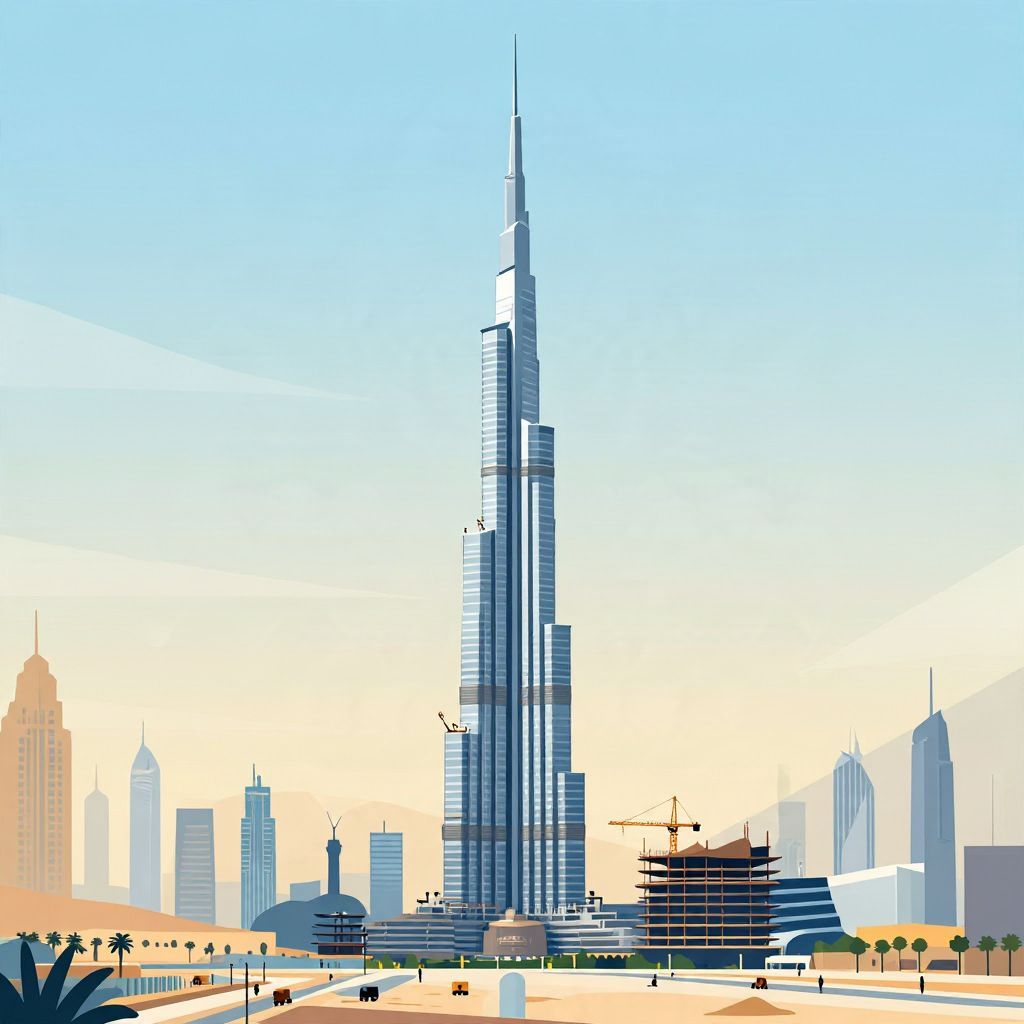
When was the Burj Khalifa built? The short answer is that construction began in January 2004, the tower was structurally completed in October 2009, and it officially opened on 4 January 2010. It was built in Dubai, United Arab Emirates, during a period of rapid urban growth and global competition to create record-breaking architecture.
The Burj Khalifa is not just a modern skyscraper; it is a landmark of 21st-century engineering, investment, and city branding. Its construction tells the story of how Dubai transformed itself from a regional trading hub into a global metropolis in just a few decades.
When Was the Burj Khalifa Built?
The Burj Khalifa was built between 2004 and 2010. Groundbreaking began in January 2004, the main structure topped out in January 2009, and the building reached practical completion in late 2009 before its grand opening on 4 January 2010. In historical terms, that means the tower’s construction took about six years from start to finish.
Burj Khalifa Construction Timeline
The tower’s development followed a clear sequence, moving from planning and excavation to record-setting height. Its timeline reflects both the speed of modern megaprojects and the technical challenges of building the world’s tallest structure.
- Early 2000s: Planning and design work for a supertall tower in downtown Dubai.
- January 2004: Construction officially began.
- 2004–2006: Foundation work and the lower levels rose rapidly.
- 2007: The tower became the world’s tallest free-standing structure.
- January 2009: The building topped out at its full height.
- October 2009: Major construction work was completed.
- 4 January 2010: Official opening and renaming as the Burj Khalifa.
Why the timeline matters
The dates matter because they show the difference between a building’s physical completion and its public debut. A tower can be structurally finished months before final interiors, systems testing, and ceremonial opening are complete. That is why the Burj Khalifa is often described as built in 2004–2010, even though it reached its final height in 2009.
Why Was the Burj Khalifa Built?
The Burj Khalifa was built as part of Dubai’s larger effort to reshape its economy and international image. In the early 2000s, Dubai was investing heavily in tourism, finance, real estate, and global visibility. A record-breaking tower served as both a practical centerpiece and a symbolic statement of ambition.
Its construction was tied to the development of Downtown Dubai, a master-planned district intended to showcase luxury urban life, major commercial space, and world-famous architecture. The tower was designed to anchor that district and attract attention from investors, tourists, and the international media.
The role of prestige in architecture
Throughout history, rulers, governments, and cities have built monumental structures to demonstrate power, wealth, and modernity. The Burj Khalifa fits that tradition, but in a contemporary form. Instead of a palace, cathedral, or fortress, Dubai chose a skyscraper to signal its place in the global economy.
Who Designed and Built It?
The Burj Khalifa was designed by the American architectural firm Skidmore, Owings & Merrill, with Adrian Smith as the lead architect. The tower was developed by Emaar Properties, one of Dubai’s major developers. Construction involved a large international team of engineers, contractors, and specialists.
The main contractor was Samsung C&T, working with other firms on different parts of the project. The building required advanced engineering for its foundation, concrete structure, wind resistance, and vertical transportation systems. Its success depended on international collaboration rather than a single national workforce or tradition.
A global project in a global city
Burj Khalifa is historically significant because it reflects globalization in architecture. Materials, expertise, labor, and design knowledge came from many countries. That makes the tower a useful example of how major landmarks in the 21st century are often created through cross-border networks rather than local craftsmanship alone.
How Tall Is the Burj Khalifa?
The Burj Khalifa stands at 828 meters tall, or about 2,717 feet. That height made it the tallest building in the world when it opened, and it remains one of the most famous skyscrapers ever built. Its height was a major reason the project attracted worldwide attention during construction.
Its record-breaking scale was not accidental. The tower was designed to rise far above existing skyscrapers, and its tapering form helped reduce wind forces as the building climbed upward. The height also created engineering challenges in pumping concrete, moving workers, and maintaining precision at extreme elevations.
Historical Context: Dubai Before the Burj Khalifa
To understand when the Burj Khalifa was built, it helps to understand Dubai’s earlier history. For much of the 20th century, Dubai depended on trade, shipping, and later oil revenue. By the late 20th and early 21st centuries, leaders in the emirate pursued economic diversification, especially in tourism, real estate, and services.
The Burj Khalifa emerged from that broader transformation. It was not simply a standalone building; it was part of a new urban identity. Dubai wanted to be known not only for commerce, but also for spectacle, luxury, and world-class development.
The boom years of the 2000s
The tower was built during a period of intense construction across Dubai. High-rise towers, artificial islands, luxury hotels, and shopping districts all appeared in quick succession. The Burj Khalifa became the most famous symbol of that boom, but it was one piece of a much larger redevelopment strategy.
Construction Challenges and Engineering Facts
Building the Burj Khalifa required solving problems that had few precedents. At such great height, wind loads, temperature changes, and material transport all become more difficult. Engineers used a reinforced concrete core, a stepped design, and careful construction sequencing to manage those risks.
One of the most difficult tasks was pouring concrete to extraordinary heights in Dubai’s heat. The project also required precise scheduling so that materials and crews could move efficiently up the structure as it rose. These challenges are part of why the tower took years to complete rather than months.
Why the building shape matters
The Burj Khalifa’s design is often described as inspired by the Hymenocallis flower, though the building is also shaped by engineering needs. Its setbacks reduce wind pressure and help stabilize the structure. In other words, the form is both aesthetic and functional, showing how modern architecture often blends symbolism with science.
When Did It Open to the Public?
The Burj Khalifa officially opened on 4 January 2010. That date is often treated as the building’s public debut, even though construction had already been completed in the preceding months. The opening ceremony marked the tower’s arrival as a global icon and accompanied Dubai’s effort to present itself as a mature international destination.
At the time of opening, the building was renamed from Burj Dubai to Burj Khalifa in honor of Sheikh Khalifa bin Zayed Al Nahyan, the ruler of Abu Dhabi and the president of the United Arab Emirates. The renaming reflected political and financial realities within the UAE, as well as the importance of inter-emirate support.
Why the Burj Khalifa Became Historically Important
The Burj Khalifa matters historically because it represents more than architectural ambition. It captures a moment when cities competed through skyline identity, when megaprojects became tools of national and regional branding, and when engineering made previously unimaginable heights possible.
It also marks a shift in how people think about landmarks. In earlier eras, the most famous monuments were often religious or political. In the 21st century, commercial skyscrapers can play a similar role, becoming symbols of a city’s aspirations and technological confidence.
Key Facts at a Glance
- Construction began: January 2004
- Topped out: January 2009
- Construction completed: October 2009
- Official opening: 4 January 2010
- Location: Dubai, United Arab Emirates
- Height: 828 meters
- Original name: Burj Dubai
- Renamed: Burj Khalifa in 2010
Conclusion
The Burj Khalifa was built from 2004 to 2010, with construction beginning in January 2004 and the official opening taking place on 4 January 2010. Its history reflects Dubai’s rapid rise, the ambitions of modern urban development, and the engineering achievements that made the world’s tallest building possible. For readers interested in major landmark construction, related examples include when the Washington Monument was built and when Disney World was built.