
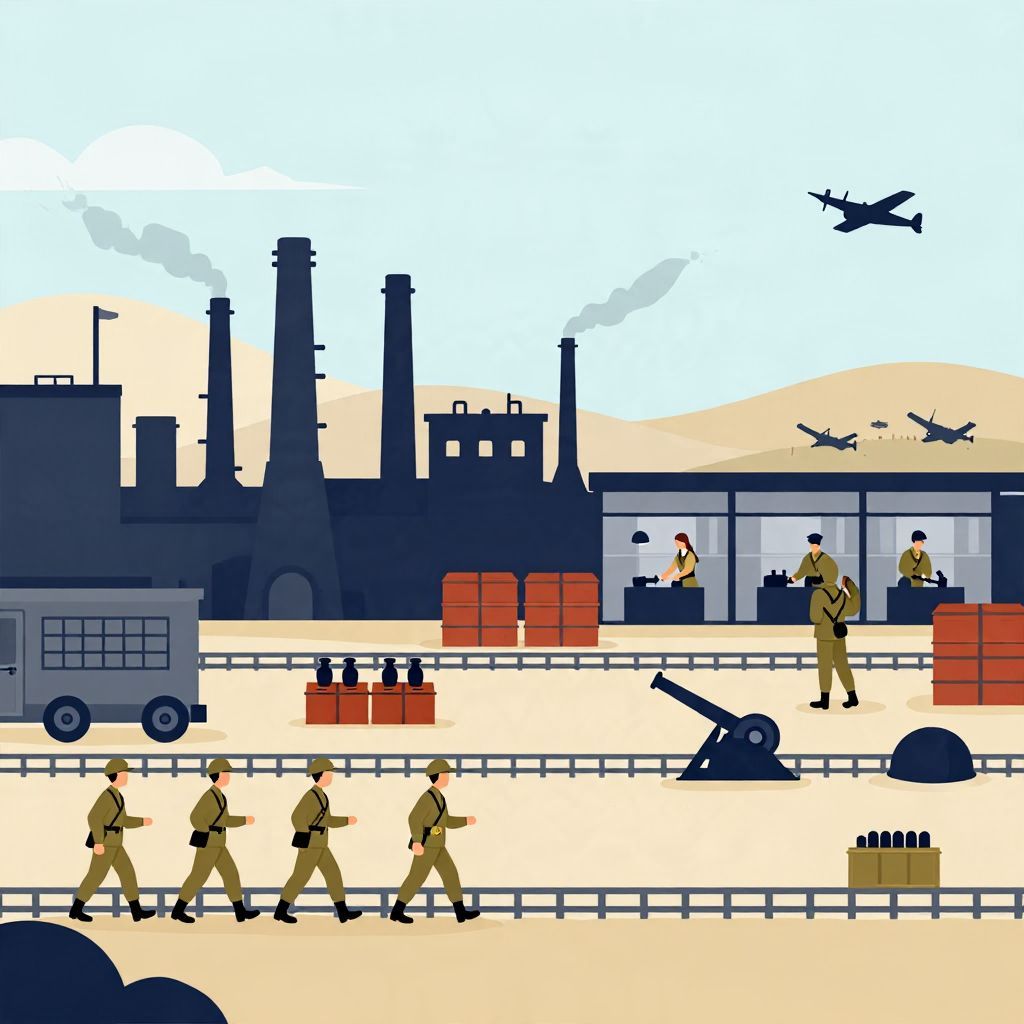
What is a total war? The phrase describes a conflict in which states mobilize nearly all available resources—soldiers, industry, food, transport, science, and propaganda—to defeat an enemy. In a total war, the boundary between the battlefield and civilian life becomes blurred, and the whole society is pulled into the war effort.
The idea is most closely associated with modern industrial warfare, especially the two world wars, but the term has older roots and is sometimes used more loosely by historians. Understanding total war means looking at how war expanded beyond armies alone and why civilian populations became central targets and participants.
What Is a Total War?
A total war is a conflict in which a government commits the full power of the state to victory and accepts that civilians, economies, and domestic life are part of the war itself. Unlike limited wars, total wars aim to overwhelm an enemy by using every available military and civilian resource.
The basic meaning
The phrase does not mean that every war is equally destructive or that every aspect of society is always controlled by the state. Historians use it to describe wars in which mobilization is unusually deep and the distinction between combatant and noncombatant becomes much less secure. The concept is especially useful for understanding industrial-age wars, when railways, factories, mass conscription, and modern communications made entire societies part of military strategy.
How historians use the term
“Total war” is partly a historical description and partly an analytical label. Some scholars argue that no war is ever completely total, because states still face limits of manpower, politics, morality, and logistics. Others use the term to identify a real historical shift in the scale and reach of warfare. So while the phrase is widely used, it should not be treated as a rigid category with a single exact definition.
Origins of the Idea of Total War
The concept emerged in the modern era, but the practice of mobilizing whole societies for war has older precedents. Ancient and early modern states sometimes razed cities, enslaved populations, or redirected entire economies toward war. What changed in the 18th and 19th centuries was the scale: industrial production, mass armies, and national politics made such mobilization far more extensive.
Early roots in earlier warfare
Long before the term existed, some wars already approached totalizing violence. In antiquity, sieges could destroy cities and displace civilian populations. In the early modern period, the Thirty Years’ War (1618–1648) devastated large parts of Central Europe, with armies living off the land and civilians suffering famine, disease, and displacement. These conflicts were not “total war” in the modern sense, but they show that the idea of war reaching beyond armies is not new.
The modern concept in the 19th century
The language of total war became more explicit in the 19th and 20th centuries. European thinkers and military planners increasingly recognized that industrial societies could sustain and intensify war in new ways. Railroads moved troops quickly, factories produced artillery and shells in vast quantities, and mass politics made public morale a strategic resource. The American Civil War is often discussed as an early example of modern war because it combined large-scale mobilization, economic destruction, and attacks on infrastructure.
Why Total War Became Possible
Total war became possible because modern states could organize people and resources on a scale earlier empires could not. Industrialization, nationalism, conscription, and bureaucratic government all made it easier to turn an entire society into a war machine. The result was not just bigger armies, but a deeper merging of military and civilian life.
Industrialization and mass production
Factories could produce rifles, artillery, ships, uniforms, and ammunition in quantities unimaginable in earlier eras. Coal, steel, chemicals, and rail transport became strategic assets. Once war depended on industrial output, destroying an enemy’s factories, rail lines, and ports became as important as defeating its army in the field.
Nationalism and mass participation
Modern nationalism encouraged people to see war as a struggle for the survival of the nation itself. Governments used patriotic appeals to recruit soldiers, raise loans, and justify sacrifices. This made it easier to demand rationing, labor discipline, and civilian endurance. In total war, civilians are not merely bystanders; they are asked to contribute directly to victory.
Centralized states and bureaucracy
By the 19th and early 20th centuries, many states had developed stronger bureaucracies capable of taxation, conscription, propaganda, and economic planning. These tools allowed governments to direct food supplies, regulate labor, censor information, and coordinate military production. Total war depends not only on weapons but also on administration.
Total War in Practice
In a total war, governments expand military service, control industry, and target enemy resources as well as enemy troops. The war effort reaches into homes, workplaces, schools, farms, and media. Civilians may be drafted, displaced, bombed, starved, or economically exploited, while propaganda seeks to sustain morale and suppress dissent.
Common features of total war
- Mass conscription of soldiers and laborers
- State direction of industry and raw materials
- Rationing and food controls
- Propaganda to shape public opinion
- Economic warfare, including blockades and sanctions
- Attacks on infrastructure such as railways, ports, and factories
- Civilian suffering through bombing, famine, occupation, or deportation
The blurring of civilian and military targets
One of the most troubling features of total war is that civilians become strategically important. Factories make weapons, workers keep transport moving, farmers feed armies, and cities house production centers. This logic can lead governments to justify bombing urban areas, blockading food supplies, or targeting enemy morale. The moral and legal boundaries of war become much harder to maintain.
World War I and the Expansion of Total War
World War I (1914–1918) is one of the clearest early examples of total war. European powers mobilized millions of soldiers, redirected economies toward military production, and subjected civilian populations to shortages, censorship, and propaganda. The war also introduced new forms of industrial slaughter on a vast scale.
Home fronts and wartime economies
Governments took unprecedented control over labor, transport, food distribution, and manufacturing. Women entered war industries in large numbers in many countries, filling jobs left by men at the front. Civilian life changed dramatically as states imposed rationing, price controls, and emergency regulations. The “home front” became as important as the battlefield.
Blockade, hunger, and morale
Britain’s naval blockade of Germany aimed to weaken the enemy’s ability to fight by restricting imports. Germany and its allies also suffered severe shortages. Hunger, inflation, and war weariness became strategic factors. This showed that victory could depend not only on battlefield success but on the ability to sustain a society under pressure.
World War II and the Full Maturity of Total War
World War II (1939–1945) is often seen as the most complete example of total war in history. It involved global mobilization, genocide, mass bombing, occupation, forced labor, and the complete subordination of civilian life to military goals. The scale of destruction was greater than in any earlier conflict.
Strategic bombing and urban destruction
Air power transformed warfare by making cities and industrial centers direct targets. Britain, Germany, Japan, and other combatants suffered devastating bombing campaigns. The aim was often to destroy factories, transport networks, and housing, while also breaking civilian morale. This marked a major escalation in the reach of war into everyday life.
Genocide and occupation
Total war in the 20th century also intersected with ideological violence. Nazi Germany’s war of conquest in Eastern Europe included mass murder, forced labor, and the Holocaust. In occupied territories, civilians were often treated as resources to be exploited or populations to be eliminated. This reveals that total war can merge with racial ideology, imperialism, and state terror.
Global mobilization
The war drew in empires, colonies, and economies across several continents. Raw materials, soldiers, shipping routes, and industrial output from around the world fed the conflict. The war effort depended on global networks, which made the conflict not just a European war but a worldwide struggle of states and empires.
Is Every Modern War a Total War?
No. The term should not be applied to every conflict simply because it is violent or technologically advanced. Many wars remain limited in aims, scale, or mobilization. A war may be brutal without involving the full transformation of society that total war implies.
Limited war versus total war
Limited wars usually have narrower political goals, smaller mobilization, or stronger restraints on civilian targeting. Governments may seek territory, regime change, or strategic advantage without fully converting the economy and society to wartime footing. Total war is different because it treats victory as requiring the comprehensive use of national power.
Why the distinction matters
Using the term carefully helps historians compare conflicts without flattening important differences. It also reminds us that war is not only a matter of armies and battles. The organization of society, the role of industry, and the treatment of civilians all shape what war becomes.
The Human Cost and Historical Legacy of Total War
Total war changed warfare permanently. It intensified civilian suffering, expanded the power of states, and helped drive the development of international law and humanitarian norms after 1945. At the same time, the Cold War and later conflicts showed that the fear of total war—especially nuclear war—could shape diplomacy even when full-scale mobilization was absent.
After 1945
The devastation of the world wars made governments and international organizations more aware of the need to protect civilians. The Geneva Conventions were strengthened, and the language of war crimes and crimes against humanity became more prominent. Yet the legacy of total war remained visible in military planning, strategic bombing doctrine, and the possibility of mass destruction through modern weapons.
A warning from history
Total war is not just a military concept; it is a social condition in which the entire structure of a society is bent toward destruction and survival. It shows how modern states can harness technology, ideology, and bureaucracy for war on an immense scale. It also explains why 20th-century conflicts left such deep scars on civilian life and global politics.
In short, total war is warfare without clear boundaries between front line and home front, army and society, soldier and civilian. It developed with industrialization and mass politics, reached its most extreme form in the world wars, and remains one of the most important concepts for understanding modern conflict. For related reading, see what war bonds were and how imperialism helped lead to World War I.