
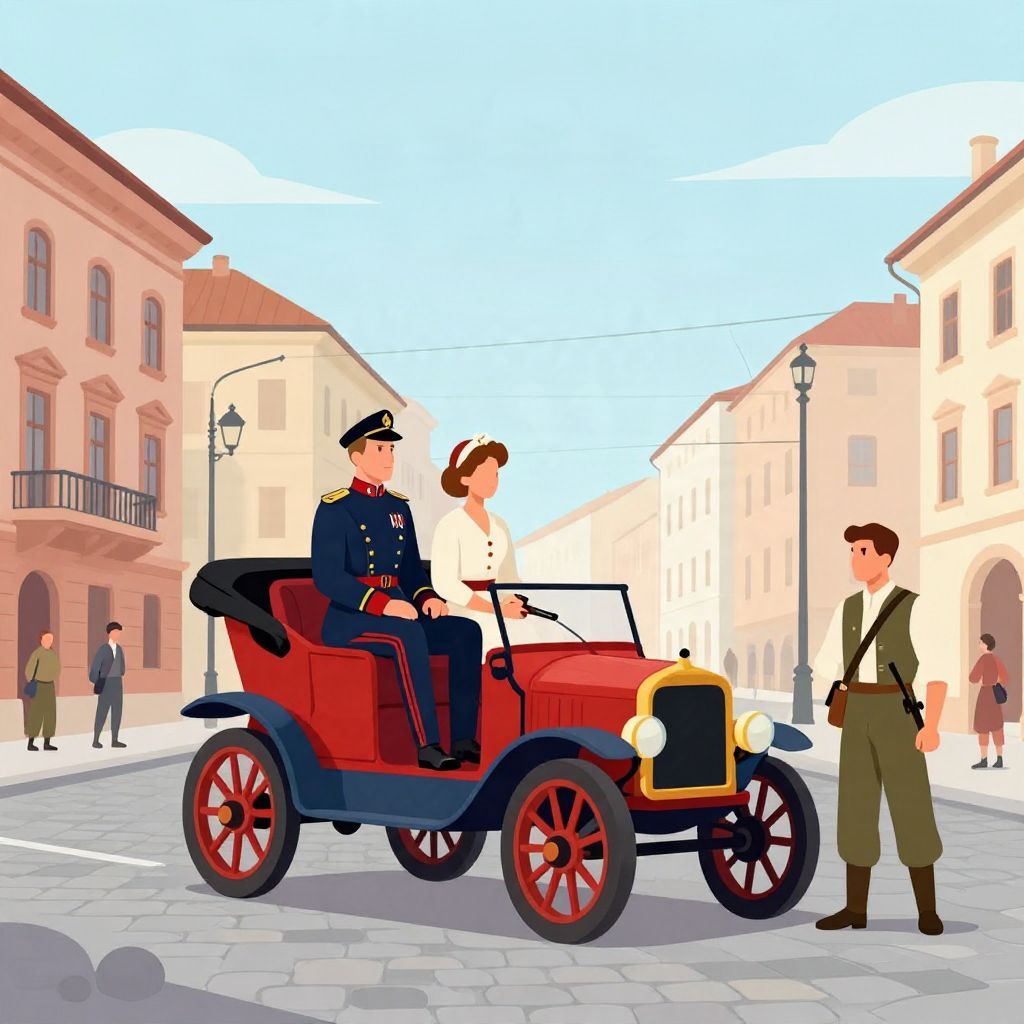
The assassination of Archduke Franz Ferdinand on 28 June 1914 did not, by itself, cause World War I. It acted as the spark that ignited a Europe already loaded with rival alliances, military planning, imperial competition, and nationalist tension.
Austria-Hungary used the killing as a reason to confront Serbia, and the crisis quickly widened because the great powers were tied together by promises, fears, and mobilization timetables. What began as a regional dispute in the Balkans became a continental war within weeks.
How did the assassination of Ferdinand lead to WWI?
The assassination of Archduke Franz Ferdinand led to World War I by triggering the July Crisis of 1914. Austria-Hungary blamed Serbia, issued a harsh ultimatum, and declared war. Because European powers were linked by alliances, military plans, and mutual suspicion, the conflict rapidly spread from the Balkans to most of Europe.
Why the assassination mattered so much in 1914
Franz Ferdinand was the heir to the Austro-Hungarian throne, and his death in Sarajevo shocked Europe. The assassin, Gavrilo Princip, was a Bosnian Serb nationalist connected to a network of anti-Austrian activists. The killing mattered because it struck at the prestige of Austria-Hungary and gave its leaders an opportunity to act against Serbia.
The political meaning of Sarajevo
Sarajevo was not just any city. It lay in Bosnia-Herzegovina, a territory annexed by Austria-Hungary in 1908 but claimed by many South Slavs as part of a wider national future. That made the assassination more than a personal tragedy: it symbolized the unstable nationalist politics of the Balkans, one of the most dangerous regions in Europe.
Why Austria-Hungary saw Serbia as the enemy
Austria-Hungary believed Serbian nationalism threatened the empire’s survival. The empire contained many ethnic groups, and its leaders feared that successful Serbian agitation might encourage Slavic subjects inside the Habsburg state to demand independence. The assassination therefore seemed, to Vienna, like proof that Serbia had to be punished or contained.
The July Crisis: how a local murder became a world war
The crucial transformation happened during the five weeks after the assassination, in what historians call the July Crisis. Diplomatic decisions, military timetables, and alliance commitments turned a Balkan confrontation into a general European war. The crisis escalated step by step rather than in one sudden leap.
1. Austria-Hungary sought German support
Before confronting Serbia, Austrian leaders consulted Germany and received what is often called the “blank cheque” assurance of support. Germany’s backing encouraged Vienna to take a hard line, assuming Russia would not dare intervene decisively. This was a major turning point, because it made a limited Balkan response far less likely.
2. Austria-Hungary issued the ultimatum to Serbia
On 23 July 1914, Austria-Hungary delivered Serbia an ultimatum with demands so severe that acceptance in full would have compromised Serbian sovereignty. Serbia accepted most terms but not all. Austria-Hungary judged the response insufficient and declared war on 28 July.
3. Russia mobilized to protect Serbia
Russia saw itself as the protector of Slavic peoples and as a rival of Austria-Hungary in the Balkans. When Austria-Hungary attacked Serbia, Russia began mobilizing its army. Mobilization was not merely a defensive measure; in the rigid military system of the time, it was often treated as a step toward war because armies needed days or weeks to assemble.
4. Germany declared war on Russia and France
Germany feared that a Russian mobilization would eventually threaten it on two fronts. On 1 August, Germany declared war on Russia. Two days later, after France stood by Russia, Germany declared war on France as well. German military planning, especially the expectation of a quick western offensive, made escalation faster and more difficult to reverse.
5. Britain entered after the invasion of Belgium
Germany’s plan required moving through neutral Belgium to attack France. When German forces invaded Belgium, Britain entered the war on 4 August 1914. Britain had no obligation to defend Serbia, but it did have strategic and treaty-based reasons to oppose the violation of Belgian neutrality and the rise of German power on the continent.
The deeper causes behind the assassination
The assassination mattered because Europe was already unstable. The war was not caused by a single bullet alone. It came from a combination of long-term tensions and short-term decisions that made a major conflict increasingly likely by 1914.
Nationalism
Nationalism fueled both the assassin’s motives and the great powers’ fears. In the Balkans, nationalist movements sought independence or unification. In larger empires such as Austria-Hungary and Russia, nationalism encouraged competition and distrust. Each state feared that concessions would weaken its authority or embolden rivals.
Alliance systems
Europe was divided into rival blocs. Germany and Austria-Hungary were closely aligned, while France and Russia had formed an alliance. Britain was not formally tied to France and Russia in the same way, but it had growing strategic cooperation with them. These relationships did not automatically cause war, but they made local conflict far more likely to spread.
Militarism and war planning
European governments placed great faith in military power. Armies were large, mobilization systems were complex, and many leaders believed war could be controlled or won quickly. Once mobilization began, it became difficult to stop. Railway schedules, reserve call-ups, and offensive doctrines pushed states toward rapid escalation.
Imperial rivalry and great-power tension
Competition over colonies, trade, and influence had already strained relations among the European powers. Germany, Britain, France, and others had clashed over imperial questions, especially in Africa and elsewhere. These disputes did not directly cause the Sarajevo assassination, but they deepened mistrust and made compromise harder.
What happened after the assassination?
After Franz Ferdinand’s death, the crisis unfolded in a chain of decisions that made war increasingly difficult to avoid. The important point is that leaders did not simply “slip” into war. Many made deliberate choices, often believing the conflict would be limited or manageable.
- 28 June 1914: Franz Ferdinand and his wife Sophie are assassinated in Sarajevo.
- 5–6 July: Germany signals strong support for Austria-Hungary.
- 23 July: Austria-Hungary issues its ultimatum to Serbia.
- 28 July: Austria-Hungary declares war on Serbia.
- 30 July: Russia orders general mobilization.
- 1 August: Germany declares war on Russia.
- 3 August: Germany declares war on France.
- 4 August: Germany invades Belgium; Britain declares war on Germany.
Was the assassination the real cause of World War I?
Historians generally treat the assassination as the immediate trigger, not the sole cause. Without the assassination, war might have come later through another crisis, because Europe was already tense and heavily armed. But without the assassination, the specific July Crisis that began in 1914 would not have unfolded in the same way.
Trigger versus cause
A useful distinction is between a trigger and a cause. The trigger is the event that starts the chain reaction; the causes are the conditions that make the chain reaction possible. Franz Ferdinand’s assassination was the trigger. Nationalism, alliances, militarism, and imperial rivalry were the underlying causes that made escalation so dangerous.
Why leaders miscalculated
Many leaders believed war could be localized or short. Austria-Hungary expected to punish Serbia without provoking a wider conflict. Germany assumed Russia might back down. Russia hoped deterrence would protect Serbia. These misjudgments mattered enormously. The war expanded because each state underestimated the others’ responses.
Why the Balkans were so explosive
The Balkans had become a flashpoint long before 1914. The decline of the Ottoman Empire, the rise of new states, and competition among Austria-Hungary, Russia, and local nationalist movements created a volatile environment. The region’s instability meant that one assassination there could quickly become an international crisis.
Serbia’s role
Serbia was a small state but an influential one in South Slavic politics. Some Serbian nationalists wanted to unite South Slavs under Serbian leadership, which alarmed Austria-Hungary. It is important, however, not to reduce Serbia to a single conspiracy. The Serbian state was not simply identical with the assassins, even though some individuals and networks in the wider nationalist milieu were involved.
Austria-Hungary’s weakness
The Habsburg Empire was powerful but internally fragile. Its leaders feared that hesitation would make the empire look weak, while a forceful response might restore authority. That insecurity helped push Vienna toward a hard line. In that sense, the assassination exposed the empire’s vulnerability rather than creating it.
The lasting significance of the assassination
The murder of Franz Ferdinand became one of the most consequential assassinations in history because it set off the process that led to World War I. The war killed millions, toppled empires, redrew borders, and reshaped global politics. The event is remembered not because one bullet caused all of that on its own, but because it exposed how unstable Europe had become.
In historical terms, the assassination of Ferdinand led to World War I by triggering a diplomatic and military crisis that the European powers failed to contain. It was the spark, not the fuel. The fuel was a continent full of rival empires, armed alliances, nationalist movements, and leaders who believed force could solve political problems.
If you want to explore the wider background, you may also find how imperialism helped lead to World War I and why Germany was blamed for World War I useful for understanding the broader causes and consequences.