
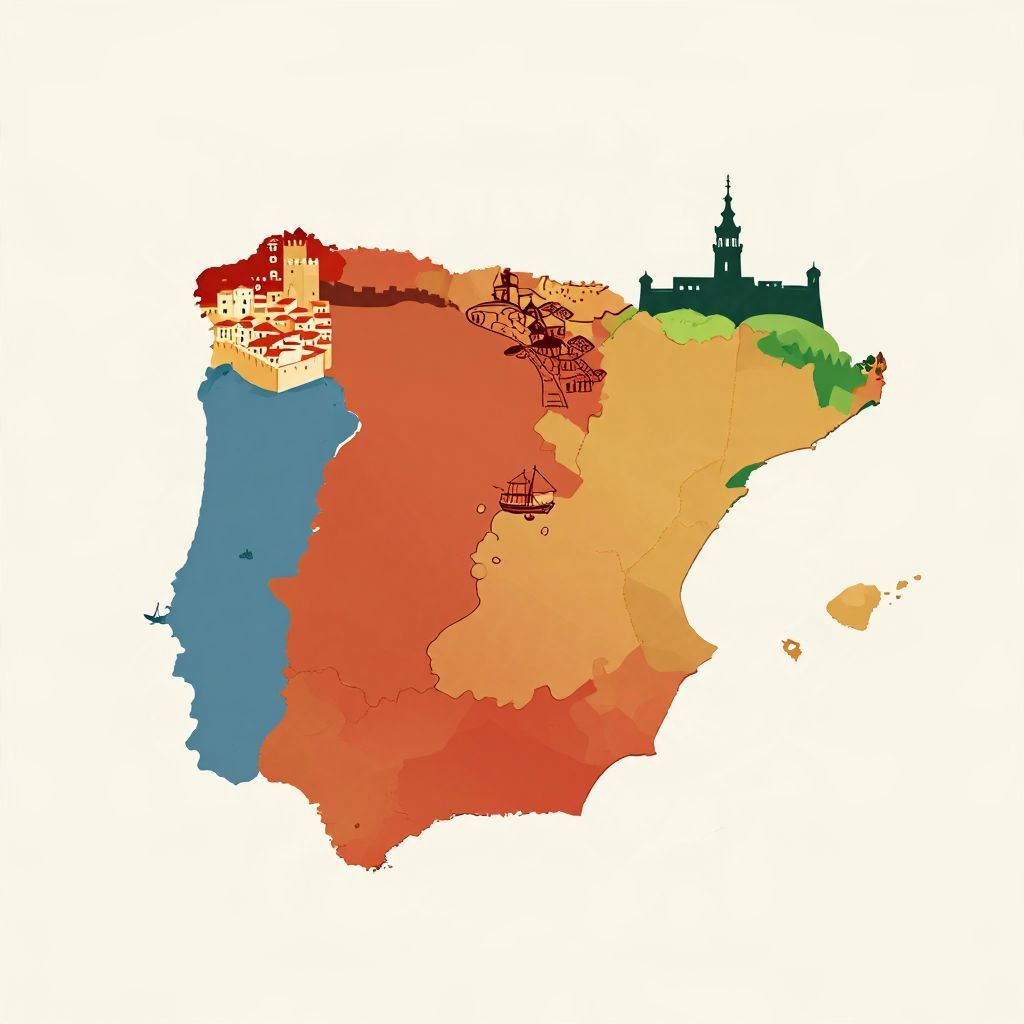
Portugal and Spain are neighboring countries on the Iberian Peninsula, but Portugal is not in Spain. The two are separate sovereign states with distinct histories, languages, and political identities. Confusion is understandable because they share a long border and much of the same peninsula, yet their national development followed different paths over many centuries.
Historically, Portugal was never simply a region of Spain in the modern sense. At times the two kingdoms were ruled by the same monarch, but even then Portugal remained legally and institutionally distinct. The answer to “Is Portugal in Spain?” is therefore no.
Is Portugal in Spain?
No. Portugal is an independent country, not part of Spain. Both countries occupy the Iberian Peninsula, but Portugal has had its own kingdom since the 12th century and its own state continuity into the modern era. While the two were united under one crown for a time in the 16th and 17th centuries, that was a dynastic union, not a permanent merger.
How Portugal and Spain Became Separate Countries
The Iberian Peninsula before modern borders
In antiquity and the early Middle Ages, the peninsula was ruled by a succession of powers, including Rome, Germanic kingdoms, and later Muslim polities. The modern countries of Spain and Portugal did not yet exist. Instead, the region was divided into shifting territories, and political identity was local, dynastic, and religious rather than national in the modern sense.
During the Christian Reconquista, several small Christian kingdoms expanded southward. Among them was the County of Portugal, originally a frontier territory under the Kingdom of León. Over time, this county gained greater autonomy and then moved toward independence.
The rise of the Kingdom of Portugal
Portugal’s emergence as a separate kingdom is usually traced to the 12th century. Afonso Henriques, the count who led the county, defeated rival forces and declared himself king. By the mid-1100s, Portugal had become a recognized kingdom, and its independence was later confirmed through diplomacy and papal recognition.
This matters because it shows Portugal was not created as a province of Spain. Instead, it developed as its own monarchy from a frontier county into a kingdom with separate rulers, laws, and ambitions. That political separation is one of the main reasons Portugal and Spain are distinct today.
Was Portugal Ever Ruled by Spain?
Yes, but only in a limited historical sense. From 1580 to 1640, Portugal and Spain were under the same monarch during the Iberian Union. Even then, Portugal was not formally absorbed into Spain. It kept its own laws, currency systems in many contexts, colonial administration, and imperial identity, though Spanish Habsburg kings ruled both crowns.
The Iberian Union, 1580–1640
The union began after a succession crisis in Portugal. When King Sebastian died in 1578 without an heir and his successor, Cardinal Henry, also died childless, the Portuguese throne was disputed. Philip II of Spain claimed the Portuguese crown and prevailed in 1580. He became King Philip I of Portugal, uniting the crowns under one ruler.
However, this was a dynastic union, not a national fusion. Portugal retained separate institutions and a distinct legal order. Many Portuguese resented the arrangement, especially as Spanish foreign policy entangled Portugal in conflicts that threatened its trade and empire. In 1640, a revolt restored Portuguese independence under the House of Braganza.
Why the union ended
The Iberian Union weakened because it served Spanish imperial interests more than Portuguese ones. Portugal’s overseas empire, especially in Asia, Africa, and Brazil, suffered from attacks by Dutch and English rivals during the period. Portuguese elites increasingly saw the union as harmful to their interests. The Restoration War that began in 1640 eventually secured Portugal’s independence.
Portugal and Spain Today: Two Countries, One Peninsula
Geography and borders
Portugal occupies the western edge of the Iberian Peninsula, with Spain to the north and east. The border between them is one of the oldest continuously defined international borders in Europe. It stretches from the northern mountains to the southern plains and has remained remarkably stable for centuries.
Because both countries share the same peninsula, people sometimes assume one is a region of the other. But geography does not determine political identity. Many neighboring countries share a landmass without being the same state, and Portugal and Spain are a clear example.
Language and identity
Portuguese and Spanish are related Romance languages, both descended from Latin, but they are not the same language. They are mutually intelligible only to a limited degree, especially in written form or in some border dialects. Language has long reinforced the sense that Portugal and Spain are related but separate cultural worlds.
National identity also developed differently. Portugal built a strong sense of monarchy, maritime expansion, and Atlantic orientation. Spain, meanwhile, emerged from the union of multiple kingdoms, most notably Castile and Aragon, and later became a composite monarchy with its own imperial trajectory. Their histories overlap, but they are not identical.
Common Reasons People Think Portugal Is Part of Spain
Shared peninsula, shared history
The biggest source of confusion is simple geography. Portugal and Spain are neighbors on the same peninsula, and their histories are deeply intertwined. Over centuries, they fought wars, negotiated alliances, and sometimes shared rulers. That overlap can make the two seem like one political unit when they were not.
The Iberian Union and modern misunderstanding
The period from 1580 to 1640 is another source of confusion. Because Portugal was ruled by Spanish Habsburg kings during those decades, some people assume it was annexed. In reality, the Portuguese crown persisted as a separate legal entity. The union ended, and Portugal resumed independent rule.
Maps and shorthand labels
Older maps, simplified school materials, and casual speech sometimes blur the distinction between the peninsula and the countries on it. “Iberia” refers to the geographic region, not a single country. Spain and Portugal are the two main sovereign states on the peninsula today, along with a few smaller territories.
Important Historical Milestones in Portugal’s Independence
Several key moments help explain why Portugal is not in Spain:
- 1139 — Afonso Henriques is traditionally associated with the emergence of Portuguese kingship after military success at Ourique, though the exact details are debated by historians.
- 1143 — The Treaty of Zamora is commonly cited as an important step in recognizing Portuguese independence.
- 1179 — Papal recognition through the bull Manifestis Probatum strengthens Portugal’s status as an independent kingdom.
- 1580 — Portugal enters the Iberian Union under Philip II of Spain, becoming ruled by the same monarch as Spain.
- 1640 — The Portuguese Restoration restores independent rule under the House of Braganza.
These milestones show a long pattern of separate political development. Even when Portugal was under the same royal house as Spain, it was not simply absorbed into Spain as a province or region.
Why the Distinction Still Matters
Understanding that Portugal is not in Spain is more than a geography quiz fact. It reflects how states form, how borders endure, and how dynastic unions can be mistaken for national mergers. Portugal’s history shows that political identity can survive periods of shared rule and external pressure.
It also highlights the diversity of the Iberian Peninsula. Rather than one country with one history, the peninsula has long contained multiple peoples, languages, and kingdoms. Portugal’s separate path helped shape Atlantic exploration, colonial expansion, and a national tradition distinct from Spain’s.
Conclusion
Portugal is not in Spain. It is an independent nation on the Iberian Peninsula with its own medieval origins, its own monarchy, and its own historical trajectory. Although Portugal and Spain have been closely linked and briefly shared a ruler, they have remained separate countries for most of recorded history. If you want to explore the broader context, related topics include the history of the Iberian Peninsula, the Reconquista, and the Iberian Union.