
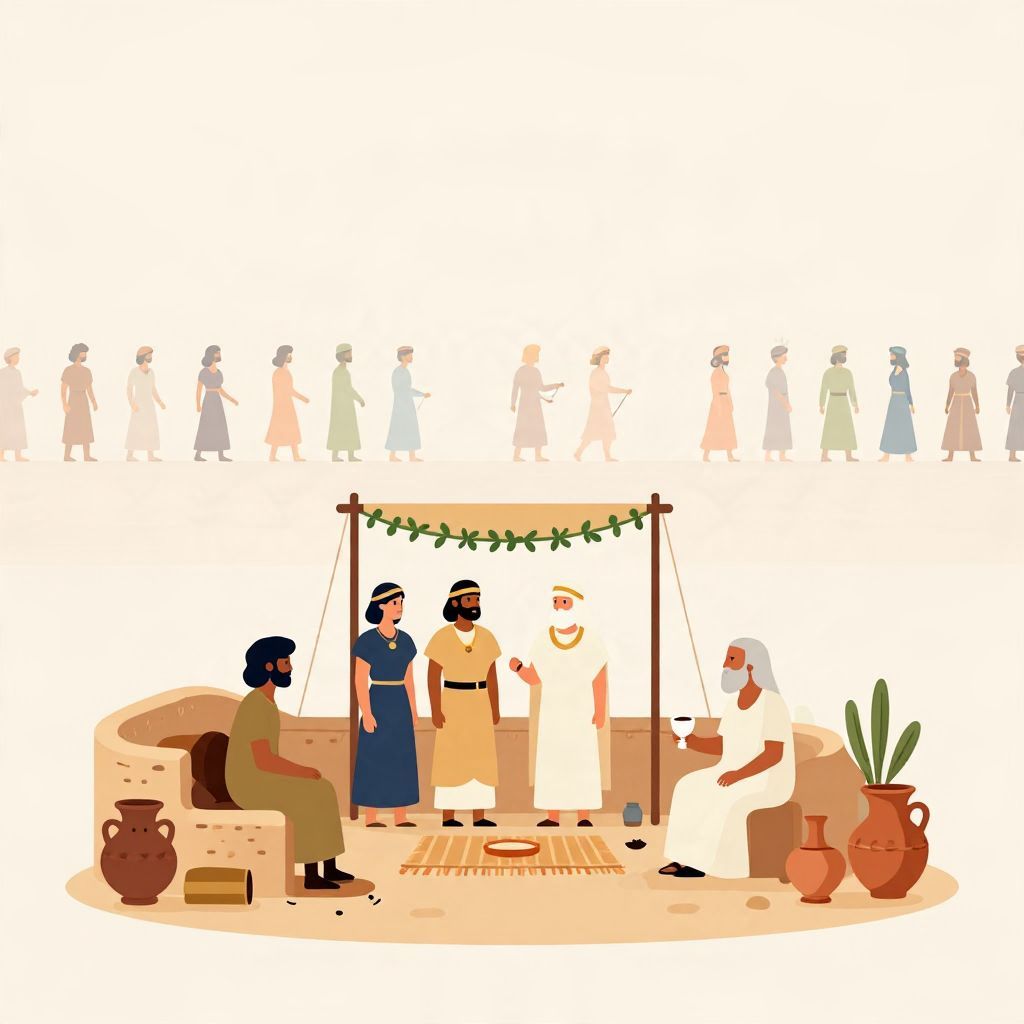
When was marriage invented? There is no single invention date, because marriage emerged gradually as human societies became more settled and organized. The earliest evidence for formal marriage-like unions appears in the ancient Near East, especially in Mesopotamia, by the third millennium BCE, though customs of pair-bonding and family formation are far older.
In other words, marriage was not invented all at once by one person, place, or law. It developed over thousands of years as communities created rules about kinship, property, inheritance, children, and social status.
When Was Marriage Invented?
Marriage was not invented on one exact date. The earliest written evidence for legal marriage comes from ancient Mesopotamia around 2000 BCE, but marriage-like unions almost certainly existed much earlier in prehistoric societies. Most historians see marriage as a social institution that evolved gradually rather than a single invention.
What Counts as “Marriage” in History?
The answer depends on definition. If marriage means a recognized union with social obligations, it may be very ancient. If it means a legally regulated contract recorded in writing, then the clearest early evidence comes from early states such as Mesopotamia, Egypt, and later Greece and Rome. Different societies defined marriage differently, and not all required the same rituals, legal rights, or religious approval.
Marriage as a social practice
Humans likely formed long-term pair bonds long before agriculture. Archaeology cannot prove “marriage” in the modern sense for deep prehistory, but it does show that early humans cared for children, organized family groups, and created stable partnerships. These behaviors laid the groundwork for later marriage systems.
Marriage as a legal institution
Once states developed, rulers and scribes began recording marriages, dowries, inheritance rights, and legitimate heirs. At that point, marriage became more than a private relationship. It turned into a legal and economic arrangement that helped organize property, lineage, and alliance-making.
The Earliest Historical Evidence for Marriage
The strongest early evidence comes from the ancient Near East. In Mesopotamia, by the early second millennium BCE, legal texts refer to husbands, wives, dowries, divorce, and inheritance. These records show that marriage was already a well-established institution by then, even if the custom itself was older.
Mesopotamia and written law
Mesopotamian societies used marriage to regulate family life and property. Marriage contracts often protected a woman’s dowry and established the rights of children. Laws associated with Babylonian rule, including later legal traditions such as the Laws of Hammurabi in the 18th century BCE, show how seriously these societies treated marital status.
Ancient Egypt
In ancient Egypt, marriage was also important, though it was less often formalized in surviving legal texts than in Mesopotamia. Egyptian marriages usually involved household arrangements, economic cooperation, and inheritance concerns. The evidence suggests that marriage was a practical social institution, even when the state did not always record it in the same way.
Other early civilizations
Marriage existed in many early societies, but the evidence varies. In the Indus Valley, early China, and later in the Mediterranean world, marriage became tied to family lineage, social rank, and political strategy. Because records are uneven, historians are careful not to claim one universal “first marriage” for all human history.
A Short Timeline of Marriage in History
Marriage developed over a very long period. This timeline shows the broad historical pattern rather than a single origin point.
- Prehistory: Human pair bonding and family groups likely existed long before writing.
- c. 3000–2000 BCE: Early states in Mesopotamia and Egypt develop formal marriage customs and records.
- c. 1750 BCE: Mesopotamian law codes reflect marriage as a regulated institution.
- 1st millennium BCE: Marriage becomes central in Greek, Hebrew, Persian, and Roman societies, often tied to inheritance and citizenship.
- Middle Ages: In Europe, Christian marriage becomes increasingly shaped by church doctrine and canon law.
- Modern era: States begin regulating marriage through civil law, and debates over consent, divorce, and interfaith or same-sex marriage reshape the institution.
Why Did Marriage Develop?
Marriage developed because it solved important social problems. It helped societies organize child-rearing, clarify inheritance, create alliances between families, and manage property. In agricultural and state societies, these functions became even more important because land, labor, and lineage mattered greatly.
Property and inheritance
As communities became more settled, families accumulated land, animals, tools, and wealth. Marriage helped determine who would inherit what. This was especially important in societies where property passed through male or female lines, or where dowries and bridewealth were used to formalize family ties.
Children and legitimacy
Marriage also helped define which children were considered legitimate heirs. That mattered for family continuity, political succession, and social identity. In many ancient societies, marriage was less about romantic love than about establishing recognized parentage and stable household structure.
Alliance between families
Marriage often linked households, clans, or elites. Royal and noble marriages could seal political alliances, strengthen claims to power, or reduce conflict. In this sense, marriage was not only a private relationship but also a diplomatic tool.
Was Marriage Always About Love?
No. For most of history, marriage was primarily a social, economic, and legal arrangement. Love could matter, and in some cultures it was celebrated, but it was rarely the main reason marriages were arranged. Romantic marriage became much more prominent in parts of the modern world, especially from the 18th and 19th centuries onward.
Arranged marriage in the ancient world
In many early societies, families arranged marriages to protect property, status, and lineage. Consent varied by culture and period, but the interests of the family often outweighed individual preference. This was especially true among elites, where marriage could affect succession and diplomacy.
The rise of companionate marriage
In Europe and North America, the idea that spouses should marry for affection and companionship gained strength over time. This shift did not replace older legal and economic functions overnight, but it changed expectations. Modern marriage increasingly came to emphasize personal choice, emotional partnership, and mutual support.
Marriage in Religion and Law
Religions and governments did not invent marriage, but they shaped it. Over time, many societies gave marriage sacred meaning and legal force. That helped standardize rules about who could marry, how marriages could end, and what obligations spouses had to one another.
Judaism, Christianity, and Islam
These major religious traditions all developed teachings about marriage, but not in identical ways. They generally treated marriage as morally significant and socially stabilizing, while also debating issues such as divorce, polygamy, and family duty. Religious authority often reinforced marriage’s importance in everyday life.
Civil law and the modern state
In the modern era, states increasingly took control of marriage registration, divorce, and legal rights. Civil marriage became especially important in many countries, separating legal recognition from religious ceremony. This shift made marriage a matter of public record and state regulation, not only family or church authority.
What the Evidence Can and Cannot Tell Us
Historians can say with confidence that marriage is ancient and that written evidence for it appears in early civilizations by the third and second millennia BCE. What they cannot say with certainty is the exact moment when the first marriage occurred. There was no universal starting point, because marriage emerged differently across cultures.
Why there is no single inventor
Marriage was not a technology created by one person. It was a social institution shaped by many communities over time. Different peoples developed different rules for spouses, children, property, and ceremony. That is why the question “Who invented marriage?” has no historical founder to name.
Why prehistoric marriage is hard to prove
Before writing, there are no marriage contracts or legal codes to consult. Archaeology can reveal households, burials, and family life, but it cannot always distinguish marriage from other forms of partnership. For that reason, claims about the “first marriage” before recorded history are educated inference, not direct proof.
The Historical Significance of Marriage
Marriage has been one of the most durable institutions in human history because it connects private life to public order. It shaped family structure, inheritance, political alliances, and social identity. Even as its meaning changed, marriage remained central to how societies organized kinship and responsibility.
So, when was marriage invented? The best historical answer is that it was not invented on one date at all. Its roots are prehistoric, but its earliest clear written evidence appears in ancient Mesopotamia around 2000 BCE. If you want more context on the ancient world that helped shape early marriage customs, see when Mesopotamia emerged and when the Roman Empire was founded.