
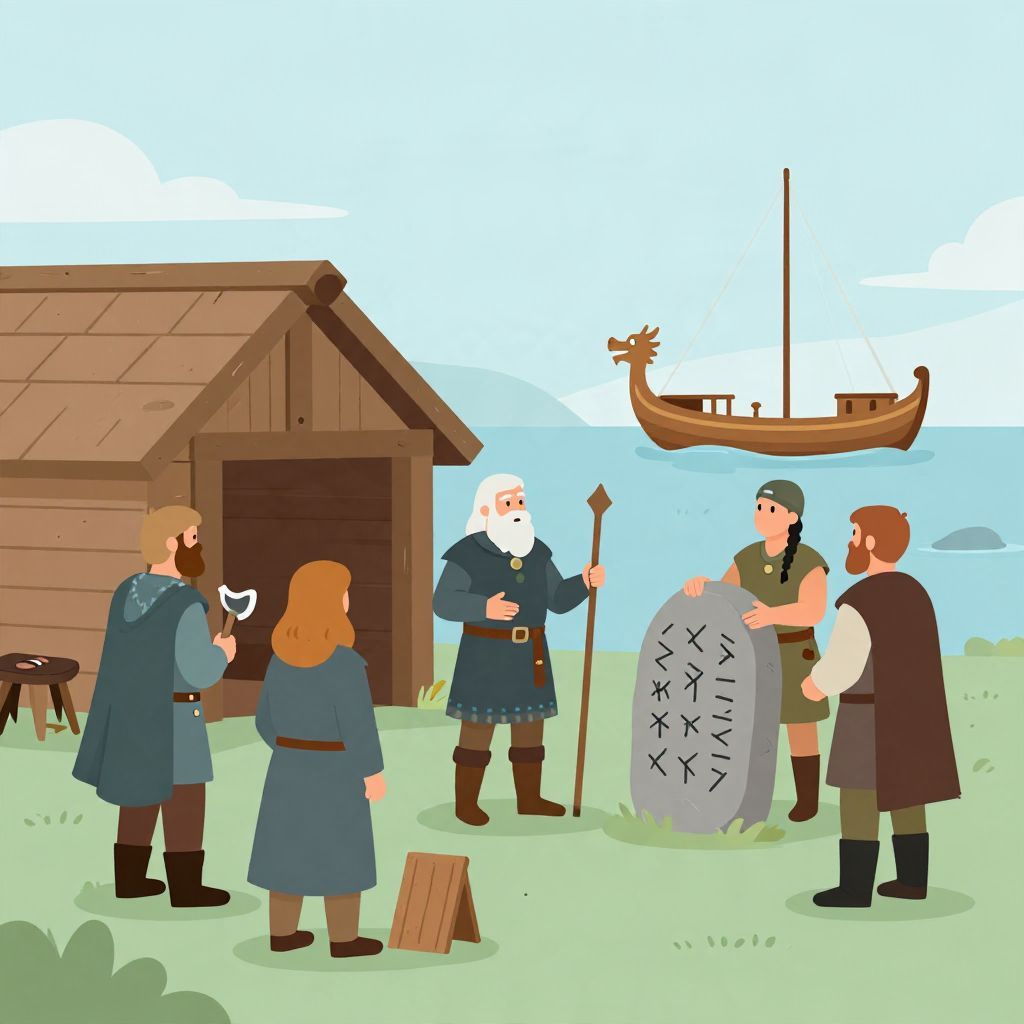
When people ask, “What language did the Vikings speak?” they are usually asking about the everyday speech of the Scandinavian seafarers who raided, traded, and settled across Europe from the late 8th to the 11th century. The short answer is that the Vikings spoke Old Norse, an early North Germanic language that later developed into the modern Scandinavian languages.
That answer is simple, but the history behind it is richer. “Viking” was not a single ethnic label or a single nation, and Old Norse was not exactly one uniform language everywhere. It changed over time and varied by region, yet it was the shared tongue of much of Scandinavia during the Viking Age.
What language did the Vikings speak?
The Vikings spoke Old Norse, especially its early forms in Denmark, Norway, and Sweden. It was the common language of Scandinavia during the Viking Age, roughly from the late 8th century to the mid-11th century. In different regions and periods, it developed local dialects, but speakers could generally understand one another.
Old Norse: the language of the Viking Age
Where Old Norse came from
Old Norse belonged to the Germanic language family. More specifically, it grew out of Proto-Norse, the earlier North Germanic speech used in Scandinavia before the Viking Age. By about the 8th century, this older language had begun to shift into the form historians and linguists call Old Norse.
Old Norse was not invented by the Vikings in a sudden moment. It emerged gradually as pronunciation, grammar, and vocabulary changed over generations. Like all living languages, it evolved through everyday use, trade, migration, and contact with neighboring peoples.
How historians know
Most of what we know about Old Norse comes from runic inscriptions, later medieval manuscripts, place names, and comparative linguistics. The famous runestones of Scandinavia are especially valuable because they preserve names, formulas, and short messages in the language of the time.
Much of the surviving literature in Old Norse was written down after the Viking Age, especially in Iceland during the 12th and 13th centuries. That means the written sources are later than the period they describe, so scholars use them carefully and compare them with archaeology and inscriptions.
Was Old Norse one language or several?
Old Norse was a shared language, but not a perfectly uniform one. Over time, it developed into regional varieties, often grouped as Old West Norse and Old East Norse. Speakers in Norway and Iceland tended toward West Norse forms, while Denmark and Sweden developed East Norse forms.
West Norse and East Norse
- Old West Norse: associated with Norway, Iceland, the Faroe Islands, and Norse settlements in the North Atlantic.
- Old East Norse: associated with Denmark and Sweden.
The differences were real, but they did not create completely separate languages during the Viking Age. They were more like dialects within a broader linguistic continuum. Over the centuries, however, these differences helped shape the modern Scandinavian languages.
Mutual understanding
People across Scandinavia could likely understand each other fairly well, especially in the early Viking Age. That said, local speech patterns, vocabulary, and pronunciation would have varied. A trader from Denmark, a farmer from Norway, and a settler from Sweden would not have sounded identical.
What did Viking speech sound like?
We cannot hear Viking speech directly, but scholars can reconstruct many features from spelling patterns, later texts, and related languages. Old Norse had a rich system of noun endings, verb endings, and grammatical genders, which made it more complex than modern English in many respects.
A highly inflected language
Old Norse used endings to show grammatical case, number, and gender. That meant word order could be more flexible than in modern English. A single noun could change form depending on whether it was the subject, object, or part of a possessive phrase.
Sounds and pronunciation
Old Norse likely had sounds unfamiliar to modern English speakers, including rolled or tapped r sounds and consonant clusters that could be difficult to pronounce. Some letters and sounds also shifted over time, which is one reason why later Scandinavian languages diverged from one another.
Did all Vikings speak the same language?
Not exactly. “Viking” describes an activity and a historical culture, not a single ethnic group. Most Vikings came from Scandinavia, so Old Norse was the main language among them, but Viking-age expeditions and settlements brought them into contact with many other languages.
Languages they encountered
Vikings interacted with speakers of Old English, Old Irish, Latin, Frankish, and various Slavic and Baltic languages. In trade centers and settlements, multilingualism was common. Some Vikings learned local languages, while others used a mix of tongues depending on where they lived and worked.
Borrowing and exchange
Language contact left traces in both directions. Old Norse words entered English, especially in areas of intense Scandinavian settlement in northern and eastern England. Everyday English words such as sky, window, egg, knife, and husband reflect this long history of contact and borrowing.
Old Norse in the Viking world
Scandinavia
In Scandinavia, Old Norse was the language of daily life, law, poetry, trade, and family life. It was spoken in farmsteads, at assemblies, on ships, and in markets. The language was central to social identity and to the oral traditions that preserved myths, genealogies, and heroic stories.
Iceland and the North Atlantic
When Norse settlers reached Iceland in the late 9th century, they brought West Norse speech with them. Iceland became especially important for preserving Old Norse literary culture, though the famous sagas were written down later. The language of medieval Icelandic texts is one reason modern scholars can study Viking-age speech in such detail.
England, Ireland, and beyond
In Viking settlements outside Scandinavia, Old Norse mixed with local languages. In parts of England under Scandinavian influence, Norse-speaking settlers lived alongside English speakers for generations. In Dublin and other Norse-Gaelic contexts, language contact was even more complex, with Norse, Gaelic, and later English all shaping the cultural landscape.
How Old Norse became the modern Scandinavian languages
After the Viking Age, Old Norse gradually split into the languages that later became Norwegian, Danish, Swedish, Icelandic, and Faroese. This was not a sudden break. Political change, regional isolation, and shifting trade networks slowly pushed the language in different directions.
Key stages in the timeline
- Before the Viking Age: Proto-Norse was spoken in Scandinavia.
- Late 8th to 11th centuries: Old Norse was the main language of the Viking world.
- 11th to 13th centuries: regional differences widened as kingdoms and local identities strengthened.
- Later Middle Ages: separate Scandinavian languages emerged more clearly.
Icelandic and Faroese retained more features of Old Norse than mainland Scandinavian languages did, partly because of geographic isolation. Modern Norwegian, Danish, and Swedish changed more rapidly under different political and social conditions.
What about Viking writing?
Most Vikings did not leave long written texts in the way modern readers might expect. Their writing system was the runic alphabet, often called the futhark after its first letters. Runes were used for inscriptions on stones, wood, metal, and other materials.
Runes versus the Latin alphabet
Runes were well suited to carving, but they were not used for the same range of writing as later medieval Latin script. After Christianization, Latin letters became increasingly important in Scandinavia. Over time, religious institutions and written administration helped shift literacy toward the Latin alphabet.
Oral culture mattered too
Even without extensive books, Viking-age society had a strong oral tradition. Poetry, law, genealogy, and storytelling helped preserve memory. Old Norse skaldic poetry, with its complex style and dense imagery, shows that the language could be highly sophisticated and artistic.
Why the language matters historically
Understanding what language the Vikings spoke helps explain more than vocabulary. It reveals how people moved, settled, traded, and formed identities across the North Atlantic and Europe. Language is one of the clearest signs of cultural continuity from the Viking Age into the medieval Scandinavian world.
Historical significance
Old Norse shaped the development of modern Scandinavian languages and left a deep imprint on English. It also gives historians a window into Viking society: its laws, beliefs, social hierarchy, and literary imagination. The language connects archaeology, literature, and history in a way few other sources can.
What the question is not asking
Sometimes people assume “Viking language” means a single mysterious code or a lost tongue unrelated to later Scandinavian speech. That is a myth. The Vikings spoke a real, well-attested language family that can be traced through inscriptions, manuscripts, and modern linguistic comparison.
The short answer, in context
The Vikings spoke Old Norse, an early North Germanic language that existed in regional forms across Scandinavia and the Norse world. It was the ancestor of several modern Scandinavian languages and a major source of loanwords in English. If you want more context on Viking culture, see what Vikings looked like, or revisit the full language guide.