
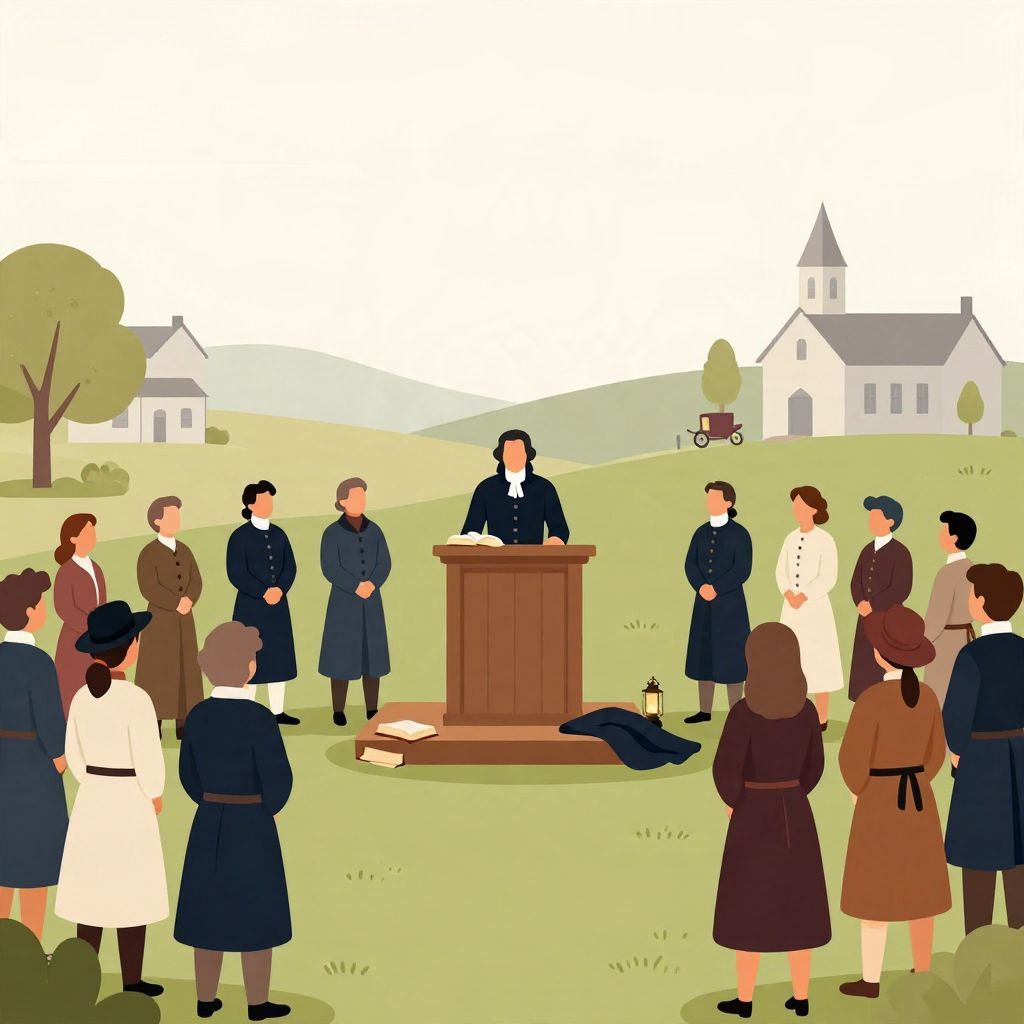
How did George Whitefield die? The famous evangelical preacher George Whitefield died on 30 September 1770 in Newburyport, Massachusetts, after collapsing from severe illness and exhaustion. He had spent years preaching almost nonstop across Britain and the American colonies, and his final weeks were marked by worsening health. Historians generally describe his death as the result of chronic overwork and respiratory illness rather than a single dramatic event.
Whitefield’s death mattered because he was one of the most influential religious voices of the Great Awakening. His passing ended a remarkable transatlantic career that had helped reshape Protestant revivalism in the 18th century.
How Did George Whitefield Die?
George Whitefield died of illness and physical exhaustion. In the weeks before his death, he was suffering from a serious chest complaint, likely aggravated by years of relentless travel, outdoor preaching, and repeated strain on his body. He became too weak to continue preaching and died at the home of a supporter in Newburyport on 30 September 1770.
The immediate cause of death
Whitefield’s final illness is usually described in contemporary accounts as a severe respiratory or chest ailment. The exact modern diagnosis cannot be stated with certainty, because 18th-century medical records were limited and diagnostic terms were broad. What is clear is that he had been declining for some time and was physically worn down by a demanding ministry that rarely allowed rest.
Why his health failed
Whitefield was famous for preaching outdoors to huge crowds, often in difficult weather and while traveling constantly between towns, ports, and colonies. He also had a long history of poor health. The combination of heavy speaking, frequent travel, and inadequate recovery likely contributed to the collapse that ended his life. In historical terms, his death reflects the physical cost of 18th-century itinerant preaching.
What Happened in Whitefield’s Final Days?
Whitefield’s last days unfolded in New England, where he had returned to continue preaching despite obvious weakness. He had become too ill to maintain his usual schedule, but he still tried to minister to supporters. According to widely accepted historical accounts, he died at the residence of a local minister and friend in Newburyport after his condition worsened rapidly.
His last journey to New England
Whitefield had crossed the Atlantic many times during his career. By 1770, he was already a celebrated figure in both Britain and the American colonies. His final American tour took him through the northeastern colonies, where he continued to attract large audiences. Even as his health declined, he remained determined to preach, which likely accelerated the end.
The final sermon tradition
One of the best-known stories about Whitefield’s death is that he preached shortly before he died, and that his final sermon was delivered from a staircase or in a constrained setting because he was too weak to stand comfortably. Such details appear in biographical tradition and are broadly consistent with reports of his final illness, though exact versions vary. The larger historical point is secure: he continued preaching until very near the end.
Who Was George Whitefield?
George Whitefield was an Anglican evangelist and one of the leading figures of the First Great Awakening, the wave of Protestant revival that spread through Britain and North America in the 1730s and 1740s. Born in 1714 in Gloucester, England, he became known for his dramatic speaking style, emotional appeals, and ability to draw enormous crowds.
Why he became so influential
Whitefield helped transform public religious culture by preaching to mixed audiences outdoors rather than only in churches. He emphasized personal conversion, repentance, and a direct emotional experience of faith. His style influenced many later evangelical movements. He also worked alongside and sometimes alongside against other revivalist leaders, including John Wesley, though their theological differences eventually mattered.
His transatlantic career
Whitefield was not just an English preacher or an American one; he was a transatlantic religious celebrity. He traveled repeatedly between Britain and the colonies, using print, correspondence, and public preaching to build a wide following. This constant movement made him unusually visible for the period, but it also exhausted him physically.
What Were the Main Causes Behind His Death?
Whitefield’s death was not the result of violence, accident, or persecution. It was the end of a long pattern of bodily strain. Historians usually point to three overlapping causes: chronic overwork, repeated illness, and the limits of 18th-century medicine. Together, these factors made recovery increasingly unlikely.
1. Chronic overwork
Whitefield preached with extraordinary intensity. He often delivered multiple sermons in a day and traveled long distances between appointments. In an age before modern transportation, this meant exposure to fatigue, poor lodging, and harsh weather. His ministry depended on physical endurance, and that endurance eventually failed.
2. Recurrent health problems
Whitefield had suffered from health difficulties earlier in life as well. He was not a robust man, and his voice and breathing were central to his vocation. Repeated strain on the lungs and throat would have made him vulnerable to serious illness. While historians avoid diagnosing him too precisely, his final illness fits a broader pattern of chronic weakness.
3. Limited medical treatment
18th-century medicine could do little for severe respiratory illness. Treatments were often based on balancing bodily humors, rest, or purging, none of which could reliably cure a serious infection or inflammatory condition. Whitefield’s doctors and attendants could offer comfort, but not a modern cure. Once he became critically ill, death could come quickly.
Why Was Whitefield Still Preaching So Near the End?
Whitefield’s persistence was part of what made him famous. He believed deeply in the urgency of revival and saw preaching as a spiritual duty that could not easily be postponed. That conviction, combined with public demand, meant he often kept speaking even when it worsened his condition.
Religious urgency
Whitefield’s message stressed repentance and salvation, and he often spoke as if time were short. For him, preaching was not merely a profession but a calling. This sense of mission helps explain why he continued despite obvious physical decline. In the religious culture of the Great Awakening, such sacrifice could be admired as evidence of devotion.
Public expectation
By the end of his life, Whitefield had become a major attraction. Crowds expected to hear him, and supporters organized venues and travel arrangements around his visits. That public demand made rest difficult. His death therefore reflects not only personal determination but also the pressure placed on revival leaders who became symbols of spiritual renewal.
How Did People React to His Death?
Whitefield’s death was widely mourned in both the American colonies and Britain. He had gathered followers across denominational lines, and many viewed him as a uniquely gifted preacher. His funeral and burial became major public events, reflecting his status as a religious celebrity of the 18th century.
Burial in Newburyport
He was buried in Newburyport, Massachusetts, where he died. Over time, his grave became a place of remembrance for admirers. The burial site itself has symbolic importance because it marks the end of a life spent crossing the Atlantic and preaching in many communities, yet it is rooted in a single New England town.
His legacy after death
Whitefield’s influence did not end with his burial. His sermons, printed works, and example continued to shape evangelical religion. He helped establish a model of revival preaching that emphasized emotional appeal, large gatherings, and personal conversion. Later evangelical movements in Britain and America inherited much from that legacy.
Why George Whitefield’s Death Still Matters in History
Whitefield’s death is important because it marks the close of a defining chapter in Atlantic religious history. He was one of the most recognizable voices of the Great Awakening, and his passing symbolized the fading of an era of charismatic revival leadership. At the same time, the movements he helped inspire continued to grow.
A turning point, not an ending
Although Whitefield died in 1770, the evangelical energy he helped unleash remained powerful. His death did not stop revivalism; instead, it highlighted how much the movement had come to depend on traveling preachers, print culture, and emotionally charged public religion. In that sense, his life and death belong to the broader transformation of Protestantism in the 18th century.
Historical significance beyond the cause of death
When people ask how George Whitefield died, they are often also asking why his death mattered. The answer lies in the combination of personal sacrifice and public influence. He died from illness and exhaustion, but he died as one of the most famous preachers in the English-speaking world, leaving behind a legacy that outlived him by generations.
In short, George Whitefield died in Newburyport on 30 September 1770 from illness worsened by exhaustion after years of nonstop preaching. His final days reflect both the physical demands of revival ministry and the scale of his influence in the Great Awakening. For readers interested in other historical death stories, see how Marie Antoinette died or how John Wayne Gacy died.