
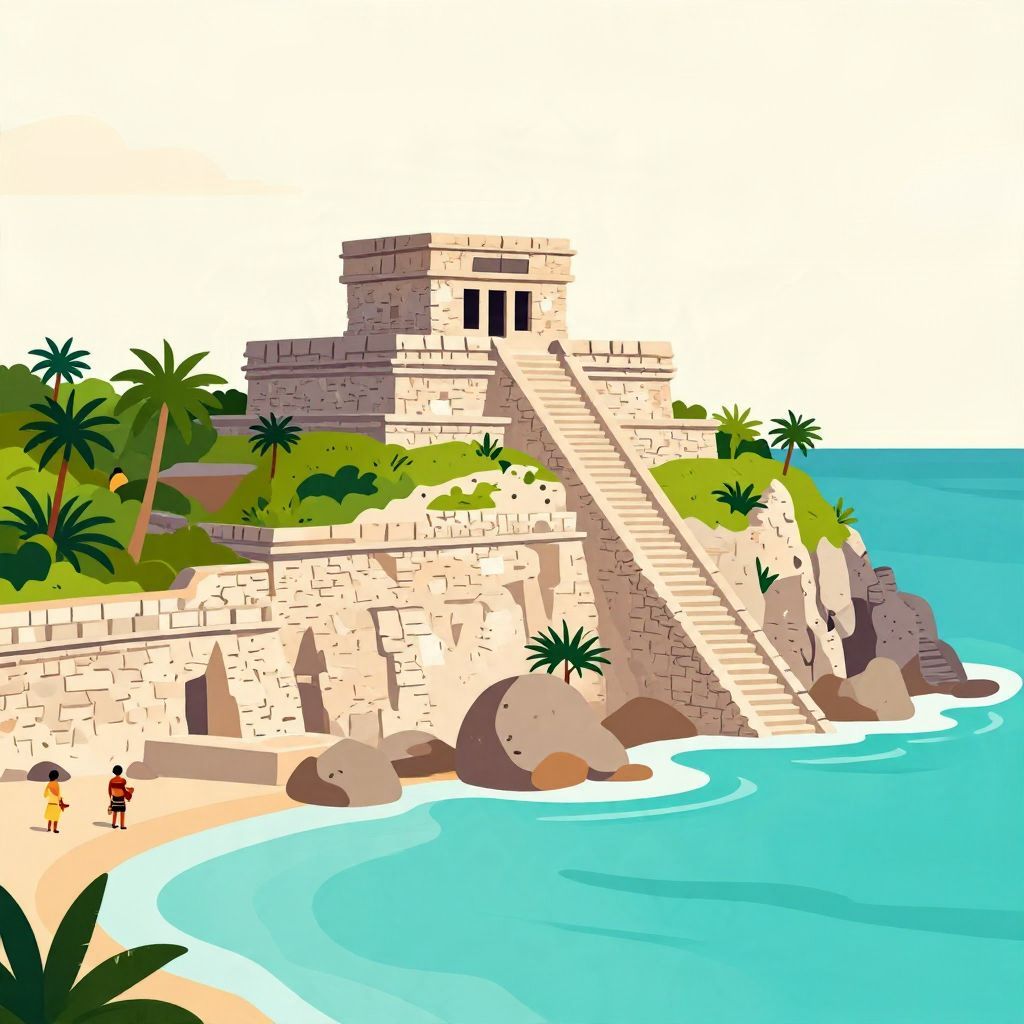
What is Tulum? The answer depends on whether you mean the modern place or its deeper past. Today, Tulum is a town and municipality on Mexico’s Caribbean coast, best known for its beaches and the nearby Maya ruins. Historically, however, the name is most closely associated with a fortified Late Postclassic Maya city that stood on the same shoreline centuries before modern tourism.
To understand Tulum properly, it helps to separate the ancient settlement from the present-day destination. The site reflects the last centuries of independent Maya urban life in the region, while the modern town grew much later around roads, commerce, and tourism in Quintana Roo.
What Is Tulum?
Tulum is both a modern coastal town in Quintana Roo, Mexico, and the name commonly used for the nearby ancient Maya city of Zama, meaning “dawn” or “morning” in Yucatec Maya. The archaeological site dates mainly to the 13th–15th centuries and is famous for its walled seafront setting, while the modern town developed in the 20th century.
The ancient city of Tulum: a Maya port on the Caribbean
The ancient Tulum was one of the last major Maya cities built and occupied before Spanish conquest reshaped the region. Unlike inland ceremonial centers such as Chichén Itzá or Cobá, Tulum occupied a dramatic coastal bluff above the Caribbean Sea. Its location made it strategically important for trade, travel, and communication along the Yucatán coast.
Why the site mattered
Tulum’s position allowed it to function as a port and coastal stronghold. Canoes could move goods along the shoreline and across the Caribbean, linking communities across the Maya world. The city was also defended by walls on its landward sides, which suggests concern for security in a period of regional competition and political fragmentation.
Archaeologists generally date the main occupation of Tulum to the Late Postclassic period, roughly from the 1200s to the early 1500s. That makes it one of the best-known examples of a late Maya coastal center, flourishing after many earlier Classic-period cities had declined or transformed.
What was Tulum called in Maya?
The name Tulum is widely used today, but it is not the original ancient name of the city. Scholars commonly identify the site with Zama, meaning “dawn,” because of its east-facing coastal position. The modern name “Tulum” is usually translated as “wall” or “fence,” a reference to the city’s defensive enclosure, though the exact historical naming process is not fully certain.
Who built Tulum, and when?
Tulum was built by Maya peoples of the Yucatán Peninsula, not by a single founder or dynasty in the way some kingdoms are remembered. Its construction belongs to a broader period when Maya political authority was more decentralized than in earlier centuries. Evidence suggests the city grew gradually rather than appearing all at once under one ruler.
A late Maya city in a changing world
By the time Tulum reached its peak, the Maya region had already experienced major shifts. Large Classic-period centers had declined centuries earlier, and power was distributed among smaller polities, trading towns, and local elites. Tulum likely served as a regional node rather than the capital of a vast empire.
Its surviving architecture includes temples, walls, and structures arranged around plazas. The most famous building is often called El Castillo, a temple perched above the sea. Other structures, such as the Temple of the Frescoes, preserve painted and sculpted elements that help historians understand late Maya ritual life and artistic traditions.
What does Tulum mean historically?
Historically, Tulum means more than a place name. It represents a transition in Maya history: a coastal city thriving in the centuries just before Spanish conquest, a site where trade and defense mattered, and a reminder that Maya civilization continued to develop long after the collapse of earlier inland centers.
Meaning of the walls
The walls at Tulum are among its most distinctive features. They are not just architectural details; they reveal how the city was organized and how its inhabitants responded to insecurity. The fortifications enclosed the main ceremonial core, leaving the sea as a natural barrier on one side. This layout helped shape the city’s identity as both sacred and strategic.
At the same time, it is important not to overstate the “fortress” image. Tulum was not simply a military outpost. It was also a religious and commercial center where elite ritual, everyday labor, and maritime exchange all took place. Like many Maya cities, it combined political, spiritual, and economic functions.
Tulum before the Spanish conquest
When Spaniards arrived in the broader Maya region in the 16th century, Tulum was still occupied or at least known as an active settlement. By then, the political landscape of the Yucatán was fragmented among multiple Maya communities and lordships. The city’s prominence was tied to this late preconquest world rather than to the earlier Classic-era system.
Contact and disruption
Spanish conquest did not destroy Tulum in one dramatic moment, but it did contribute to the wider collapse of indigenous political autonomy, trade networks, and population stability. Disease, coercion, resettlement, and colonial rule transformed the coastal region over time. As a result, Tulum’s role as a living city faded, even though the ruins remained visible.
Because the site survived as a ruin, it later became a source of historical memory and archaeological interest. That survival matters: Tulum is one of the few Maya coastal cities where the relationship between architecture, seascape, and settlement can still be studied directly.
The modern town of Tulum
The modern town of Tulum is much younger than the ancient site. It developed in the 20th century as roads improved and the eastern Yucatán became more connected to the rest of Mexico. For a long time, the area remained relatively remote, but tourism, conservation, and real estate development eventually transformed it into one of the Caribbean coast’s best-known destinations.
From archaeological site to tourist center
In the modern era, Tulum became famous first for its ruins and later for its beaches, cenotes, hotels, and eco-tourism image. The archaeological zone helped put the name on the map, but the town’s current identity is shaped by contemporary travel culture. This is why people today may mean either the ruins, the beach district, or the municipality when they say “Tulum.”
That modern popularity has created a tension familiar in many historic places: preservation versus development. The ancient city is protected as an archaeological site, while the surrounding area continues to change rapidly. Understanding Tulum therefore means seeing both the deep past and the pressures of the present.
Why Tulum is historically important
Tulum matters because it shows that Maya civilization did not end with the decline of famous inland cities. Instead, Maya societies adapted, relocated, and continued building new political and religious centers. Tulum also demonstrates the importance of coastal trade in the pre-Columbian Caribbean world.
Key historical significance
- Late Maya continuity: Tulum is evidence of active Maya urban life in the centuries before Spanish rule.
- Maritime exchange: Its location shows how important sea routes were in the Maya economy.
- Defensive planning: The walls reveal concerns about protection and territorial control.
- Cultural survival: The site preserves art, architecture, and ritual practices from a late phase of Maya history.
- Modern heritage: Tulum became a symbol of how ancient places are reinterpreted in tourism and national heritage.
Common misconceptions about Tulum
Because Tulum is so popular, it is often simplified in misleading ways. One common misconception is that it was the “largest” or “most important” Maya city. In fact, it was important, but not among the largest of the Classic period. Another is that it was purely a fortress; in reality, it was also a ceremonial and commercial center.
What historians can say with confidence
Scholars can confidently say that Tulum was a Late Postclassic Maya city, that it occupied a strategic coastal site, and that its ruins reflect a blend of ritual, trade, and defense. Less certain are some details of its political organization, including exactly which local rulers controlled it at different moments and how its original name was used in daily life.
That uncertainty is normal in ancient history. The archaeological record is rich, but it cannot answer every question. What remains clear is that Tulum was a real urban center with a distinct place in Maya history, not just a scenic backdrop for modern visitors.
So, what is Tulum?
Tulum is both a modern Mexican town and the remains of an important Maya coastal city known for its walls, temples, and seafront setting. Historically, it was a Late Postclassic settlement that helped connect the Maya world through trade, ritual, and defense. Its enduring significance lies in the way it links ancient Maya history with the living present of Mexico’s Caribbean coast.
If you want to explore more about the region’s past, related topics such as Maya civilization and Chichén Itzá history can help place Tulum in its wider historical context.