
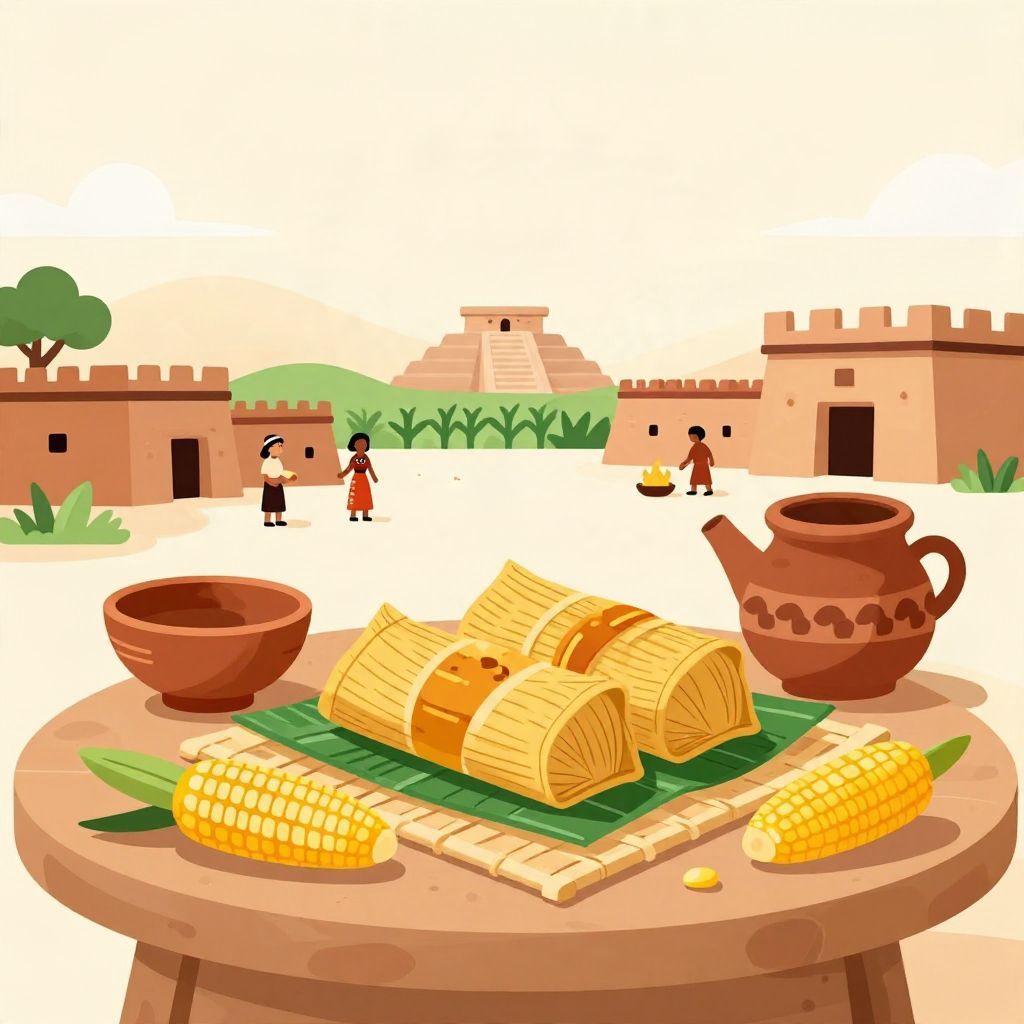
Where did tamales originate? The shortest answer is that tamales originated in Mesoamerica, especially among Indigenous peoples of what is now Mexico, long before the Spanish conquest. Archaeological and historical evidence points to a very old food tradition built around maize, a staple crop that shaped daily life, ritual practice, and regional cuisines across the Americas.
Because tamales spread widely and changed over time, there is no single “inventor” or exact birthplace in the modern sense. Instead, tamales emerged from a broad Indigenous culinary world in which maize dough was wrapped in leaves, filled, and steamed or baked for portable meals, ceremonies, and travel.
Where Did Tamales Originate?
Tamales originated in Mesoamerica, most likely in the cultural heartland of ancient central and southern Mexico, where maize agriculture developed and spread. They are an Indigenous food with deep pre-Columbian roots, later adopted and adapted across much of Latin America and beyond.
That answer reflects the strongest historical consensus. While no single archaeological site can be named as the one “true” origin, evidence from pre-Hispanic Mexico, Maya regions, and related Mesoamerican societies shows that tamales were already established long before Europeans arrived in the 16th century.
The Mesoamerican Roots of Tamales
Maize made tamales possible
Tamales are inseparable from maize, or corn, which became the foundation of Mesoamerican agriculture thousands of years ago. Once people developed ways to process maize into dough, they could shape it into many forms. Tamales were one of the most practical: portable, filling, and adaptable to local ingredients.
The basic idea was simple but powerful. Maize dough could be mixed with meat, beans, chilies, squash seeds, herbs, or other fillings, then wrapped in corn husks, banana leaves, or similar plant material and cooked by steaming or baking. This made tamales useful for both everyday eating and special occasions.
An ancient food with no single founder
Unlike a modern recipe credited to one person, tamales developed gradually within Indigenous food traditions. Scholars generally treat them as part of a long culinary continuum rather than a one-time invention. Different peoples across Mesoamerica likely created their own versions over centuries, using local plants, cooking methods, and ceremonial customs.
This is why tamales appear in many forms: sweet, savory, large, small, wrapped in different leaves, and filled with ingredients that vary by region. The diversity of tamales is itself evidence of a long history rather than a recent invention.
What Is the Historical Evidence for Tamales?
Archaeology and pre-Columbian foodways
Direct archaeological evidence for tamales is difficult because the ingredients and wrappers are organic and decay quickly. Even so, researchers reconstruct their history from surviving traces: grinding tools, cooking vessels, depictions in art, and knowledge of ancient maize-based diets. Taken together, these sources strongly support a pre-Columbian origin.
Ethnohistorical records from the early colonial period are especially important. Spanish chroniclers described Indigenous foods in the Americas, including maize dough preparations wrapped and cooked in leaves. These accounts do not “create” the tradition; they document a food that already existed when Europeans arrived.
Written records after the Spanish conquest
After the conquest of Mexico in the 16th century, Spanish observers recorded many Indigenous foods and rituals. Tamales appear in these descriptions because they were already widespread and significant. The fact that early colonial writers mention them so often suggests they were not a novelty but a well-established part of daily and ceremonial life.
These records also show that tamales were associated with social gatherings, offerings, and travel. Their portability made them especially useful in societies with long-distance movement, markets, tribute systems, and military campaigns.
How Tamales Fit into Ancient Mesoamerican Life
Food for travel, work, and ceremony
Tamales were practical in a world without modern packaging or refrigeration. Wrapped in leaves, they could be carried, stored briefly, and eaten without utensils. That convenience made them ideal for farmers, merchants, messengers, and warriors. At the same time, tamales also had ceremonial importance and were often linked to feasts and religious observances.
In many Indigenous societies, food was not merely nourishment. It carried social and symbolic meaning. Tamales could represent abundance, community, reciprocity, and devotion to sacred forces connected with maize and fertility.
Regional diversity across Mesoamerica
Although tamales are most strongly associated with Mexico today, their history extends across a broader Mesoamerican zone that included parts of present-day Guatemala, Belize, Honduras, El Salvador, and neighboring regions. Maya communities, for example, developed their own tamale traditions, some of which survive in modified form today.
This regional spread matters because it shows tamales were not confined to one ethnic group. They were part of a shared culinary landscape that crossed political boundaries and changed with local tastes, languages, and environments.
Tamales in Aztec, Maya, and Other Indigenous Traditions
The Aztec world
By the time of the Aztec Empire in the 15th and early 16th centuries, tamales were deeply embedded in central Mexican life. They appear in descriptions of markets, tribute, and ritual feasting. In the Aztec world, maize foods were central to identity, and tamales fit naturally into that system.
Aztec society also relied on organized food production and exchange. Tamales could be made in large quantities for festivals, elite households, and public ceremonies. Their versatility helped them move easily between ordinary and elite settings.
The Maya and other peoples
Maya communities also had long-standing tamale traditions, though not identical to those of central Mexico. In some areas, tamales were wrapped in banana leaves rather than corn husks, reflecting local ecology and cooking habits. The fillings and seasonings likewise varied from place to place.
These differences are important because they show tamales were never a frozen “national dish” in the ancient period. They were a family of related foods, shaped by local history and environment.
How the Spanish Conquest Changed Tamales
Continuity and adaptation
The Spanish conquest did not eliminate tamales. Instead, the food survived and adapted. Indigenous cooks continued to make tamales, while new ingredients such as pork, chicken, lard, raisins, olives, and other Old World foods were gradually incorporated into some regional recipes. This created hybrid traditions without erasing the dish’s Indigenous foundation.
That process is common in colonial history. When cultures meet under unequal conditions, older foods often persist but change in response to new ingredients, markets, and social pressures. Tamales are a clear example of continuity amid disruption.
From Indigenous staple to wider Latin American food
Over time, tamales spread beyond their original Mesoamerican setting through migration, trade, and cultural exchange. Today they are found in many countries across Latin America, each with distinct styles. Yet the historical center of origin remains Mesoamerica, especially Mexico, where the deepest documentary and cultural roots are found.
In the modern era, tamales became both a local comfort food and a symbol of heritage. Families often make them for holidays, religious celebrations, and reunions, preserving techniques passed down through generations.
Popular Legends and What Historians Can Safely Say
Not one story, but many traditions
Some popular stories try to assign tamales to a single ancient civilization or a specific moment of invention. Those stories are often oversimplified. The historical reality is more complex: tamales emerged over time within a broad Indigenous agricultural world centered on maize.
It is safer to say that tamales are an ancient Mesoamerican food tradition than to claim a precise “first tamale” or a single birthplace. The evidence supports a long development across multiple peoples and regions, not one isolated event.
Why uncertainty matters
Food history often leaves incomplete traces. Recipes were transmitted orally, ingredients changed with seasons, and organic materials rarely survive for centuries. That means historians must rely on a combination of archaeology, colonial descriptions, and living culinary traditions. The result is a well-supported origin story, but not a pinpointed date or inventor.
Why Tamales Matter Historically
Tamales are more than a beloved dish. They are a record of Indigenous innovation, agricultural knowledge, and cultural continuity. Their history reflects the central role of maize in Mesoamerican civilization and the resilience of Indigenous foodways after conquest and colonization.
Seen this way, tamales are part of a much larger historical story: how people turned a staple crop into a flexible, meaningful, and enduring cuisine. Their survival across centuries shows how food can preserve memory, identity, and community even as societies change.
So, where did tamales originate? They originated in Mesoamerica, especially in the ancient Indigenous cultures of what is now Mexico, and they spread through the wider region long before European contact. For readers interested in related food histories, you may also enjoy exploring where tacos originated and how other traditional dishes developed over time.