
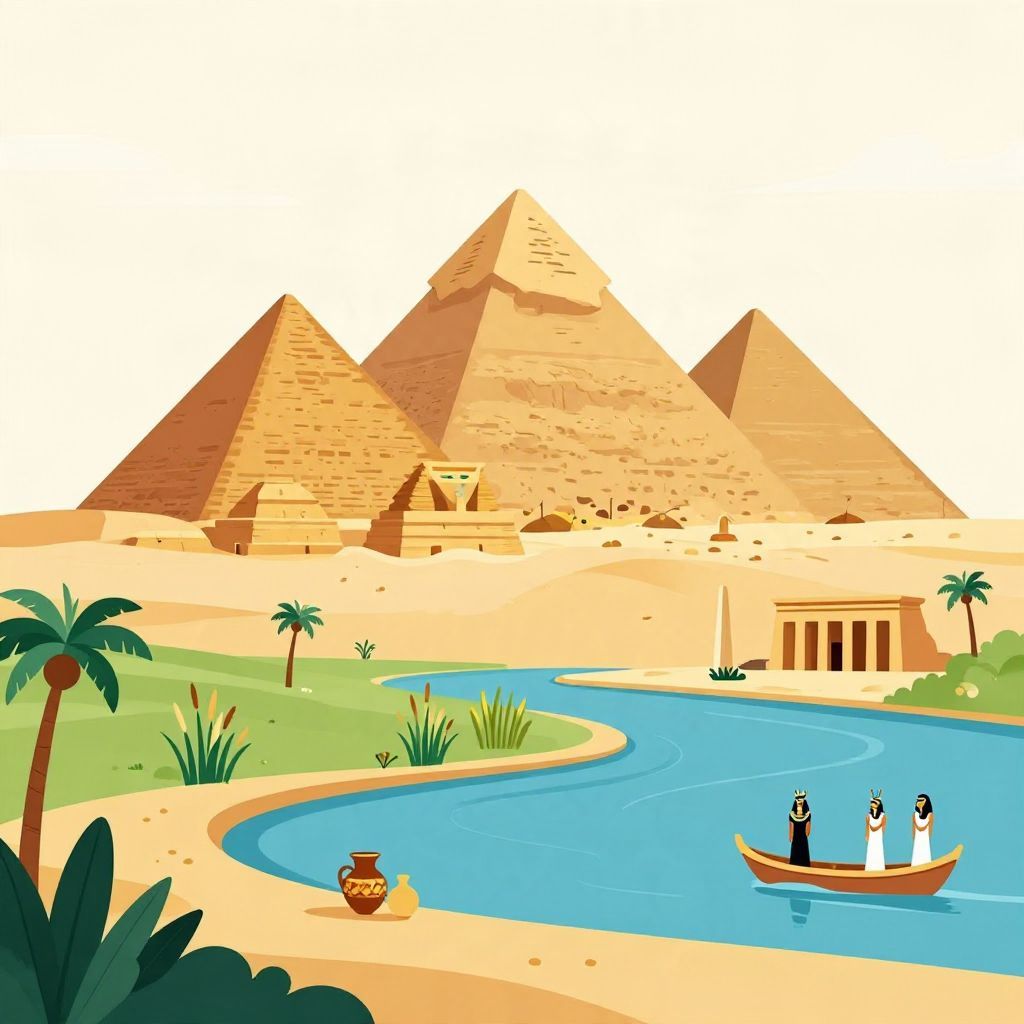
What is Egypt known for? In historical terms, Egypt is best known for the ancient civilization that grew along the Nile River, the pyramids and temples of pharaonic rule, and a cultural legacy that shaped religion, writing, architecture, and statecraft across the Mediterranean and Near East.
But Egypt is more than its monuments. Its history stretches from prehistoric river settlements to the pharaohs, from Greek and Roman rule to the Islamic era and the modern republic. That long continuity is why Egypt remains one of the world’s most recognizable historical civilizations.
What Is Egypt Known For?
Egypt is known for ancient pharaohs, the Nile River, the pyramids of Giza, monumental temples, hieroglyphic writing, and a civilization that lasted for millennia. It is also known for its strategic location linking Africa, Asia, and the Mediterranean, which made it a major center of trade, empire, religion, and politics.
The Nile: Egypt’s Historical Lifeline
Egypt’s history cannot be separated from the Nile. The river’s annual flooding deposited fertile silt in an otherwise arid landscape, allowing agriculture to flourish in a narrow band of land. This predictable environment supported dense settlement, surplus food, and centralized government long before many other ancient states emerged.
Why the Nile mattered
- It made large-scale farming possible in a desert region.
- It served as a transport route linking Upper and Lower Egypt.
- It supported taxation, storage, and state administration.
- It helped unify communities under one political system.
Because the river was so important, ancient Egyptians often saw it as part of a divinely ordered world. Geography did not determine history by itself, but in Egypt it strongly shaped how power, religion, and daily life developed.
Ancient Egypt and the Age of the Pharaohs
When people ask what Egypt is known for, they usually mean Ancient Egypt. This civilization emerged gradually in the late fourth millennium BCE, when smaller communities in the Nile Valley became united under early kings. By around 3100 BCE, the first dynasties had formed, creating one of the world’s earliest territorial states.
Pharaohs and kingship
The pharaoh was more than a political ruler. In Egyptian thought, the king helped maintain ma’at, a concept of order, balance, and rightness. This gave kingship religious significance and helped justify centralized authority. Over time, dynasties rose and fell, but the idea of sacred kingship remained central to Egyptian identity.
Egyptian history is often organized into broad periods:
- Early Dynastic Period — roughly 3100–2686 BCE
- Old Kingdom — roughly 2686–2181 BCE
- Middle Kingdom — roughly 2055–1650 BCE
- New Kingdom — roughly 1550–1070 BCE
These are modern historical categories, not labels used by the ancient Egyptians themselves, but they help explain the rise, fragmentation, reunification, and imperial expansion of the state.
The Pyramids and Monumental Architecture
Egypt is perhaps most famous for its pyramids, especially the pyramids at Giza near modern Cairo. These were built during the Old Kingdom, mainly in the 26th century BCE, as royal tombs designed to protect and honor the dead king. They were part of a broader funerary tradition that linked kingship, religion, and the afterlife.
Why the pyramids matter historically
The pyramids show the organizational power of the Egyptian state. They required skilled labor, administrative planning, quarrying, transport, food supply, and long-term coordination. They were not built by a single “mystery civilization” or by aliens, as popular myths sometimes suggest, but by human communities with advanced engineering and social organization for their time.
The Great Pyramid of Khufu is the largest and most famous of the Giza pyramids. Nearby, the Sphinx and other tomb complexes reflect the scale of royal funerary culture. Egyptian pyramid building did not last forever; later periods favored different tomb styles, especially hidden rock-cut tombs in the Valley of the Kings.
Beyond the pyramids
Egypt is also known for its temples, obelisks, tomb paintings, and colossal statues. Sites such as Karnak, Luxor, Abu Simbel, and the Valley of the Kings reveal a civilization deeply invested in religion, memory, and royal display. These monuments were not just decorative; they were part of a system that linked gods, kings, and the afterlife.
Writing, Science, and Knowledge
Another major reason Egypt is famous is its writing system. The ancient Egyptians developed hieroglyphs, a complex script used for religious inscriptions, royal monuments, and formal texts. Over time, simpler scripts such as hieratic and demotic were also used for administration and everyday writing.
What hieroglyphs tell us
Hieroglyphic writing helped preserve religious texts, royal decrees, administrative records, and literature. It also made possible a rich historical record that allows modern scholars to study Egyptian society in unusual detail. The script was deciphered in the 19th century after the discovery of the Rosetta Stone, which contained the same text in Greek, demotic, and hieroglyphic forms.
Egypt is also known for early achievements in mathematics, medicine, astronomy, and engineering. These fields were practical rather than abstract in the modern sense. Physicians treated injuries and illnesses, surveyors measured land after the Nile flood, and astronomers tracked celestial cycles for religious and agricultural purposes.
Religion, Gods, and the Afterlife
Ancient Egypt was deeply religious, and its beliefs became one of the civilization’s most enduring features. Egyptians worshipped a large pantheon of gods and goddesses, including Ra, Osiris, Isis, Horus, and Amun. Religious practice changed over time, but the connection between divine power, kingship, and cosmic order remained central.
The afterlife in Egyptian belief
Egypt is especially known for its elaborate ideas about death and the afterlife. Tombs were furnished with goods, texts, and images meant to support the deceased in the next world. Mummification preserved the body, because bodily integrity was thought to matter for survival after death. These beliefs shaped art, architecture, and ritual for centuries.
One famous episode is the reign of Akhenaten in the 14th century BCE, when the royal court promoted the worship of the Aten in a dramatic religious reform. Scholars still debate how far this was a true monotheism, but it clearly shows that Egyptian religion was not static; it could change under royal pressure and political conflict.
Egypt as an Empire and Crossroads of Power
At its height, Egypt was not only a valley civilization but also an imperial power. During the New Kingdom, Egyptian armies and administrators extended influence into Nubia, the Levant, and parts of the eastern Mediterranean. This expansion brought wealth, tribute, diplomacy, and military conflict.
Foreign rule and cultural continuity
Egypt’s later history is equally important. The country came under Persian rule in the first millennium BCE, then was conquered by Alexander the Great in 332 BCE. After his death, the Ptolemaic dynasty ruled Egypt from Alexandria, blending Greek and Egyptian traditions. Cleopatra VII, the last Ptolemaic ruler, became a symbol of the end of independent pharaonic rule when Rome annexed Egypt in 30 BCE.
Under Roman and later Byzantine rule, Egypt remained a vital grain-producing province. In the 7th century CE, Arab Muslim armies conquered Egypt, and the region gradually became part of the Islamic world. Arabic language and Islamic culture transformed public life, but Egypt retained its importance as a political and commercial center.
Egypt in the Islamic and Modern Eras
Egypt is also known for its role in medieval and modern history. Cairo became a major intellectual and political center under Muslim dynasties, especially the Fatimids, Ayyubids, and Mamluks. The city’s mosques, madrasas, and markets made it one of the great urban centers of the medieval world.
Modern Egypt
In the 19th and 20th centuries, Egypt became a focal point of imperial competition, nationalist politics, and state reform. British influence grew after the 1882 occupation, and Egyptian nationalism intensified in response. Formal independence came in 1922, though British power remained influential for years afterward. The 1952 revolution ended the monarchy and helped shape the modern republic.
Today, Egypt is known not only for its ancient past but also for its modern population, regional diplomacy, and cultural influence in the Arab world. Cairo, Alexandria, and other cities connect the country’s deep history to contemporary life.
What Makes Egypt Historically Unique?
Egypt stands out because its history shows remarkable continuity across very long periods. Civilizations rose and changed along the Nile, yet the country remained a recognizable center of power, religion, and culture for thousands of years. Few places have such a visible link between ancient monuments and later historical development.
Key reasons Egypt remains famous
- It produced one of the earliest and longest-lasting civilizations.
- Its monuments, especially the pyramids, became global symbols of antiquity.
- Its writing system and religious texts transformed how historians study the ancient world.
- Its strategic location made it central to empires, trade, and conquest.
- Its cultural influence continued through Greek, Roman, Islamic, and modern periods.
In other words, Egypt is known for much more than a single monument or dynasty. It is known for a civilization that adapted across eras while leaving behind some of the world’s most enduring historical landmarks.
Conclusion
So, what is Egypt known for? Historically, it is known for the Nile, the pharaohs, the pyramids, hieroglyphs, temples, mummies, and a civilization that helped define the ancient world. It is also known for later layers of Greek, Roman, Islamic, and modern history that made Egypt a lasting crossroads of cultures. For related reading, see what country has the most pyramids and when the Pyramids of Giza were built.