
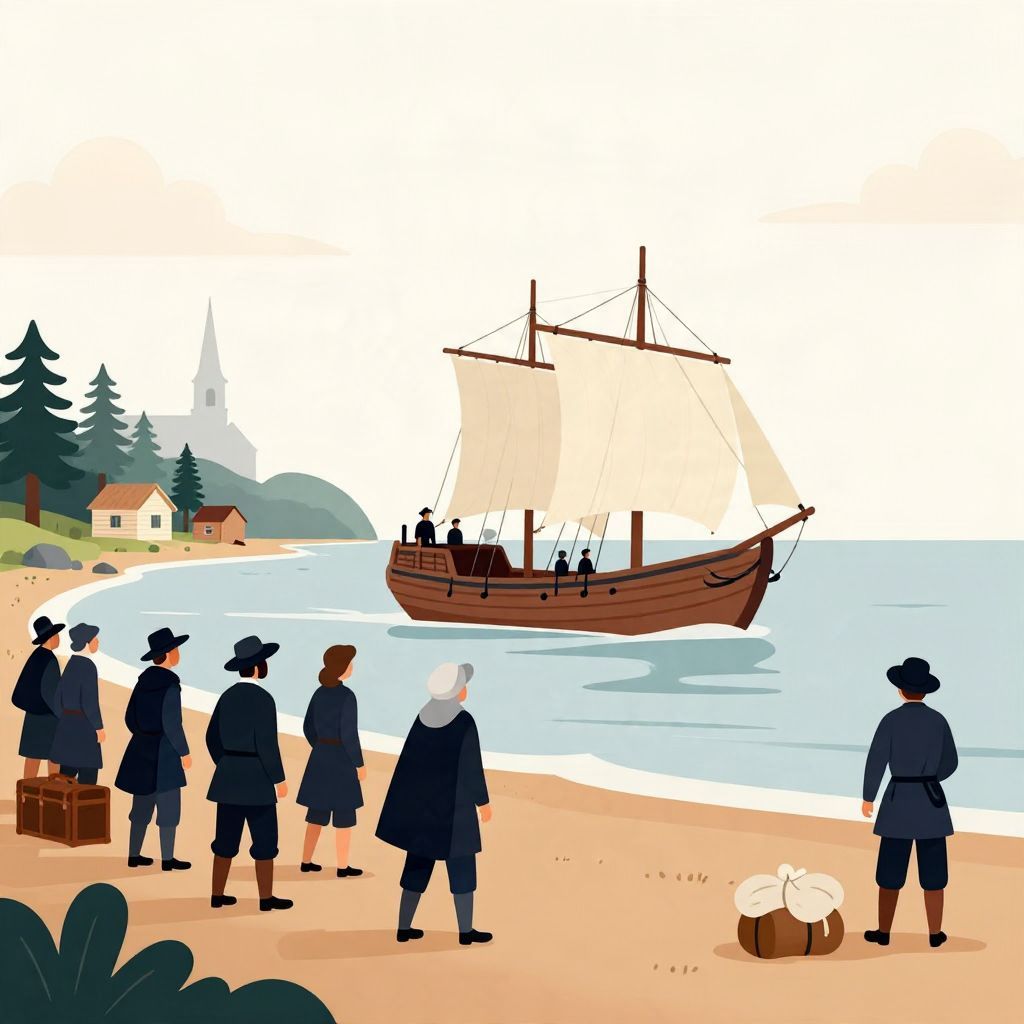
Why did Pilgrims come to America? The short answer is that they came seeking religious freedom, but the full story is more complicated. They were English Separatists who wanted to worship outside the Church of England, and they believed they could not do that safely in their homeland.
Their migration was also shaped by politics, economics, and the harsh realities of early 17th-century Europe. The Pilgrims did not arrive in North America simply to “start America”; they came as a small religious community trying to survive, first in the Netherlands and then across the Atlantic.
Why did Pilgrims come to America?
The Pilgrims came to America primarily to practice their religion without interference from English authorities. As Separatist Protestants, they rejected the Church of England’s structure and rituals. After years of pressure, exile, and uncertainty, they moved to North America in 1620 because they hoped to build a stable community where they could govern their own worship and daily life.
Religious conflict was the main cause
The Pilgrims were part of a broader wave of English Protestant dissent in the late 1500s and early 1600s. They believed the Church of England had not gone far enough in breaking from Catholic traditions. Unlike other reformers who wanted to change the church from within, Separatists wanted to leave it entirely.
That decision made them vulnerable. In England, refusing to attend Anglican services could bring fines, imprisonment, or social pressure. Under the reigns of Elizabeth I and James I, religious conformity mattered not only as a matter of faith but also as a matter of political loyalty. To the government, religious dissent could look like disobedience.
They first left England for the Netherlands
Before crossing the Atlantic, many Pilgrims fled to Leiden in the Dutch Republic around 1608. The Netherlands offered more religious tolerance than England, so it seemed like a safer place to live openly as Separatists. For a time, this solved their immediate problem.
But life in Leiden brought new difficulties. The community struggled economically, and many feared that their children were becoming too absorbed into Dutch culture. They worried about losing their English identity and their distinct religious way of life. So even though the Netherlands gave them more freedom, it did not feel like a permanent solution.
They wanted a place to preserve their community
The move to America was not only about freedom of conscience. It was also about creating a self-governing religious society. The Pilgrims hoped to build a community where they could raise their children, work together, and maintain their beliefs without outside pressure.
This goal helps explain why they accepted the enormous risks of Atlantic migration. Crossing the ocean, settling in unfamiliar territory, and surviving without established support networks was dangerous. Yet they believed the long-term reward—religious and communal stability—was worth the risk.
Who were the Pilgrims?
The Pilgrims were English Separatists, a small group of Protestant dissenters. The best-known leaders included William Bradford, who later became governor of Plymouth Colony, and William Brewster, an important elder in the community. They are often confused with the broader category of Puritans, but the two groups were not the same.
Pilgrims and Puritans were related but different
Puritans wanted to reform the Church of England from within. Pilgrims, by contrast, believed the church was beyond repair and should be separated from completely. This distinction matters because it explains why the Pilgrims were more likely to leave England altogether.
In popular memory, “Pilgrims” sometimes refers to all early New England settlers. Historically, however, the term usually refers to the small group connected to the Plymouth Colony and the voyage of the Mayflower in 1620.
The name “Pilgrims” came later
The settlers themselves did not always use the word “Pilgrims” in the way it is used today. The term became common later, especially in American historical memory. It reflects the idea of a religious journey, but it should not be taken as proof that they imagined themselves as founders of a new nation.
Why leave England instead of staying and fighting?
Many people wonder why the Pilgrims did not simply remain in England and seek reform there. The answer lies in the political and religious climate of the time. England was a kingdom where church and state were closely linked, and dissent could be treated as a threat to order.
Pressure from authorities made life difficult
Separatists were not the only religious dissenters in England, but they were among the most vulnerable. Their meetings were often illegal, and their leaders risked arrest. Even when punishment was not immediate, the constant possibility of surveillance and prosecution made normal life difficult.
For a small religious group trying to raise children and sustain a shared identity, migration seemed more practical than endless conflict.
Economic and family concerns also mattered
Religion was central, but it was not the only factor. The Pilgrims were ordinary people with families, trades, and practical needs. In Leiden, many found work that was low-paying or unstable. Some feared their children would lose English language and customs. Others worried that life in exile would never provide lasting security.
America offered the possibility—though not the guarantee—of land, independence, and a fresh start.
Why did they choose North America?
The Pilgrims did not choose America because it was easy. They chose it because it was distant, available, and outside direct English control in a way that seemed to offer room for a new settlement. North America was part of a wider age of European colonization, and English promoters were encouraging settlement there.
They needed permission and support
The Pilgrims did not simply sail off on their own. They negotiated with investors and sponsors who helped fund the voyage and expected economic returns. This arrangement was common in early English colonization. The Pilgrims hoped to settle in the Hudson River region, which was then within the English sphere of interest, though they eventually landed farther north, at Cape Cod.
The journey was therefore both religious and practical. They needed a place to live, but they also needed a legal and financial framework to make settlement possible.
The Mayflower voyage was not planned as a romantic adventure
The Mayflower voyage in 1620 was difficult, cramped, and dangerous. The ship carried both the Separatists and other passengers, often called “strangers,” who were not part of the original religious congregation. That mix created tension, but it also shows that the settlement was a practical colonial venture as well as a religious migration.
When the ship landed outside the area authorized by their patent, the settlers drafted the Mayflower Compact, a short agreement to govern themselves. This was not a declaration of democracy in the modern sense, but it did show their need to create order quickly in an uncertain situation.
What happened after they arrived?
The Pilgrims arrived in 1620 and founded Plymouth Colony. Their first years were extremely hard. They faced hunger, disease, and exposure. Many died during the first winter. Their survival depended in part on Indigenous knowledge, alliances, and local conditions that the settlers did not control.
They depended on Native peoples
Popular stories often simplify the first Thanksgiving into a peaceful meeting between equals, but the broader historical reality was more complex. Indigenous peoples already lived in the region and had their own political and social systems. The Pilgrims’ survival depended on interactions with Native communities, including the exchange of knowledge, food, and diplomacy.
Any historical account of why the Pilgrims came to America should therefore include not only their motives, but also the fact that they entered an already inhabited world.
The colony became a symbol later
Over time, the Pilgrims gained outsized importance in American memory. Their story came to symbolize religious liberty, perseverance, and the origins of the United States. But that later meaning should not be confused with their original intentions. They were not trying to create a modern pluralistic nation. They were trying to preserve a specific religious community.
What were the main causes in summary?
The Pilgrims came to America because of a combination of religious conviction, political pressure, and practical hardship. Their deepest motive was to worship according to their beliefs without interference. At the same time, they wanted a stable community, economic security, and a future for their children.
- Religious separation: They rejected the Church of England and wanted to worship independently.
- Political pressure: English authorities treated dissent as a threat to order.
- Exile in the Netherlands: Leiden offered tolerance but not long-term security.
- Community preservation: They wanted to protect their identity and faith.
- Colonial opportunity: North America offered land and the chance to govern themselves.
Why this history matters
The Pilgrims’ migration is important because it shows how religion, migration, and colonization were intertwined in early modern history. Their journey was not a simple tale of brave pioneers seeking freedom in the abstract. It was the result of conflict in England, exile in Europe, and the difficult realities of building a new settlement in North America.
So, why did Pilgrims come to America? They came mainly to escape religious persecution and to create a community where they could live according to their beliefs. Their story became famous later, but its original meaning lies in the struggle of a small dissenting group trying to survive in a world that gave them few safe choices. For related reading, see why Europeans came to America and one reason colonists came to America.