
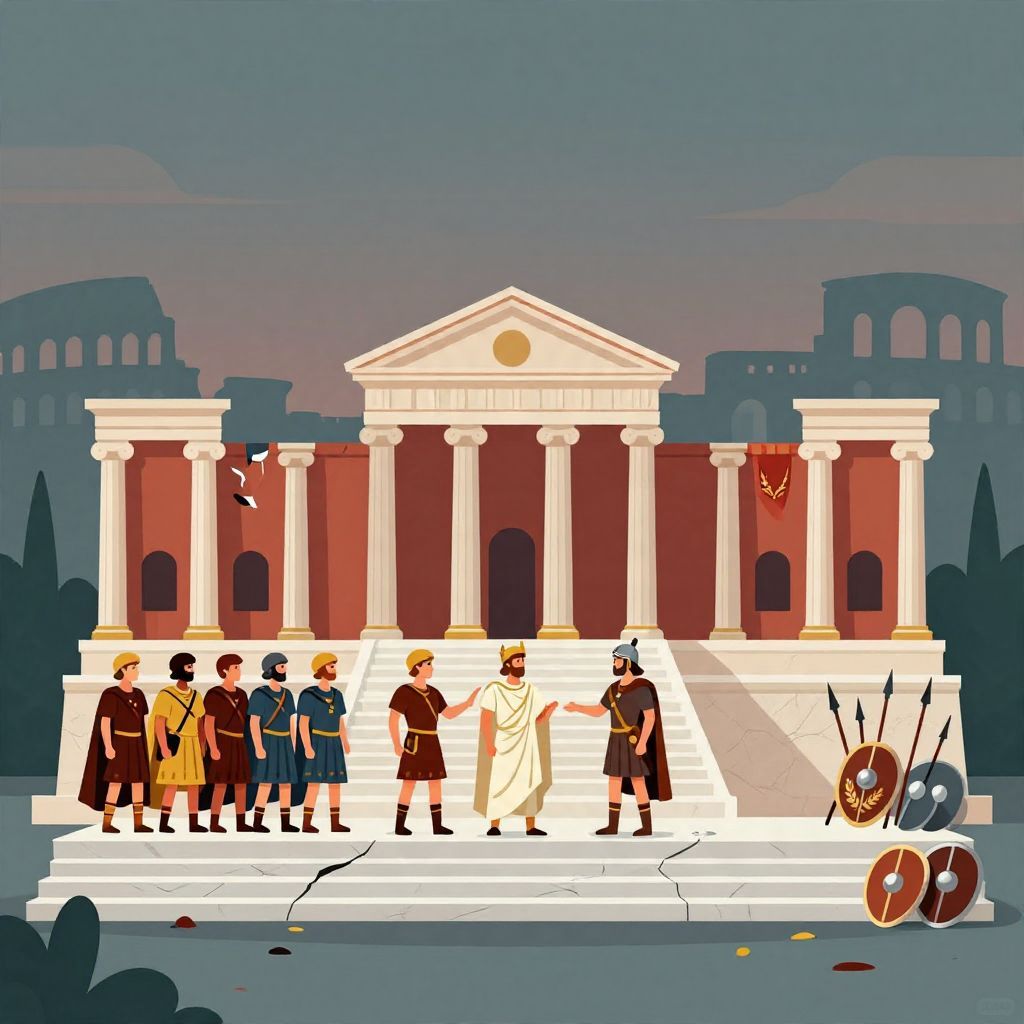
When people ask what year Rome fell, they usually mean the end of the Western Roman Empire. The most common answer is 476 CE, when the last western emperor, Romulus Augustulus, was deposed in Italy.
But Rome did not collapse in a single day. The Roman state changed over centuries, and the eastern half of the empire continued as the Byzantine Empire for nearly 1,000 more years. So the “fall of Rome” is best understood as a long political transformation rather than one dramatic event.
What year did Rome fall?
Rome fell in 476 CE in the traditional historical sense, when the Germanic military leader Odoacer removed Romulus Augustulus from the western imperial throne. This date marks the end of the Western Roman Empire, though Roman institutions, law, and culture survived in altered forms, especially in the East.
Why 476 CE is the standard answer
The year 476 became the standard date because it is the point at which the Western Empire no longer had its own emperor. Romulus Augustulus was a teenage ruler with little real power, and Odoacer, commanding the army in Italy, sent the imperial insignia to the emperor in Constantinople. That symbolic act signaled that the western imperial office had ended.
What happened to Romulus Augustulus?
Romulus Augustulus is often remembered as the “last emperor of the West,” but his situation was unusual. He ruled only briefly, from 475 to 476, and he was not a powerful sovereign in the traditional sense. His deposition was less a final battlefield defeat than the culmination of political weakness, military dependence, and administrative fragmentation in the western provinces.
Was Odoacer the one who ended Rome?
Odoacer did not destroy Rome itself. He ruled Italy after 476 and presented himself as a king, while formally acknowledging the eastern emperor. His takeover showed that the western imperial system had become too unstable to sustain a separate emperor. In that sense, 476 marks the end of the Western Roman Empire, not the disappearance of Roman civilization.
Rome did not fall all at once
The idea of a single “fall” can be misleading. The Roman Empire had been weakening unevenly for generations, and different historians choose different dates depending on what they mean by “Rome.” If the question is about the western imperial government, 476 is the usual answer. If it is about the city of Rome, the Roman people, or Roman culture, the story is much longer.
Other possible dates historians discuss
- 410 CE — Rome was sacked by the Visigoths, shocking the ancient world.
- 455 CE — Rome was sacked again, this time by the Vandals.
- 476 CE — the last western emperor was removed from power.
- 480 CE — Julius Nepos, a rival western emperor, died; some historians treat this as the final end of the western imperial line.
These dates matter because they reveal that Rome’s decline was a process. The empire lost territory, revenue, military control, and political unity over time. By the late fifth century, the western imperial office had become more a title than a functioning source of authority.
A short timeline of Rome’s fall
To understand the year Rome fell, it helps to follow the major stages that led there. The empire’s decline was shaped by internal instability, civil wars, pressure on the frontiers, and the growing power of military leaders who were not Roman by origin but were deeply embedded in Roman politics.
- 3rd century CE: Rome faced repeated civil wars, economic strain, and external invasions during the Crisis of the Third Century.
- 284 CE: Diocletian reorganized the empire to make it more manageable, dividing authority among multiple rulers.
- 330 CE: Constantine established Constantinople as a major imperial capital in the East.
- 395 CE: After Theodosius I died, the empire was permanently divided between eastern and western administrations.
- 410 CE: Visigoths under Alaric sacked Rome.
- 455 CE: Vandals sacked Rome again.
- 476 CE: Odoacer deposed Romulus Augustulus.
Why did the Western Roman Empire collapse?
There was no single cause. The western empire fell because several long-term problems reinforced one another. Political instability made it hard to govern effectively. Military defense became more expensive. Tax collection weakened. Powerful generals competed for control. At the same time, migration and warfare on the frontiers increased pressure on the state.
Political instability and civil war
Roman emperors in the later empire often came to power through military backing rather than stable succession. Rival claimants, usurpations, and short reigns made the government fragile. When emperors fought each other, frontier defense suffered, and local elites often had to choose between competing authorities.
Economic strain
The western empire struggled to maintain its tax base. Wars disrupted agriculture and trade, and some wealthy landowners avoided imperial obligations. Because the army was expensive, emperors needed reliable revenue. As control over provinces weakened, so did the state’s ability to pay troops and officials.
Military dependence on non-Roman commanders
By the late empire, Roman armies included many soldiers and leaders from outside Italy and even outside the empire’s old core regions. This was not automatically a sign of decline, since Rome had long incorporated outsiders. But it did mean that imperial power increasingly depended on negotiated loyalty rather than direct control from the center.
Pressure from migrating and invading groups
Groups such as the Goths, Vandals, Franks, and others moved into Roman territory for different reasons, including conflict with other peoples and opportunities inside the empire. Some were enemies, some were allies, and some became settled federate groups. Roman authorities sometimes used them as soldiers, but this strategy could also backfire when central authority was weak.
What happened in 476 CE?
In 476, Odoacer, a military leader in Italy, overthrew the western emperor Romulus Augustulus. Rather than appointing another western emperor, Odoacer ruled Italy in his own name while recognizing the authority of the eastern emperor. This was a decisive political change, because the western imperial court never returned.
Why this moment mattered
The fall of the western emperor meant that the Roman imperial system in the West no longer functioned as before. Local kings and military rulers replaced imperial administration in many regions. Roman law, language, and institutions continued, but they now operated under new political masters. That is why 476 is remembered as a turning point.
Did the city of Rome fall in 476?
No. The city of Rome had already lost much of its political importance before 476, and it remained inhabited after the western empire ended. The city was damaged by earlier sackings and by the shifting center of power toward Constantinople and other regional capitals. Rome remained important religiously and symbolically, especially as the center of the papacy.
Rome as a city versus Rome as an empire
This distinction is essential. The city of Rome existed long after the western imperial government disappeared. The empire’s fall was about sovereignty and administration, not the physical disappearance of the city or its people. In fact, many Roman traditions survived in medieval Europe through the church, law, architecture, and language.
What about the Eastern Roman Empire?
The Eastern Roman Empire did not fall in 476. It continued from Constantinople and is usually called the Byzantine Empire by modern historians, though its rulers called themselves Romans. The eastern state survived because it had stronger finances, a more defensible capital, and more durable administrative structures.
When did the East fall?
The Eastern Roman Empire ended much later, in 1453 CE, when Constantinople fell to the Ottoman Turks. That is why the question “what year did Rome fall?” can produce different answers depending on whether the speaker means the western empire or the Roman Empire as a whole.
How historians interpret the fall of Rome
Historians do not all describe Rome’s end in the same way. Some emphasize military collapse and invasion. Others focus on internal decline, administrative overload, or transformation rather than catastrophe. A growing number of scholars prefer the idea of late antiquity, a period in which the Roman world changed gradually into medieval Europe.
Decline or transformation?
The older story of Rome’s “fall” suggests sudden collapse, but the evidence supports a more complex picture. In many places, Roman elites kept their land, local administration, and cultural habits even after imperial rule ended. The western empire disappeared as a political unit, yet Roman civilization adapted and persisted in new forms.
Historical facts worth remembering
Several facts help clarify the answer to the question. First, 476 CE is the conventional date for the fall of the Western Roman Empire. Second, the Eastern Roman Empire survived until 1453. Third, Rome’s decline was gradual, not instantaneous. Finally, Roman influence remained powerful long after the imperial government in the West disappeared.
- Most common answer: 476 CE
- Event: Deposition of Romulus Augustulus
- Who replaced imperial rule in Italy? Odoacer
- Did Roman civilization end? No, it transformed and continued
Conclusion: the year Rome fell and why it still matters
If you need one date, the best answer to what year did Rome fall is 476 CE. But the fuller historical truth is that Rome’s fall was a long process of political fragmentation, military pressure, and institutional change. The Western Roman Empire ended, yet the Roman world lived on in the East and in the cultures that followed. For related reading, see how long the Roman Empire lasted and when the Holy Roman Empire fell.