
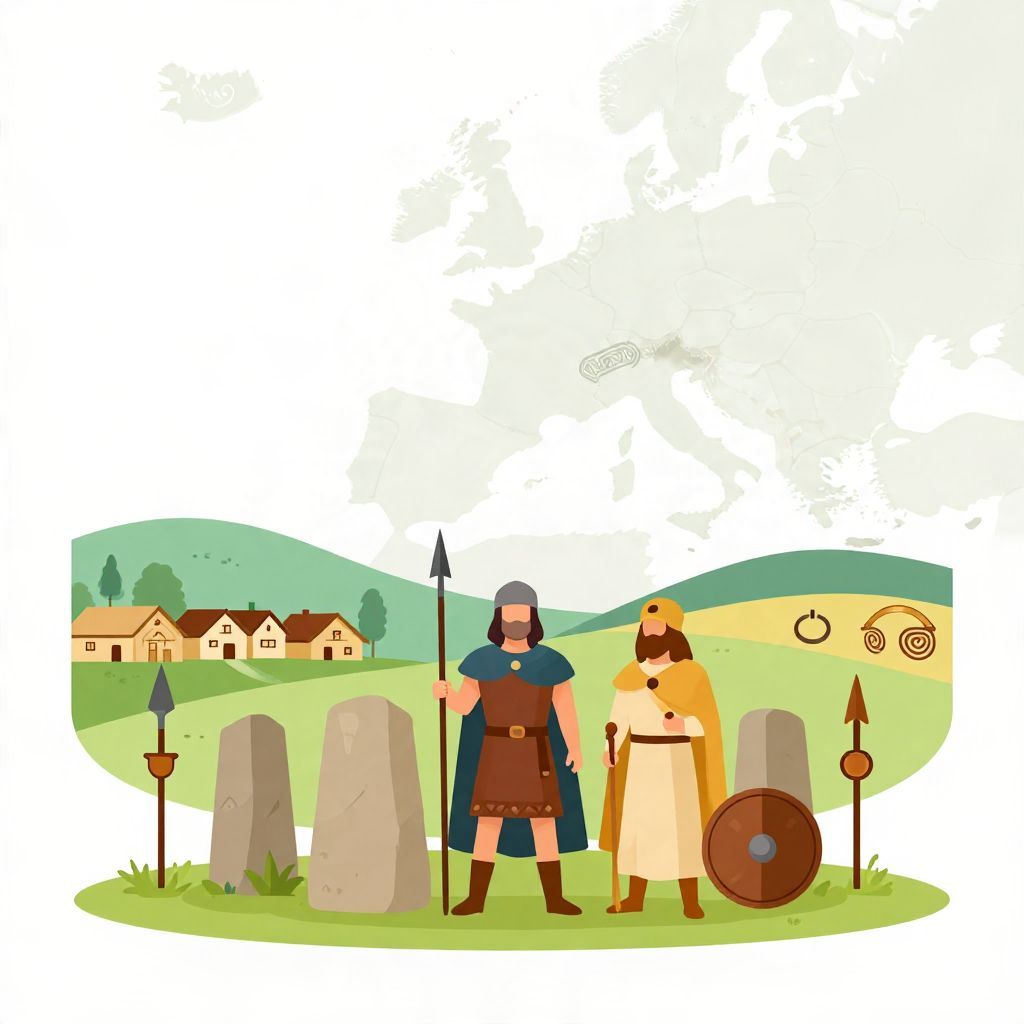
What does Celtic mean? In history, the word has referred to an ancient group of peoples in Europe, their languages, and, much later, a broader cultural identity linked especially to Ireland, Scotland, Wales, Brittany, Cornwall, and the Isle of Man.
The meaning has changed over time. It began as a term used by Greek and Roman writers for certain peoples they encountered, then evolved through archaeology, language study, nationalism, and modern cultural revival.
What does Celtic mean in history?
Celtic originally referred to ancient peoples in parts of Europe who shared related languages and some cultural traits, especially in the Iron Age. Today, it can mean a language family, a historical culture, or a modern identity connected to the Celtic nations. The exact meaning depends on context.
The ancient origins of the word Celtic
Greek and Roman usage
The earliest known written uses come from classical authors. Greek writers used terms such as Keltoi for peoples in parts of western and central Europe, while Roman writers used Celtae and related labels. These were outsider terms, not necessarily the names those communities used for themselves.
That matters because “Celtic” was never a single ancient empire or a unified nation. It was a broad label applied by Greeks and Romans to diverse groups with related languages and material cultures. Some lived in Gaul, others in Iberia, Britain, Ireland, and central Europe.
What the ancient Celts were not
They were not a single centralized civilization like Rome. They did not all share one king, one religion, or one political system. Archaeology shows regional variation, and modern scholarship emphasizes that “Celtic” is a useful umbrella term, not proof of complete uniformity.
The Celtic world in the Iron Age
When did Celtic cultures emerge?
Scholars usually associate the rise of Celtic-speaking cultures with the late Bronze Age and Iron Age, roughly from around 1200 BCE to the Roman period. Two important archaeological horizons are often discussed: the Hallstatt culture in central Europe, beginning around the 8th century BCE, and the La Tène culture, which flourished from about the 5th century BCE.
These archaeological cultures are not identical with “the Celts” in a simple one-to-one way, but they are closely associated with ancient Celtic-speaking populations. They help historians trace art styles, burial practices, weapons, trade networks, and elite social structures.
Language as the strongest evidence
Today, the strongest basis for using the word Celtic is linguistic. Celtic languages form a branch of the Indo-European language family. Ancient Celtic languages included Gaulish, Celtiberian, Lepontic, and others. The surviving modern Celtic languages are Irish, Scottish Gaelic, Manx, Welsh, Breton, and Cornish.
Linguists divide these languages into two main groups: Goidelic and Brittonic. That division helps explain the historical development of later Celtic-speaking regions, though it does not mean all speakers saw themselves as one people.
How the meaning of Celtic changed over time
From ancient label to medieval memory
After the Roman conquest of much of western Europe, many ancient Celtic languages and identities were absorbed, transformed, or replaced by Latin and later Romance languages. In Britain and Ireland, however, Celtic languages survived. Medieval people usually identified more by kingdom, tribe, territory, or dynastic loyalty than by a pan-Celtic identity.
The word “Celtic” itself was not a common everyday medieval self-description. It became much more important later, when scholars and antiquarians tried to classify the past.
Early modern scholarship and the rediscovery of the term
From the 16th to 18th centuries, European scholars became increasingly interested in ancient languages, inscriptions, and national origins. They revived “Celtic” as a scholarly category for languages and peoples in Britain, Ireland, and parts of continental Europe. This was a major turning point: the word shifted from classical geography into historical classification.
By the 18th and 19th centuries, “Celtic” was also tied to romantic ideas about ancient freedom, noble warriors, and distinctive national character. Those ideas were powerful, but they often mixed evidence with myth.
What does Celtic mean today?
A language family
In modern historical and linguistic usage, Celtic most often means a group of languages descended from earlier Celtic speech. This is the most precise academic meaning. When historians speak of Celtic language history, they are usually referring to patterns of linguistic development, migration, contact, and survival over many centuries.
A cultural identity
In popular usage, Celtic can also mean the shared or related cultural traditions of the modern Celtic nations. These include music, folklore, literature, symbols, and national revivals in places such as Ireland, Scotland, Wales, Brittany, Cornwall, and the Isle of Man. This modern identity is real, but it is also historically recent and partly shaped by 18th- and 19th-century nationalism.
A sporting and commercial label
Outside history, “Celtic” can simply be a modern brand or name, such as in sports clubs or cultural organizations. In those cases, the word often signals heritage, not ancient accuracy. That is why context is essential when interpreting the term.
Timeline of the meaning of Celtic
- Classical era, c. 5th century BCE onward: Greek and Roman writers use terms like Keltoi and Celtae for peoples in western and central Europe.
- Iron Age, c. 1200–50 BCE: Archaeological cultures associated with Celtic-speaking peoples spread across large parts of Europe.
- Roman period, 1st century BCE to 5th century CE: Many continental Celtic languages decline under Roman rule, while some survive in Britain and Ireland.
- Medieval period: Local, regional, and dynastic identities dominate; “Celtic” is not a common self-label.
- Early modern period: Scholars revive “Celtic” as a linguistic and historical category.
- 18th–19th centuries: Romantic nationalism turns Celtic into a symbol of ancient heritage and cultural distinctiveness.
- Modern era: Celtic refers to ancient peoples, language families, and living cultural traditions in selected regions.
Why historians debate the term
Identity versus classification
One reason the term is debated is that it combines two different ideas: a historical label and a modern scholarly category. Ancient peoples may not have thought of themselves as “Celtic” in the modern sense, even if they spoke related languages or shared certain artistic styles.
Historians therefore use the term carefully. It is helpful for grouping related evidence, but it can become misleading if treated as proof of a single ancient nation or race.
Archaeology, language, and nationalism
Different fields emphasize different evidence. Archaeologists study objects and burial customs. Linguists focus on language relationships. Historians examine texts and political change. Nationalist movements, especially in the 19th century, sometimes used “Celtic” to support claims of ancient continuity and cultural pride. Those claims can be meaningful, but they should not be confused with direct ancient evidence.
Historical significance of the Celtic idea
Understanding Europe before Rome
The concept of Celtic helps explain parts of Europe’s pre-Roman past that would otherwise be hard to connect. It highlights long-distance trade, elite networks, artistic traditions, and the spread of languages across a wide area. It also shows that Europe was culturally diverse long before modern states formed.
Survival and revival
The endurance of Celtic languages in Ireland, Wales, Scotland, Brittany, Cornwall, and the Isle of Man is historically significant because it shows how some local cultures survived conquest, political change, and language pressure. Later revivals of music, literature, and identity turned “Celtic” into a living cultural term rather than only an ancient one.
Popular images and historical reality
Modern images of Celts often include tartans, druids, knotwork, and warrior legends. Some of these are rooted in historical traditions, while others were amplified by later romanticism. For example, tartan and the kilt are strongly associated with Scottish identity today, but they are not simple proofs of a single ancient Celtic uniform. The same caution applies to many popular symbols.
So, what does Celtic mean?
Historically, Celtic means an ancient and later scholarly label for related peoples, languages, and cultures spread across parts of Europe, especially in the Iron Age and in the surviving language traditions of Britain and Ireland. In modern use, it also means a living cultural identity shaped by history, revival, and memory. If you want to explore related traditions, you may also find what a kilt is and what Greece is known for useful for broader cultural context.