
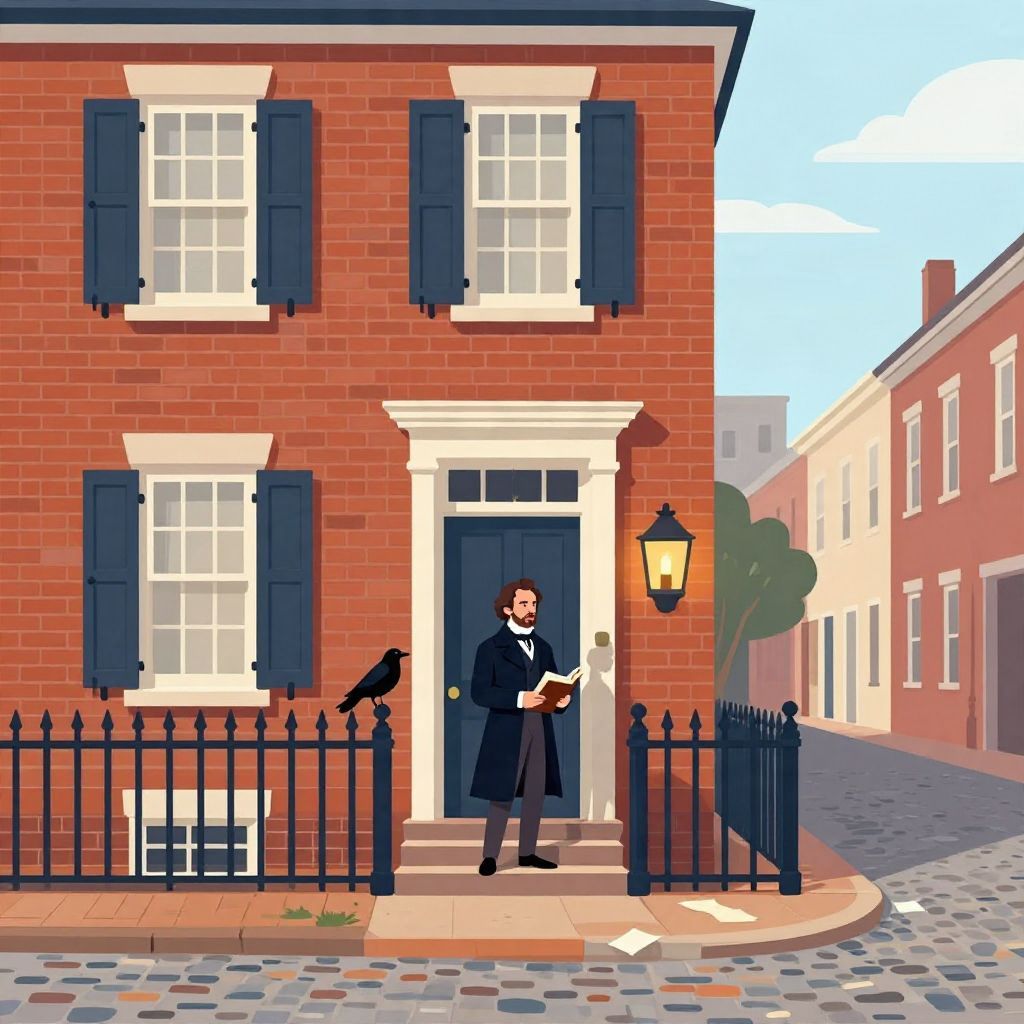
Where did Edgar Allan Poe live? The short answer is that Poe lived in several places along the eastern United States, but he is most closely associated with Boston, Richmond, Baltimore, Philadelphia, New York City, and the small cottage in the Bronx where he spent his final years. He moved often because of family changes, work, financial instability, and the demands of a literary career that never provided steady security.
Because Poe’s life was marked by travel, boarding houses, and short-term residences, the question is less about one permanent home than about the places that shaped his writing, relationships, and reputation. His movements also reflect the broader world of early 19th-century America, when writers rarely lived comfortably from literature alone.
Where did Edgar Allan Poe live?
Edgar Allan Poe lived in a series of homes in the United States, especially in Virginia, Maryland, Pennsylvania, New York, and Massachusetts. He was born in Boston in 1809, grew up mainly in Richmond and nearby areas, studied briefly in Charlottesville, worked in Baltimore, Philadelphia, and New York, and died in Baltimore in 1849 after living his last stable domestic period in Fordham, then part of Westchester County and now the Bronx.
The main places associated with Poe’s life
- Boston, Massachusetts — birthplace, 1809
- Richmond, Virginia — childhood home and later adult residence
- Charlottesville, Virginia — University of Virginia, 1826
- Baltimore, Maryland — lived at different times; died there in 1849
- Philadelphia, Pennsylvania — major working years as editor and writer
- New York City — final urban residence before Fordham and after
- Fordham, New York — final home with Virginia Poe, 1846–1849
Boston and Poe’s earliest years
Poe was born in Boston on January 19, 1809, to actors David and Elizabeth Arnold Poe. He did not remain there long. After his parents’ deaths, he was taken in by the Allan family of Richmond, Virginia, and Boston became more of a birthplace than a childhood home. Still, it marks the starting point of his life story.
Why Boston matters
Boston is important because it anchors Poe’s biography to New England, even though his later identity was shaped more by the Mid-Atlantic and the South. The city also reminds readers that Poe came from the transient world of the theater, not from a settled literary household. His early instability would follow him for the rest of his life.
Richmond, Virginia: the city most closely tied to Poe
Richmond was the city Poe lived in most consistently during his youth and where he returned as an adult. After his mother’s death, he was raised there by John and Frances Allan. Richmond gave him education, social connections, and some of the strongest personal attachments of his life, even though his relationship with John Allan later became strained.
Childhood and schooling in Richmond
Poe attended local schools in Richmond and absorbed the culture of a growing Southern commercial city. Richmond was not a literary capital, but it offered the social world that shaped his early ambitions. The city also became a place of memory in Poe’s writing and later mythology, especially because of his youthful attachments and family tensions there.
Adult return to Richmond
Poe returned to Richmond in the 1830s and 1840s, especially when working on publishing projects or visiting family and acquaintances. He also became engaged to his childhood sweetheart, Sarah Elmira Royster, though that relationship did not lead to a stable marriage. Richmond remained emotionally important, even when he could not remain there permanently.
Charlottesville and the University of Virginia
In 1826, Poe attended the University of Virginia in Charlottesville for a short period. He lived there as a student, but financial problems quickly ended the arrangement. His time in Charlottesville was brief and difficult, marked by debts, pressure, and conflict with John Allan over money.
What his university years reveal
Poe’s Charlottesville experience shows how fragile his position was. He was educated enough to aspire to a literary career, but not wealthy enough to sustain the lifestyle expected of a gentleman student. His departure from the university pushed him toward military service and, eventually, a career in writing and editing.
Baltimore: a city of family, work, and death
Baltimore appears repeatedly in Poe’s life. He stayed there with relatives, including the Clemm family, and it was in Baltimore that he spent his final days in 1849. The city is therefore both a family refuge and the place of his death, which has made it central to Poe’s later legend.
Family ties in Baltimore
Poe’s aunt Maria Clemm, his cousin Virginia, and other relatives were connected to Baltimore. These family links mattered because they provided emotional and practical support at times when Poe had little money. Baltimore was not his longest residence, but it was one of the places where personal and literary life intersected most sharply.
Why Baltimore is historically significant
When Poe died in Baltimore on October 7, 1849, the circumstances were unclear and remain partly mysterious. Historians know the date and place of death, but not every detail of his final illness or movements. This uncertainty has encouraged speculation, yet the reliable evidence only supports a cautious account: he was found in Baltimore and died there after a period of distress and confusion.
Philadelphia: Poe’s major working city
Poe lived in Philadelphia during some of his most productive years, especially in the 1830s and early 1840s. This was one of the most important publishing centers in the United States, and it gave him opportunities as editor, critic, and fiction writer. For a time, Philadelphia was where his literary career became most visible.
Boarding houses and urban mobility
Like many working writers of the period, Poe often lived in rented rooms or boarding houses rather than in a permanent family home. Philadelphia’s literary environment helped him publish stories such as “The Murders in the Rue Morgue” and develop his reputation as a critic. The city also illustrates how urban, commercial publishing shaped American literature in the 19th century.
Philadelphia’s place in Poe’s career
His years there were not carefree, but they were important. He was trying to support a household, including Virginia and Maria Clemm, while also building a name for himself. The city’s newspapers and magazines gave him a platform, but the pay was often inadequate. Poe’s Philadelphia years show both his talent and the financial precarity of literary labor.
New York City and Fordham: Poe’s final homes
Poe lived in New York City in the later 1840s, but his most famous final residence was the cottage at Fordham, then outside the city and now part of the Bronx. He moved there with Virginia and Maria Clemm in 1846. The cottage became his last stable home and is closely associated with his final poems and personal losses.
The Fordham cottage
The Fordham house is often described as Poe’s “last home,” and for good reason. It was a modest dwelling, not a grand literary retreat. In this house Poe experienced the illness and death of Virginia in 1847, one of the defining tragedies of his life. The home later became a site of literary memory and preservation.
Why the Bronx home matters
Fordham matters because it captures the contrast between Poe’s ambition and his circumstances. He was a major American writer, but he lived in a small, simple house far from literary luxury. This setting has become part of the public image of Poe: brilliant, troubled, and often struggling to maintain stability.
Did Poe have one permanent home?
No. Poe did not have a single permanent home in the modern sense. His life was shaped by repeated relocation, short-term lodging, and dependence on relatives, employers, and patrons. That instability was common for many writers in the 19th century, but Poe’s case was especially severe because of illness, debt, and family loss.
Why he moved so often
- Family change — orphanhood and dependence on the Allan family shaped his early life.
- Education and work — he moved for school, military service, and editorial jobs.
- Money problems — he frequently lacked the income needed for long-term stability.
- Publishing opportunities — literary work often required him to live near newspapers and magazines.
- Personal crisis — illness and bereavement, especially Virginia’s decline, altered his final years.
What Poe’s residences tell us about his life
Poe’s homes help explain his writing as much as his biography. The cities he lived in were centers of print culture, commerce, and change. His repeated moves show a man trying to build a career in a society that rewarded talent unevenly and offered little security to writers. His residences were not just addresses; they were part of his struggle to survive.
Historical background: American life in Poe’s era
In the early 1800s, the United States was still developing its urban and literary institutions. Writers often depended on magazines, editors, and patrons rather than royalties or stable salaries. Poe’s life illustrates this reality. His movement from city to city was not unusual for a working intellectual, but his poverty and instability made the pattern more dramatic.
Frequently asked question: where is Poe most closely associated today?
Although Poe lived in several places, he is most strongly associated with Richmond, Baltimore, Philadelphia, and Fordham in New York. If one place is chosen as the most important, Richmond often comes first because it shaped his youth and early identity. If the question is about his final home, Fordham is the best answer.
Conclusion
Edgar Allan Poe lived in many places, but his life was centered on the eastern United States, especially Virginia, Maryland, Pennsylvania, and New York. Boston was his birthplace, Richmond was his formative home, Philadelphia and New York were key literary cities, and Baltimore was where he died. His shifting residences reflect both the instability of his personal life and the realities of being a writer in 19th-century America. For related reading, see broader historical context at HistoryOrg and explore ideas that shaped the era in What Is Political Ideology?