
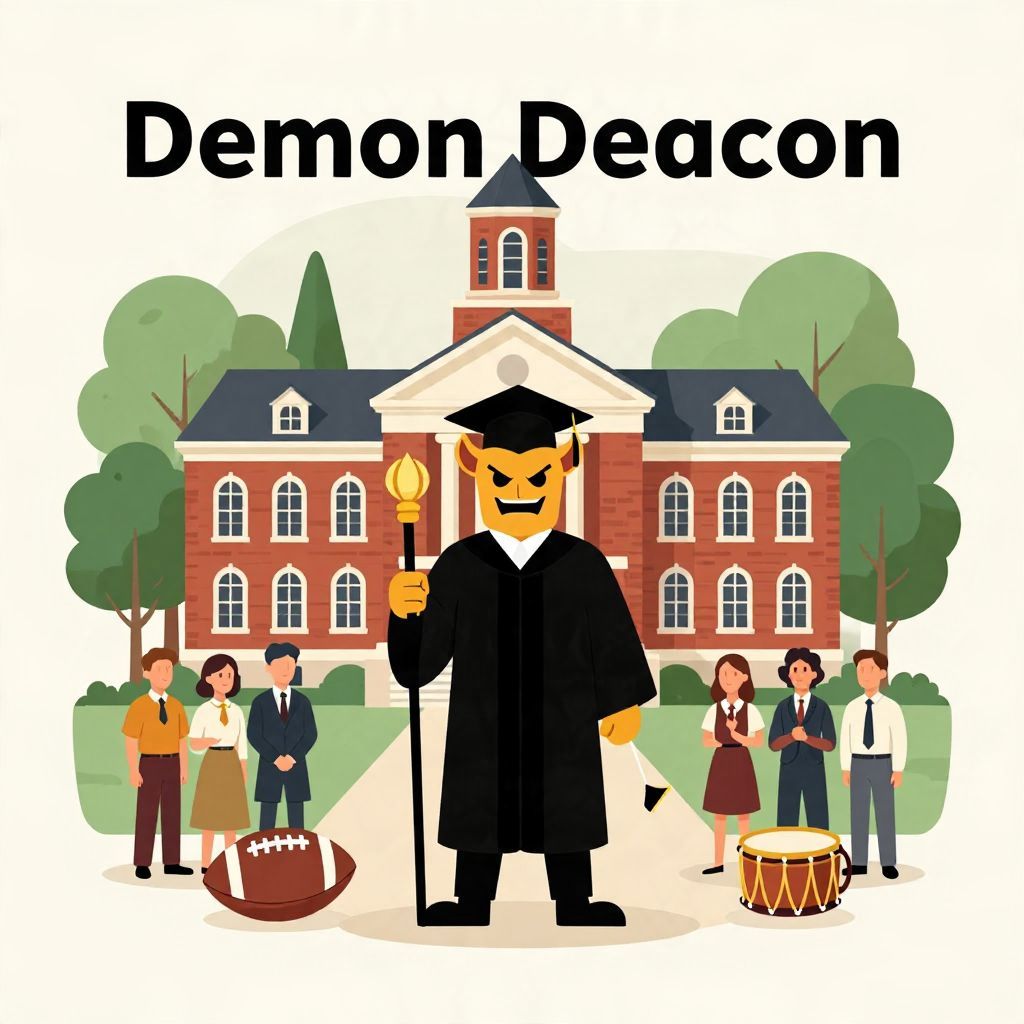
What is a Demon Deacon? The phrase sounds ominous, but in American history it usually refers not to a literal demon, but to the mascot of Wake Forest University, a private university in North Carolina. The name combines two very different traditions: the school’s old Baptist identity and a spirited, devil-like symbol used for athletics.
Understanding the term means tracing how a religious college came to adopt a provocative nickname, and how that nickname changed over time. The story reflects broader shifts in American higher education, college sports culture, and the way institutions balance tradition with public image.
What Is a Demon Deacon?
A Demon Deacon is the long-standing mascot and nickname associated with Wake Forest University, especially its athletic teams. It represents a stylized figure dressed as a gentlemanly “deacon” with devilish flair. The term is historical and symbolic, not a religious title or reference to actual demon worship.
How the Demon Deacon Name Began
The name emerged in the early 20th century, when Wake Forest was still closely tied to Baptist life and campus traditions. The exact origin is not tied to a single official founding moment, but to student culture and the growth of organized sports. Over time, the nickname stuck because it was memorable, playful, and distinct.
Wake Forest’s religious roots
Wake Forest College was founded in 1834 in Wake Forest, North Carolina, as a Baptist institution. Like many American colleges of the period, it grew out of a religious and moral framework. The word “deacon” fit that heritage, since deacons are church officers in many Protestant traditions, including Baptist congregations.
By the late 19th and early 20th centuries, however, college life in the United States was changing. Athletics became more organized, school spirit more visible, and mascots more important. Colleges wanted symbols that could rally students and distinguish one school from another.
Why “demon” was added
The “demon” part likely came from the popular language of sports rivalry rather than from theology. In American college culture, “demon” could mean fierce, energetic, or hard to beat. Combined with “deacon,” it created a striking contrast: a figure that suggested both respectability and mischief.
That contrast helped the nickname stand out. A “Demon Deacon” sounded unusual, humorous, and a little rebellious, which made it ideal for athletics. It also reflected the way college mascots often mixed irony, exaggeration, and local identity.
The Historical Meaning of the Term
The Demon Deacon is best understood as a cultural symbol rather than a literal description. It combines the university’s Baptist background with the competitive spirit of intercollegiate sports. Historically, the name shows how American colleges often transformed serious institutional identities into mascots that could be used in a lighter, public-facing way.
Religion and college identity in the South
In the American South, many colleges began with religious affiliations. As these schools expanded, they often retained traces of their original denominational identity even when they became more secular in practice. Wake Forest is a good example of this broader pattern.
The “deacon” part of the nickname preserved a connection to the school’s Baptist past, even as the “demon” part signaled a modern, competitive athletic culture. The result was not a contradiction so much as a symbol of transition: a religious college adapting to the age of big-time sports.
A mascot shaped by humor and rivalry
College mascots in the United States often developed through student humor, newspaper references, and athletic rivalry. The Demon Deacon fits that tradition. It was never meant as a solemn emblem. Instead, it became a memorable character that could appear in programs, cheers, and later on the sidelines.
Because the name was unusual, it helped Wake Forest stand apart. In the crowded world of college athletics, distinctiveness mattered. A mascot had to be recognizable on posters, in headlines, and in the imagination of fans.
How the Demon Deacon Evolved Over Time
The Demon Deacon did not always look the way it does today. Like many mascots, it changed as visual culture, school branding, and sports marketing evolved. Early representations were often informal or inconsistent, while later versions became more polished and standardized.
From campus nickname to official symbol
At first, the term functioned mainly as a nickname connected to athletics and student life. Over time, it became an official school symbol. That shift mattered because mascots in the 20th century increasingly became part of institutional branding, not just campus folklore.
As Wake Forest’s athletic profile grew, the Demon Deacon became more visible in public settings. The mascot appeared at games, in printed materials, and in school promotion. What began as a playful label became a key part of the university’s identity.
Changing visual style
The modern Demon Deacon is usually shown as a dignified, top-hatted figure with a devilish edge, often riding a motorcycle or appearing in dramatic athletic poses. This visual style is far removed from the more loosely defined early versions. The polished image reflects 20th-century trends in mascot design, when schools sought memorable logos and repeatable characters.
Importantly, the mascot’s appearance has always balanced two ideas: respectability and intensity. The “deacon” suggests formality, while the “demon” suggests energy and aggression. That tension is the core of the symbol’s appeal.
Why the Name Matters in American History
The Demon Deacon is a small but revealing example of how American institutions adapt old identities to new cultural forms. It shows how a religious college could preserve a link to its origins while embracing the spectacle of modern athletics. In that sense, the mascot is part of a larger history of American higher education.
College sports and institutional branding
By the mid-20th century, college sports had become a major public stage. Schools used mascots, colors, songs, and slogans to build loyalty. These symbols helped create a sense of continuity, even as universities changed in size, mission, and social composition.
The Demon Deacon worked because it was unusual and adaptable. It could be humorous in one setting, intimidating in another, and nostalgic in a third. That flexibility helped it survive as a recognizable emblem across generations.
Tradition without literalism
One reason the Demon Deacon remains interesting is that it is not meant to be taken literally. It is a symbolic blend of old and new, sacred and secular, reverence and play. Many American college traditions work this way: they preserve fragments of the past while reshaping them for contemporary use.
This makes the mascot historically valuable as a window into campus culture. It reveals how institutions use language and imagery to negotiate identity, especially when their origins differ from their present-day image.
Common Misunderstandings About the Demon Deacon
People unfamiliar with Wake Forest sometimes assume the term refers to a religious office, an occult figure, or some kind of historical person. None of those interpretations is correct. The phrase is a mascot name, rooted in school history and sports culture.
Not a church title
A deacon is indeed a real church role, but the Demon Deacon is not a clerical office. The word was borrowed because Wake Forest had Baptist roots and because it sounded distinctive when paired with “demon.”
Not a sign of anti-religious intent
Although the phrase may seem irreverent, it does not necessarily indicate hostility toward religion. In historical context, it reflects the playful language of student culture and athletics. Many colleges with religious origins developed symbols that became more secular or humorous over time.
Not a single historical person
The Demon Deacon is not one founder, coach, or athlete. It is a collective symbol that emerged gradually. That is why its history is best told as a cultural evolution rather than a biography.
What the Demon Deacon Represents Today
Today, the Demon Deacon remains one of the most recognizable mascots in American college sports. It represents Wake Forest’s athletic tradition, but also its long institutional memory. The mascot links the university’s Baptist beginnings with its modern identity as a major research institution and competitive sports program.
Its endurance shows how historical symbols can survive by adapting. What once may have been a campus joke became a lasting emblem because it was memorable, flexible, and tied to a real story about the school’s past.
Conclusion: A Symbol of Tradition and Change
The answer to “What is a Demon Deacon?” is that it is Wake Forest University’s historic mascot, a symbol born from the meeting of Baptist heritage and college sports culture. Its unusual name captures a broader American pattern: old traditions often survive by being remade into something new, vivid, and public-facing.
For readers interested in the history of college identity and campus symbols, related topics often include the evolution of American university mascots and the religious origins of Southern colleges.