
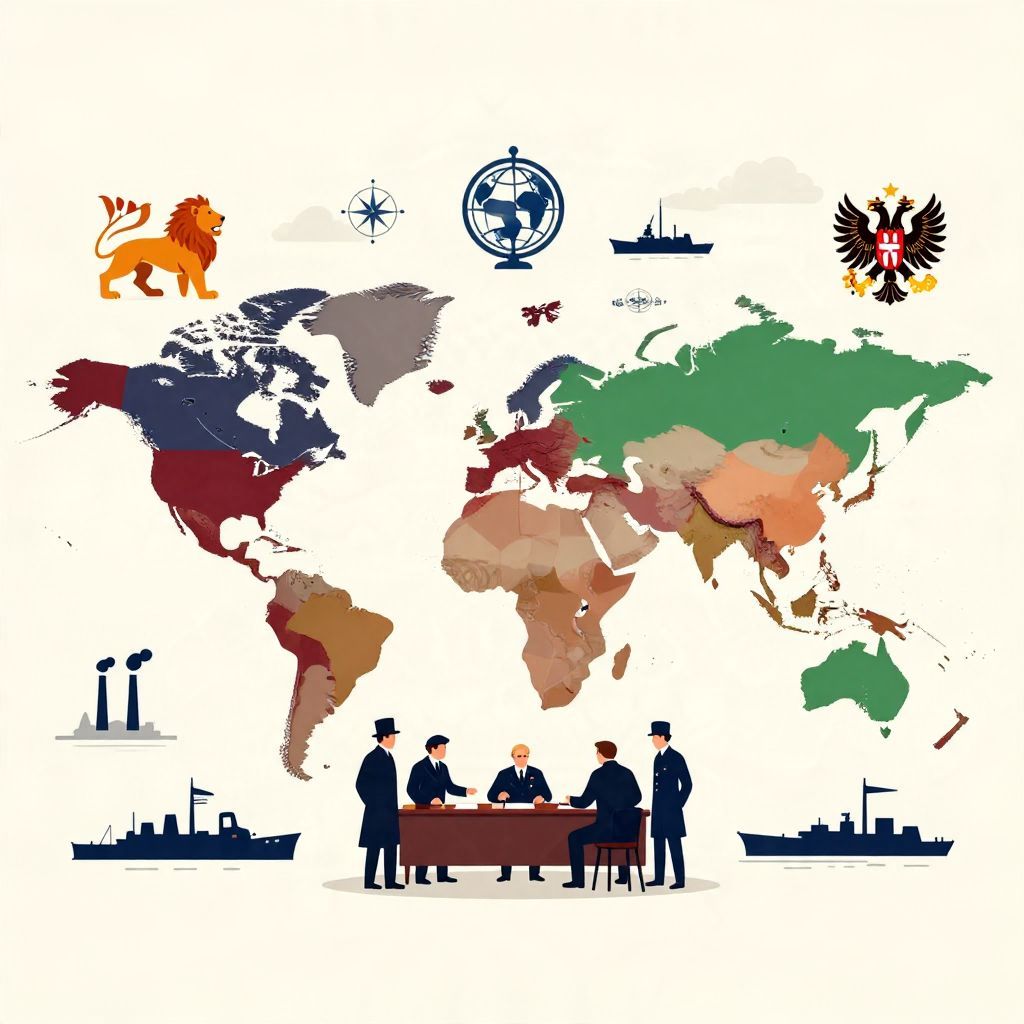
How did imperialism lead to World War I? In short, imperialism intensified rivalries among Europe’s great powers, especially in Africa, Asia, and the Balkans. Competition for colonies, prestige, trade routes, and military influence made international politics more hostile and suspicious in the decades before 1914.
Imperialism did not by itself cause the war, but it helped create the tense atmosphere in which a crisis could spread. It sharpened distrust, encouraged arms races, and tied local disputes to larger struggles for power. When the July Crisis began after the assassination of Archduke Franz Ferdinand, those imperial rivalries made compromise much harder.
How did imperialism lead to World War I?
Imperialism helped lead to World War I by turning European politics into a global struggle for power and prestige. As states competed for colonies, markets, and strategic territory, they became more suspicious of one another, built larger militaries, and formed rival alliances. These tensions did not directly cause the war, but they made a wider conflict far more likely in 1914.
What imperialism meant in the late 19th and early 20th centuries
In this period, imperialism meant the extension of political, economic, and military control over other regions, often through formal colonies or informal domination. Britain and France already had large empires, while Germany, Italy, Belgium, and others sought their own overseas possessions. The scramble for territory became a measure of national strength and status.
Empire as power and prestige
By the 1880s and 1890s, empire was not only about trade. It was also about national honor, strategic advantage, and public prestige. Leaders and newspapers often treated colonial expansion as proof that a nation was a great power. That made imperial competition emotionally charged and politically difficult to compromise over.
The scramble for Africa and Asia
The “Scramble for Africa” after about 1880 and the competition for influence in Asia increased friction among European states. Borders were drawn with little regard for local societies, and rival claims often overlapped. Even when disputes were settled diplomatically, the process left resentment and fear that other powers were gaining too much.
The main ways imperialism increased tensions before 1914
Imperialism contributed to World War I in several connected ways: it created rivalries over colonies, encouraged naval and military buildup, strengthened alliance systems, and made crises in distant regions feel like tests of national credibility. Together, these pressures turned local disputes into international confrontations.
1. Rivalry over colonies and trade
European powers competed for raw materials, markets, and strategic ports. Britain, France, and Germany in particular worried about being left behind. Colonial disputes in places such as Morocco, the Congo, and parts of East Africa did not always lead directly to war, but they deepened suspicion and hardened diplomatic blocs.
Germany’s late arrival as a colonial power mattered here. Unified only in 1871, it sought a “place in the sun,” as the German leadership put it, and this alarmed Britain and France. German efforts to expand overseas were often interpreted by rivals as evidence of aggressive intent.
2. The naval arms race
Imperialism helped fuel the naval race, especially between Britain and Germany. A global empire required a powerful navy to protect trade routes, colonies, and sea lanes. Germany’s decision to build a battle fleet challenged Britain’s long-standing naval dominance and pushed both states toward greater military spending.
This mattered because imperial empires depended on communication and transport across oceans. A strong navy was not just a symbol; it was a practical tool of imperial control. As each side expanded its fleet, the other read it as a threat, not a defensive measure.
3. Alliance politics became more rigid
Imperial competition helped harden alliances. Britain, France, and Russia drew closer together partly because each feared the ambitions of the others’ rivals. Germany, Austria-Hungary, and Italy formed the Triple Alliance, though Italy’s commitment was limited. By 1914, Europe was divided into armed camps, making diplomatic crises more dangerous.
These alliances were not created only by imperialism, but colonial and global rivalries made cooperation seem necessary. Once the powers were locked into blocs, a conflict involving one empire could quickly involve several others.
4. Crisis diplomacy became a test of credibility
Imperial disputes taught governments to treat backing down as dangerous. If a state appeared weak in one crisis, it might lose influence in future negotiations. This mentality made compromise harder in 1914. Leaders feared that retreating in the Balkans, Morocco, or elsewhere would damage their status as a great power.
Key imperial crises that raised tensions before World War I
Several prewar crises showed how imperialism could turn local disputes into major international confrontations. These episodes did not cause the war alone, but they revealed how fragile European peace had become.
The Fashoda Incident, 1898
In 1898, British and French forces confronted each other at Fashoda in the Sudan region. The crisis nearly brought the two countries to war, but France eventually backed down. The episode showed how colonial expansion could create direct military standoffs between major powers.
The Moroccan Crises, 1905 and 1911
Morocco became one of the most important flashpoints before 1914. Germany challenged French influence there in 1905 and again in 1911. These crises increased distrust and pushed Britain and France closer together. Germany’s interventions were seen by its rivals as attempts to disrupt the balance of power.
The Moroccan crises were especially important because they showed that imperial disputes were no longer isolated. A disagreement in North Africa could involve diplomacy across Europe and deepen alliance commitments. The result was not peace through negotiation, but greater polarization.
Competition in the Balkans
The Balkans were not a formal overseas empire in the usual sense, but imperial logic still applied there. Austria-Hungary and Russia both sought influence in the region, while local nationalist movements challenged imperial control. The Balkans became known as a “powder keg” because great-power rivalry and local nationalism combined so dangerously.
Austria-Hungary’s annexation of Bosnia and Herzegovina in 1908 angered Serbia and Russia. Russia saw itself as protector of Slavic peoples, while Austria-Hungary feared the spread of nationalism within its own empire. This tension was crucial in 1914, when the assassination in Sarajevo set off the July Crisis.
How imperialism connected to the outbreak in 1914
Imperialism did not directly cause the assassination of Archduke Franz Ferdinand, but it shaped the world in which the crisis unfolded. The war began in Europe, yet the major powers thought in imperial terms: about prestige, deterrence, strategic routes, and the survival of empires. That mindset made escalation more likely.
Great-power fear and miscalculation
By 1914, leaders believed that if they did not act firmly, their empire or alliance position might weaken. Austria-Hungary feared losing control in the Balkans. Russia feared humiliation and the loss of influence. Germany feared encirclement by hostile powers. Britain feared a continent dominated by a single rival. Imperial rivalry magnified these fears.
Why compromise was so difficult
Imperialism encouraged zero-sum thinking: one power’s gain seemed like another’s loss. That attitude made compromise seem risky or dishonorable. During the July Crisis, diplomatic options existed, but leaders interpreted events through a lens of competition and credibility. The result was a chain of decisions that widened a regional crisis into a world war.
Was imperialism the main cause of World War I?
Historians usually treat imperialism as one major cause among several, not the single cause. Militarism, alliance systems, nationalism, and the immediate July Crisis all mattered greatly. Imperialism’s importance lies in how it intensified those other forces and made European politics more aggressive, suspicious, and unstable.
How it worked with nationalism and militarism
Imperialism often reinforced nationalism by encouraging people to see empire as proof of national greatness. It also supported militarism, because empires required armies and navies to defend territory and project power. In that sense, imperialism was part of a broader culture of competition that made war more thinkable.
Different historical interpretations
Some historians emphasize Germany’s aggressive Weltpolitik and naval expansion. Others stress the wider imperial system, in which all the great powers pursued expansion and prestige. A balanced view is that imperialism was not a single trigger, but a structural force that made the international system more volatile before 1914.
Why imperialism mattered after the war began
Once war started, imperial empires shaped its scale and duration. Britain, France, Germany, Russia, and later other powers drew on colonial resources, troops, and trade networks. Fighting also spread beyond Europe to Africa, the Middle East, and Asia, showing that the war was truly global.
Colonial subjects were recruited, conscripted, or drawn into the conflict in many ways. The war did not simply happen in Europe; it was sustained by imperial systems that had been built over decades. In that sense, imperialism helped create both the causes and the global reach of World War I.
Conclusion
Imperialism led to World War I by intensifying rivalry among great powers, fueling naval and military competition, and turning colonial disputes into tests of national strength. It did not single-handedly cause the war, but it made Europe more divided, fearful, and willing to risk conflict. To understand 1914, imperialism must be seen as one of the key forces that made a general war possible.