
What is classical music? The answer depends on whether you mean a broad musical tradition or a narrower style from a specific period. In everyday use, the phrase usually refers to art music rooted in the traditions of Europe, especially works written for concert performance, study, and preservation rather than for immediate popular entertainment.
Historically, “classical music” is not one single genre but a long, changing tradition that stretches from medieval sacred song to modern orchestral and experimental works. Its meaning has shifted over time, and the label itself became common only after later generations looked back on earlier European music as a cultural canon.
What Is Classical Music?
Classical music is a broad term for composed art music that developed in Europe and later spread worldwide. In the strict historical sense, it can also mean the Classical period of roughly 1750 to 1820, the era of Haydn, Mozart, and early Beethoven. In everyday speech, however, it usually means the wider Western concert tradition.
The Origins of Classical Music
The roots of classical music lie in the musical life of medieval Europe, especially the Christian Church. Early written traditions of chant, theory, and notation helped preserve music across generations, making it possible to build a large repertoire rather than rely only on oral memory.
From chant to notation
One of the most important developments was the creation of musical notation. By the early Middle Ages, singers in monasteries and cathedrals used systems that gradually became more precise, allowing melodies to be recorded and transmitted. This was a major turning point: music could now be studied, copied, and refined over time.
Polyphony and complexity
As notation improved, composers began writing polyphony, music with multiple independent melodic lines. This was a defining step in the history of classical music. Instead of a single sung melody, voices could move together in carefully structured harmony, creating richer and more complex works for religious and later secular settings.
How the Tradition Developed
Classical music evolved over centuries, shaped by courts, churches, cities, and later public concert halls. It was never static. Each era added new forms, instruments, and listening habits, while also preserving older works through teaching and performance.
The Renaissance: balance and imitation
During the Renaissance, roughly the 15th and 16th centuries, composers such as Josquin des Prez and Palestrina helped define a style of smooth vocal polyphony. Music became more balanced and text-sensitive, especially in sacred works. Printing also made music easier to distribute, helping styles spread across Europe.
The Baroque era: drama and ornament
In the Baroque period, roughly 1600 to 1750, composers developed opera, concerto, sonata, and fugue. This era favored contrast, ornament, and emotional intensity. Figures such as Johann Sebastian Bach, George Frideric Handel, and Antonio Vivaldi expanded the expressive power of instrumental and vocal music. The orchestra began to take a more recognizable shape during this time.
The Classical period: clarity and form
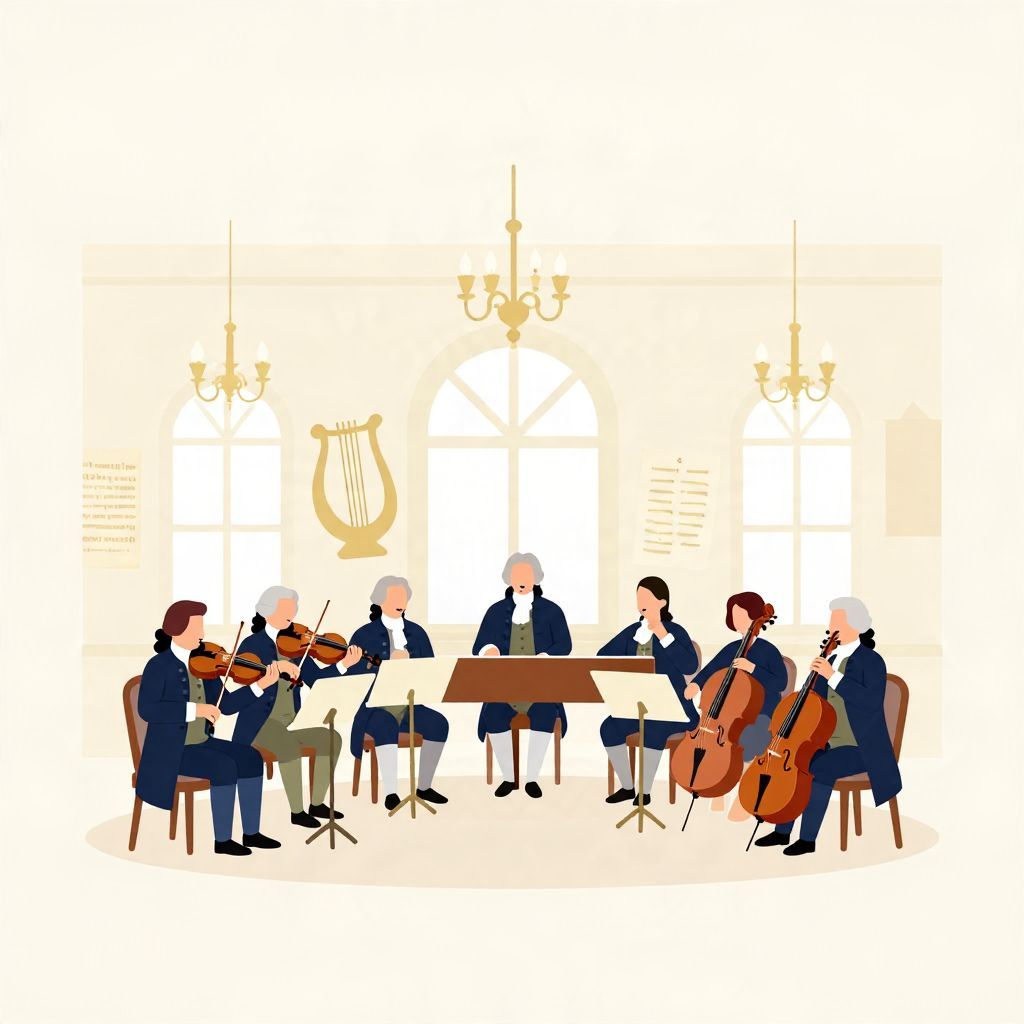
The term “classical music” is often associated most directly with the Classical period, centered in the later 18th century. This was an age of clarity, symmetry, and formal balance. Haydn and Mozart were central figures, and Beethoven began within this style before pushing beyond it. Sonatas, symphonies, and string quartets became especially important forms.
The Romantic era: emotion and expansion
In the 19th century, composers such as Franz Schubert, Frédéric Chopin, Richard Wagner, and Johannes Brahms expanded the scale and emotional range of the tradition. Orchestras grew larger, harmony became more adventurous, and music was often linked to national identity, literature, and personal expression. Concert culture also became more public and commercial.
Why the Term “Classical Music” Means Different Things
The phrase classical music can be confusing because it is used in two main ways. Historically, it can refer to the music of the Classical period. More broadly, it means the entire Western art-music tradition. The broader usage became common in the 19th and 20th centuries, when people began treating earlier European music as a canon of “classics.”
Classical as a style, not just a time period
In common modern usage, classical music is defined less by a single style than by its tradition of composition, notation, and performance. A symphony by Beethoven, a mass by Bach, and a modern orchestral work by a living composer may all be called classical music, even though they belong to very different historical moments.
The role of the concert hall
Another reason for the term’s broad meaning is the rise of the public concert. As music moved from courts and churches into concert halls, it became something to be listened to attentively and repeatedly. This helped distinguish classical music from folk traditions, dance music, and later popular music, even though the boundaries have never been absolute.
What Makes Classical Music Distinct?
Classical music is often identified by a few historical features: written composition, complex structure, long development over time, and performance by trained musicians. But these are tendencies, not rigid rules. The tradition includes devotional works, operas, chamber music, symphonies, and solo pieces, each with its own purpose and style.
Composition and notation
Unlike many traditions that rely mainly on improvisation or oral transmission, classical music has long depended on scores. Composers write music for others to perform, and those scores can be studied, revised, and revived centuries later. This has allowed a remarkably large historical repertoire to survive.
Form and development
Classical music often emphasizes large-scale structure. A piece may unfold through themes that are introduced, varied, contrasted, and resolved. This can be heard in symphonies, fugues, sonatas, and operas. The listener is expected to follow musical argument as well as melody or rhythm.
Institutions and patronage
For much of its history, classical music depended on patronage from churches, nobles, and later the public. Courts employed composers and performers; churches needed sacred music; opera houses and orchestras required audiences and funding. These institutions shaped what kinds of music were written and preserved.
Classical Music Beyond Europe
Although classical music began in Europe, it is now global. Composers and performers around the world have adopted, adapted, and transformed the tradition. In the 19th and 20th centuries, conservatories, orchestras, and opera companies spread across the Americas, Asia, Africa, and beyond.
Global adaptation and exchange
In many places, local composers blended European forms with national or regional musical ideas. This produced new traditions without erasing older ones. The result is that classical music today is not simply “European music,” but a worldwide practice with many local histories.
Modern and contemporary classical music
In the 20th century, classical music diversified further. Some composers continued tonal traditions, while others explored atonality, serialism, electronic sound, minimalism, and other approaches. Figures such as Igor Stravinsky, Arnold Schoenberg, and Philip Glass show how the tradition kept evolving rather than ending in the past.
Common Misunderstandings About Classical Music
People often assume classical music is only old, formal, or elite. Historically, that is too narrow. The tradition includes music written for worship, entertainment, ceremony, private study, and public spectacle. Some works were popular in their own time, while others were rediscovered later.
It is not the same as “old music”
Classical music is not simply music from the past. Much of it is contemporary in origin, and new works continue to be composed. The tradition survives because it is performed, taught, and reinterpreted, not because it belongs only to history.
It is not one fixed sound
There is no single “classical music sound.” Gregorian chant, a Bach fugue, a Mozart opera, a Mahler symphony, and a modern string quartet can all fall under the same umbrella, even though they differ greatly in style, scale, and purpose. The unity lies in the tradition, not in one musical formula.
Why Classical Music Still Matters
Classical music matters historically because it preserves centuries of artistic development, social change, and intellectual exchange. It reveals how Europeans and later global audiences thought about religion, power, emotion, public culture, and artistic skill. Its long written record also makes it one of the most continuous traditions in world music history.
In short, classical music is both a historical tradition and a living practice: a body of art music that began in medieval Europe, matured through the Renaissance, Baroque, Classical, and Romantic eras, and continues to evolve today. If you want to explore related history, you may also enjoy learning about the history of the orchestra and the Baroque era.