
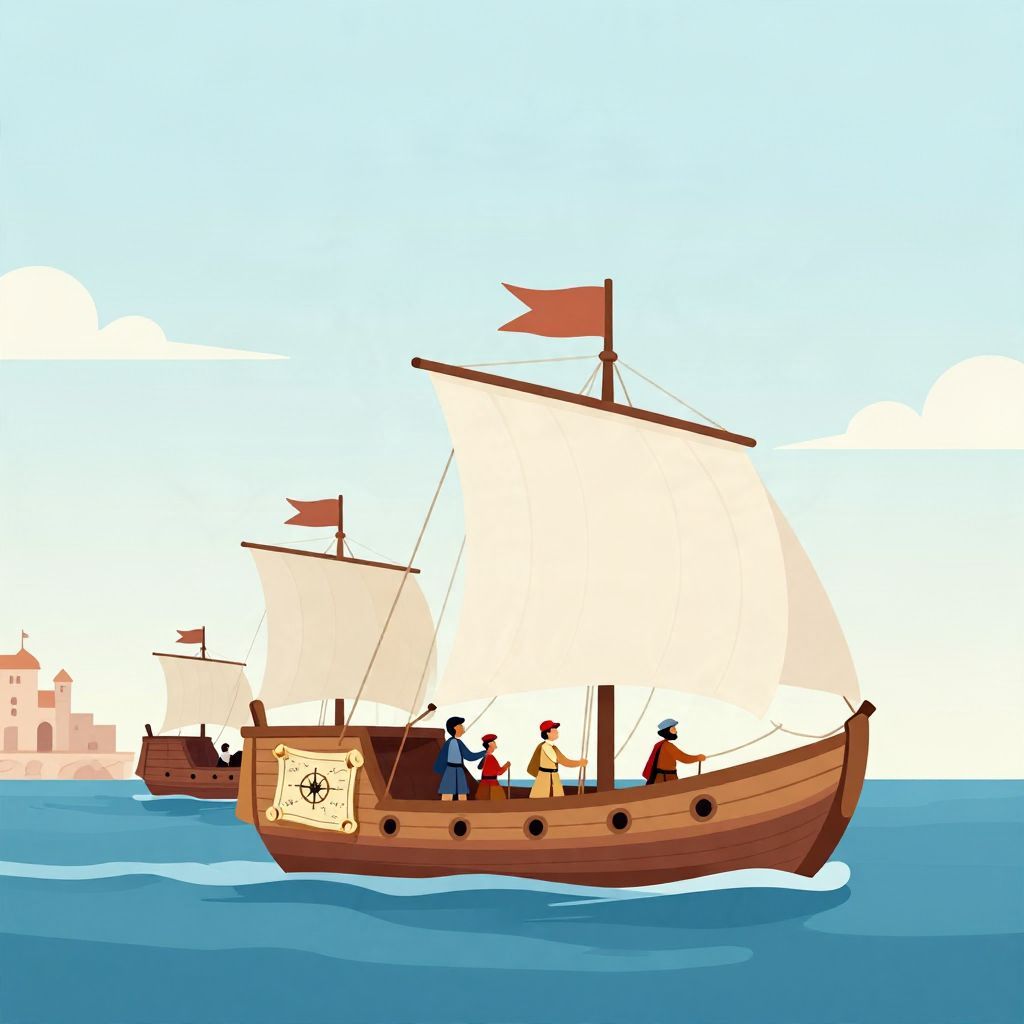
When people ask, “When did Christopher Columbus sail the ocean blue?” they are usually asking about the first voyage that brought him across the Atlantic in 1492. The famous rhyme points to the year Columbus left Spain and reached the Caribbean, beginning sustained European contact with the Americas.
The exact date matters because Columbus’s voyage was not a vague medieval legend but a documented expedition ordered by the Spanish Crown. It took place during a moment of intense competition for trade routes, wealth, and imperial power, and it changed world history in ways that were immediate, far-reaching, and deeply controversial.
When did Christopher Columbus sail the ocean blue?
Christopher Columbus set sail from Palos de la Frontera, Spain, on August 3, 1492. After a stop in the Canary Islands, his expedition crossed the Atlantic and first reached land in the Bahamas on October 12, 1492. The phrase “sail the ocean blue” is a later rhyme, not a historical quotation.
The 1492 voyage in context
Columbus’s first voyage was part of a broader European search for a western sea route to Asia. Portuguese sailors had been working around Africa, while Columbus argued that sailing west across the Atlantic would be faster. He was wrong about the distance, but he convinced Ferdinand and Isabella of Spain to support the expedition.
Why 1492 was important
The year 1492 is one of the most famous dates in world history because it marked a turning point in global contact. In the same year, Spain completed the conquest of Granada, ending the long Reconquista on the Iberian Peninsula. That victory helped free resources and attention for overseas ventures.
Columbus’s voyage was not the “discovery of America” in the literal sense. Indigenous peoples had lived throughout the Americas for thousands of years, and Norse seafarers had reached parts of North America centuries earlier. What 1492 did mark was the start of permanent, large-scale European colonization and exchange across the Atlantic.
A simple timeline of Columbus’s first voyage
Columbus’s first Atlantic crossing unfolded over several months. The journey is well documented in broad outline, though some details come from later copies and summaries of logs rather than Columbus’s original journal alone.
- August 3, 1492: Columbus departs from Palos with three ships: the Santa María, the Pinta, and the Niña.
- August 9–September 6, 1492: The expedition sails to the Canary Islands, where repairs and final preparations are made.
- September 6, 1492: The fleet leaves the Canaries and heads west into the open Atlantic.
- October 12, 1492: Land is sighted in the Bahamas, likely on an island the Taíno people inhabited. Columbus names it San Salvador.
- October–December 1492: Columbus explores parts of the Bahamas, Cuba, and Hispaniola.
- December 25, 1492: The Santa María runs aground and is lost near Hispaniola.
- March 15, 1493: Columbus returns to Spain.
What did Columbus actually find?
Columbus believed he had reached islands near Asia, often called the “Indies” in European writing of the time. In reality, he had reached the Caribbean. He never understood that he had encountered a landmass unknown to most Europeans, and he died still believing he had sailed to the edges of Asia.
Why the misunderstanding happened
Columbus underestimated the size of the Earth and overestimated how far Asia extended eastward. That mathematical error made the westward route seem much shorter than it really was. Once he arrived in the Caribbean, he interpreted the region through the geographical ideas available to him, rather than recognizing a new continent.
This mistake did not make the voyage less significant. On the contrary, it helped open a sustained era of exploration, conquest, forced labor, migration, and exchange between Europe, Africa, and the Americas.
The ships, crew, and route
The expedition was small by later standards, but it was still a major undertaking for the late 15th century. Columbus’s fleet included three vessels and a crew of roughly 90 men, though exact numbers vary by source.
- Santa María: The largest ship, and Columbus’s flagship.
- Pinta: A faster caravel, useful for scouting.
- Niña: Another caravel, known for its maneuverability.
The route began in southern Spain, moved to the Canary Islands, and then crossed the Atlantic using the trade winds. These winds pushed the ships westward, while the return journey relied on a different route through the North Atlantic winds back toward Europe.
What happened after 1492?
Columbus made three more voyages to the Americas, in 1493, 1498, and 1502. His later expeditions expanded European knowledge of the Caribbean and parts of Central and South America, but they also intensified colonization and conflict.
Immediate consequences
The first voyage led to Spanish claims in the Caribbean and eventually to broader imperial competition among European powers. It also initiated devastating changes for Indigenous peoples, including warfare, displacement, enslavement, and disease. These consequences were not accidental side effects; they were tied to the colonial systems that followed.
At the same time, the voyage began what historians often call the Columbian Exchange: the movement of plants, animals, people, diseases, and ideas across the Atlantic. Crops such as maize and potatoes eventually transformed diets in Europe, Africa, and Asia, while Old World animals and pathogens reshaped life in the Americas.
The famous rhyme and the popular memory of Columbus
The line “In 1492, Columbus sailed the ocean blue” is a modern educational rhyme, not a phrase from Columbus’s era. It became popular because it is memorable and easy to teach, especially in schools. The rhyme captures the date, but it simplifies a much more complex history.
Why the simplified version can mislead
Popular memory often presents Columbus as a lone heroic explorer who “discovered America.” That framing leaves out the Indigenous societies already living there, the violence of colonization, and the role of Spanish monarchy, sailors, navigational knowledge, and Atlantic winds. A more accurate view recognizes both the voyage’s historical importance and its human cost.
Historical facts worth remembering
Several facts help place Columbus’s first voyage in proper context:
- Date of departure: August 3, 1492.
- Date of first landfall in the Caribbean: October 12, 1492.
- Place of departure: Palos de la Frontera, Spain.
- Patrons: Ferdinand II of Aragon and Isabella I of Castile.
- Main significance: The beginning of sustained European contact with the Americas.
It is also important to note that Columbus did not “prove the Earth was round.” Educated people in Europe had long accepted a spherical Earth. The real debate was not about whether the Earth was round, but about how large it was and whether Asia could be reached quickly by sailing west.
Why the question still matters today
Asking when Columbus sailed the ocean blue is really asking when a major turning point began. The answer is 1492, but the deeper story is about encounter, misunderstanding, empire, and transformation. Columbus’s voyage connected distant worlds, but it did so through unequal power and immense suffering for Indigenous peoples.
For readers who want to explore the wider historical setting, related topics include the Age of Exploration and the Spanish Empire. You can continue with more background at HistoryOrg. The date is simple; the history behind it is not.