
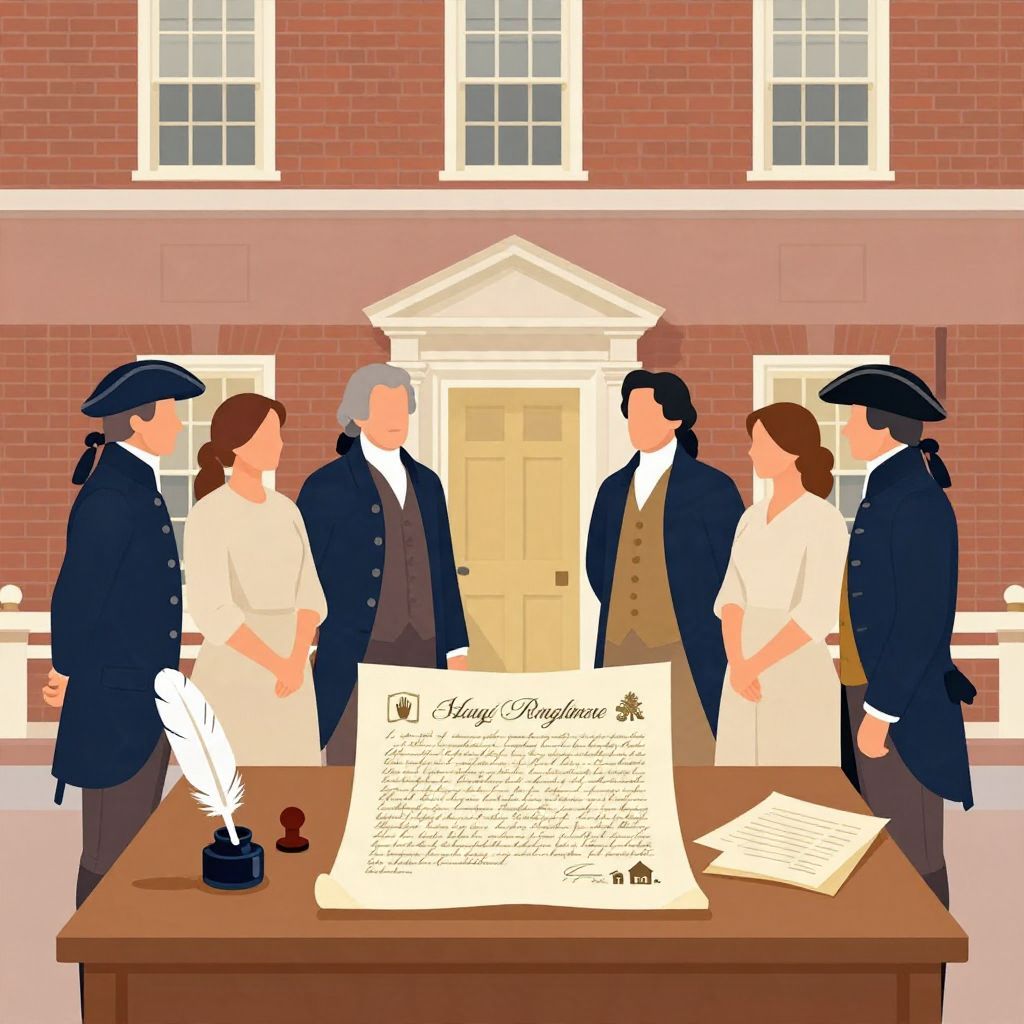
When people ask, “What are two rights in the Declaration of Independence?” they are usually looking for the famous rights named in Thomas Jefferson’s 1776 text. The most cited answer is life and liberty, though the Declaration also names the pursuit of happiness as a third natural right.
These rights mattered because the Declaration was not just announcing separation from Britain; it was explaining why independence was justified. Its language drew on Enlightenment ideas about natural rights and government by consent, and it became one of the most influential political statements in American history.
What are two rights in the Declaration of Independence?
The two rights most directly named in the Declaration of Independence are life and liberty. In the document’s famous phrase, people are endowed with “certain unalienable Rights,” including “Life, Liberty and the pursuit of Happiness.” If you need two, life and liberty are the clearest answer.
Where do these rights appear in the document?
The rights appear in the Declaration’s second paragraph, where Jefferson explains a general political principle before listing colonial grievances against King George III. This is the section that begins with the idea that “all men are created equal” and continues with the claim that people have natural rights that governments exist to protect.
The key phrase in context
Jefferson wrote that all people are created equal and are endowed with “certain unalienable Rights,” among them “Life, Liberty and the pursuit of Happiness.” The wording is important. The Declaration does not present these as privileges granted by a king or parliament. It presents them as rights that exist before government and cannot justly be taken away.
What did life and liberty mean in 1776?
In the late 18th century, life meant the basic right to exist without arbitrary destruction by government, while liberty meant freedom from unjust restraint and the ability to act as a self-governing person. These were broad Enlightenment ideals, not a detailed legal code, and their meaning could vary depending on who was applying them.
Life
“Life” in this context was a moral and political claim: government should not treat people as disposable subjects. It suggested protection from tyranny, violence, and arbitrary punishment. In practice, however, the new American republic did not extend equal protection of life to everyone, especially enslaved people, Native peoples, and many women.
Liberty
“Liberty” meant freedom from oppressive rule and the right to participate in one’s own political future. For the colonists, it especially meant freedom from what they saw as British overreach: taxation without representation, military coercion, and limits on self-government. Yet the revolutionary generation often defined liberty in ways that still excluded large parts of the population.
Why does the Declaration include the pursuit of happiness?
The third right, the pursuit of happiness, is often overlooked, but it completes the famous trio. Jefferson’s phrase reflects Enlightenment thought, especially the idea that people should be free to seek well-being, fulfillment, and a good life. It was intentionally broad rather than narrowly legal.
Not the same as guaranteed happiness
The Declaration does not promise that the government will make people happy. Instead, it says people have a right to pursue happiness for themselves. That distinction matters: the document describes a political order that should protect opportunity and freedom, not one that can control personal outcomes.
Why were these rights so important in 1776?
These rights gave the American Revolution its moral argument. The colonies were not simply rebelling over taxes or trade regulations. The Declaration claims that Britain had violated the natural rights of the people, making independence both lawful and necessary. In that sense, rights were the foundation of the case for revolution.
The political logic of the Declaration
- People possess natural rights.
- Governments are created to protect those rights.
- When a government becomes destructive of those ends, the people may alter or abolish it.
- Britain, according to the Declaration, had done exactly that.
This logic was radical for its time because it placed political authority in the people rather than in a monarch. It also framed resistance as a defense of principle, not just a bid for power.
Where did the idea of natural rights come from?
The Declaration’s rights language grew out of long intellectual traditions, especially English political thought and the European Enlightenment. Thinkers such as John Locke argued that people have natural rights and that government exists through the consent of the governed. Jefferson adapted those ideas into a powerful revolutionary statement.
Enlightenment influence
Locke’s influence is especially clear in the Declaration’s structure and logic, though Jefferson did not copy Locke word for word. The American version emphasized equality and a broader moral appeal. It was designed not as a philosophical treatise, but as a public justification for independence before the world.
Jefferson’s wording
Jefferson drafted the Declaration in June 1776, and the Continental Congress revised it before adoption on July 4, 1776. The final wording reflects both Jefferson’s ideas and the collective political judgment of the Congress. That means the document is best understood as a shared revolutionary statement, not the creation of one man alone.
Did the Declaration really mean equality for everyone?
Historically, this is one of the most important questions about the Declaration. The answer is complicated. The text uses universal language, but the society that produced it was deeply unequal. Enslavement, racial hierarchy, property restrictions, and the legal dependence of women all limited who could enjoy those rights in practice.
The gap between ideals and reality
Many historians emphasize this tension. The Declaration’s language became a powerful standard that later reformers used to challenge slavery, deny discrimination, and expand democracy. At the same time, the revolutionary generation often failed to apply its own principles consistently. That contradiction is central to understanding American history.
Why the language still mattered
Even with its limits, the Declaration created a lasting political ideal. By stating that rights are universal, it gave later Americans a language for criticism and reform. Abolitionists, suffragists, civil rights activists, and others would later appeal to the Declaration’s promise to argue that the nation had not yet fulfilled its founding ideals.
How the rights in the Declaration shaped later American history
The rights named in the Declaration did not become a legal bill of rights in 1776, but they deeply shaped American political culture. The U.S. Constitution came later, in 1787, and the Bill of Rights followed in 1791. Together, these documents helped translate revolutionary ideals into law, though imperfectly.
Influence on the Bill of Rights
The first ten amendments protect many liberties that Americans associate with the Declaration’s spirit, such as freedom of speech, religion, press, assembly, and due process protections. The wording is different, but the underlying concern is similar: government should not crush individual freedom.
Influence beyond the founding era
The Declaration’s rights language has had a long afterlife. It has been used in debates over slavery, citizenship, civil rights, women’s rights, and the meaning of equality itself. Its power comes partly from its simplicity: it names fundamental human claims in language that is easy to remember and difficult to ignore.
Common misconceptions about the Declaration’s rights
Because the Declaration is so famous, people sometimes misunderstand what it says. A few clarifications help:
- It is not the Constitution. The Declaration announces independence; it does not create the federal government.
- It does not list a full legal rights code. It offers a political philosophy, not detailed law.
- It says “pursuit of happiness,” not guaranteed happiness. The right is to seek it, not to receive it automatically.
- Its universal language was not fully universal in practice. Large groups were excluded from its benefits at the time.
So, what are two rights in the Declaration of Independence?
The two clearest rights are life and liberty. They appear in the Declaration’s famous list of unalienable rights and express the document’s core idea: people have inherent freedoms that governments must respect. The full phrase also includes the pursuit of happiness, making the Declaration one of history’s most influential statements of natural rights.
If you want to explore the broader story behind this document, you may also enjoy reading about the history of the Declaration of Independence and the causes of the American Revolution.