
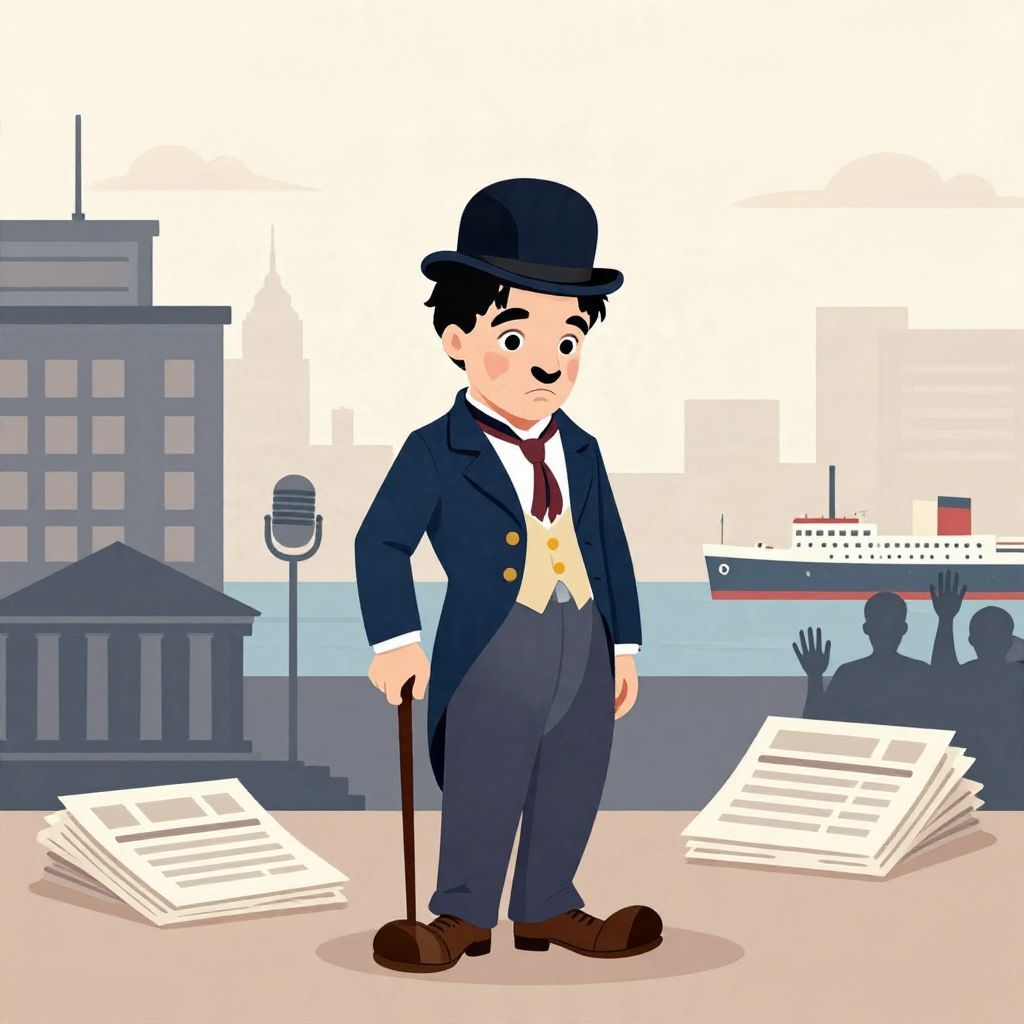
Charlie Chaplin was not formally “exiled” by a government in the legal sense, but he was effectively forced out of the United States in 1952. The main reason was political hostility during the early Cold War, when his left-leaning views, outspoken criticism of U.S. society, and unconventional private life made him a target of anti-communist suspicion.
After leaving for Europe, Chaplin was denied re-entry to the United States, and he chose to settle in Switzerland. His case became one of the most famous examples of how Cold War politics, public morality campaigns, and federal investigations could combine to drive a major cultural figure out of America.
Why was Charlie Chaplin exiled?
Charlie Chaplin was effectively exiled because U.S. authorities and public critics came to see him as politically suspect and morally controversial. In the anti-communist climate of the late 1940s and early 1950s, his criticism of capitalism, his associations with progressive causes, and accusations about his private life made him vulnerable. When he traveled abroad in 1952, the U.S. government revoked his re-entry permit, and he never returned to live in America.
The political climate that pushed Chaplin out
Chaplin’s departure cannot be understood apart from the Red Scare. After World War II, the United States entered a period of intense fear of communism, espionage, and subversion. Public figures were pressured to prove their loyalty, and anyone with left-wing sympathies, labor activism, or anti-establishment views could face suspicion. Chaplin, though not a Communist Party member, was often treated as if he were one.
Chaplin’s politics made him a target
Chaplin had long been sympathetic to social reform and had criticized inequality, war, and corporate power in his films and public remarks. During the 1930s and 1940s, this put him at odds with conservative critics. His film Modern Times and later Monsieur Verdoux were read by some as attacks on capitalism and conventional morality. In the Cold War atmosphere, such criticism could be framed as disloyalty rather than artistic expression.
Anti-communism turned suspicion into action
By the late 1940s, anti-communism had become a powerful force in American politics and culture. Congressional investigations, blacklists, and loyalty campaigns affected Hollywood especially hard. Chaplin was not the only entertainer targeted, but he was unusually prominent and vulnerable because of his international fame and his refusal to conform to patriotic expectations.
Was Charlie Chaplin actually deported?
Not exactly. Chaplin was not deported after a criminal conviction or formal immigration hearing in the usual sense. Instead, when he sailed to Europe in September 1952 for the premiere of Limelight, U.S. officials informed him that his re-entry permit had been revoked. He could have applied to return, but he decided not to do so. In practical terms, this amounted to exile.
The 1952 turning point
The key event came while Chaplin was abroad. The U.S. Attorney General announced that Chaplin would need to answer questions about his political and moral character if he wanted to re-enter the country. Rather than submit to what he saw as a humiliating process, Chaplin settled in Switzerland with his wife, Oona O’Neill, and their children. He remained there for the rest of his life.
The role of morality, scandal, and public opinion
Politics alone did not drive Chaplin out. Public criticism of his private life also played a major role. For years he had been accused of scandalous behavior in his relationships with younger women, and several paternity and custody disputes had damaged his reputation. In the moral climate of mid-century America, these accusations reinforced the idea that he was somehow un-American.
Why his private life mattered so much
Chaplin’s personal life had always attracted attention, but in the 1940s it became a political liability. Opponents used moral outrage to weaken him, blending sexual scandal with ideological suspicion. This was common in the era: public morality and political conformity often worked together. A celebrity who seemed improper in private could be portrayed as dangerous in public life.
Public hostility built over time
Chaplin had already become controversial before 1952. Some Americans resented his foreign birth, his accent, and his refusal to become a U.S. citizen. Others disliked his social criticism and his refusal to play the patriotic celebrity role expected during wartime and after. By the early 1950s, he had many enemies and few defenders in official circles.
How the U.S. government treated Chaplin
The U.S. government did not ban Chaplin from making films, but it made his position in America increasingly unstable. Federal scrutiny, public accusations, and the possibility of immigration action created pressure that was difficult to resist. The revocation of his re-entry permit in 1952 was the decisive act that ended his American residence.
No single accusation explains everything
It would be too simple to say Chaplin was driven out for one reason only. He was not exiled solely because of politics, nor solely because of scandal. His case was the result of overlapping pressures: Cold War anti-communism, resentment toward his social criticism, and a culture that punished nonconformity. Together, these forces made him politically unwelcome.
Why Chaplin chose not to fight to stay
Chaplin could have tried to contest the government’s decision, but he was weary of American hostility and skeptical that fair treatment was possible. By 1952 he had already spent years facing criticism from newspapers, politicians, and moral crusaders. Switzerland offered privacy and stability, and he chose exile rather than a public legal battle in a country that had turned against him.
His decision was also practical
Chaplin was older, internationally famous, and financially secure enough to live elsewhere. Unlike many lesser-known targets of the Red Scare, he did not need to remain in the United States for his career to survive. His move abroad was therefore both a protest and a retreat: a refusal to submit, and a practical solution to a hostile environment.
What happened after his exile?
Chaplin’s exile became a symbol of Cold War intolerance. In later decades, many Americans came to see his treatment as excessive and embarrassing. He remained internationally admired, and his reputation eventually improved in the United States. In 1972, he returned briefly to receive an honorary Academy Award, a public acknowledgment that contrasted sharply with the suspicion that had driven him away.
The meaning of his return
His 1972 visit did not erase what had happened in 1952, but it did show how historical judgment can change. The man once treated as a suspect outsider was later celebrated as one of cinema’s greatest artists. That shift reflects a broader reassessment of the Red Scare and the damage caused by political fear.
Historical significance of Chaplin’s exile
Chaplin’s case matters because it reveals how culture, politics, and public morality intersected in mid-20th-century America. He was not removed because of a single proven crime, but because he became a symbol onto which many anxieties were projected. His exile shows how easily fame could turn into vulnerability when nationalism and suspicion dominated public life.
In the end, Charlie Chaplin was exiled because the United States no longer trusted him. The combination of anti-communist politics, criticism of his social views, and scandal over his private life made his continued presence politically inconvenient. His forced departure remains one of the clearest examples of how the Cold War shaped American culture and punished dissent.