
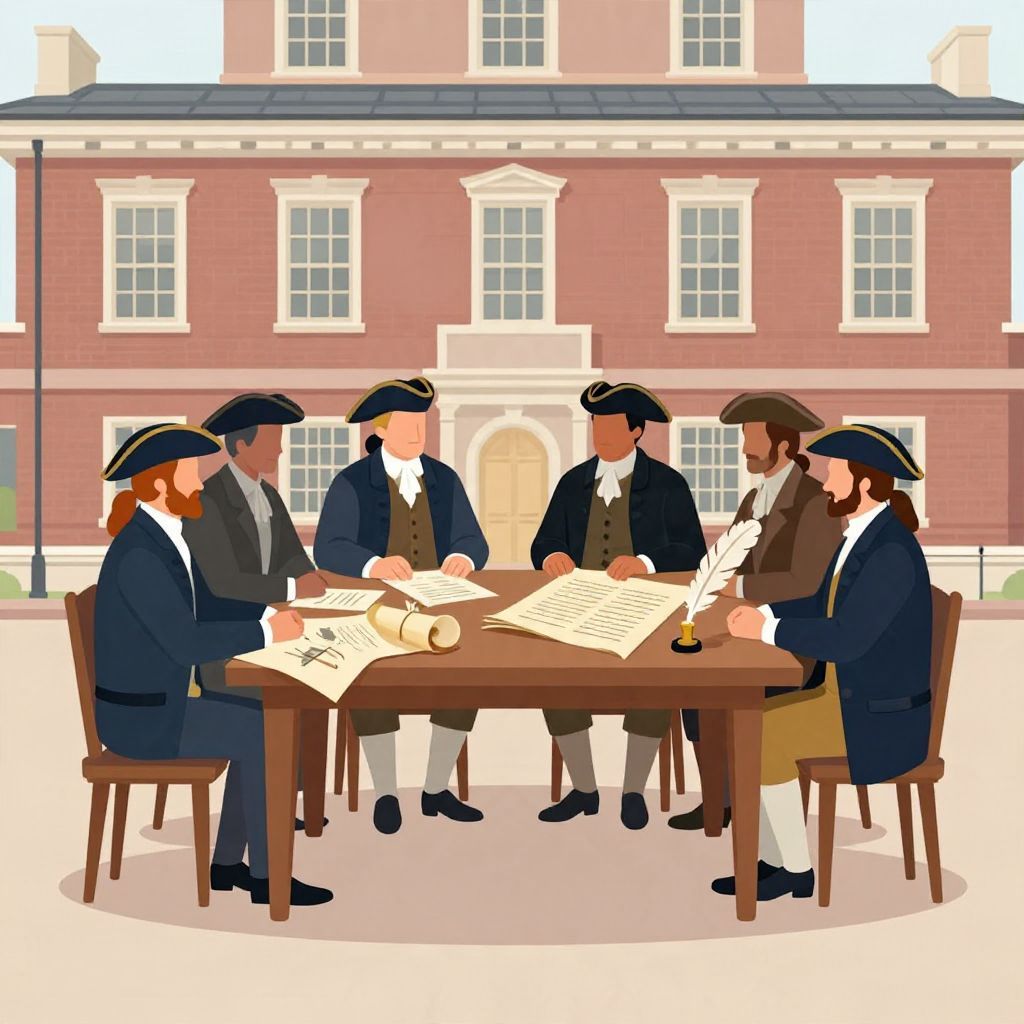
Why were the Articles of Confederation replaced with the Constitution? In short, the Articles created a national government that was too weak to solve the new United States’ biggest problems after the Revolution. Congress could not reliably raise money, regulate trade, or enforce its decisions, and the states often acted like separate countries.
By the mid-1780s, many American leaders concluded that the Confederation needed a stronger framework. The Constitution, drafted in 1787 and ratified in 1788, was designed to keep the advantages of union while giving the federal government enough power to govern effectively.
Why Were the Articles of Confederation Replaced With the Constitution?
The Articles of Confederation were replaced because they produced a government that was too weak to manage the nation’s finances, trade, diplomacy, and internal stability. After the Revolution, Americans wanted to preserve state independence, but experience showed that the Confederation could not solve urgent problems or command respect at home and abroad.
What the Articles of Confederation Actually Did
The Articles, ratified in 1781, were the first national constitution of the United States. They created a “league of friendship” among the states rather than a strong central state. Congress existed, but it had limited authority and depended on the states for money, troops, and enforcement.
A government built to avoid tyranny
Many Americans in the 1770s feared concentrated power because of their experience with British rule. The Articles reflected that caution. They gave most power to the states and kept the central government deliberately weak. That design helped protect liberty in one sense, but it also made collective action difficult.
Major limits of the Articles
- Congress could not directly tax citizens.
- It could not regulate interstate or foreign trade.
- It had no independent executive branch to enforce laws.
- It had no national court system to settle disputes.
- Amending the Articles required unanimous approval, making reform nearly impossible.
The Main Problems That Pushed Americans Toward Change
The replacement of the Articles was not caused by one event alone. It was the result of several connected crises that revealed how hard it was to govern a new republic with a weak central authority. Economic trouble, political conflict, and public unrest all exposed the system’s flaws.
1. The national government could not raise enough money
After the Revolutionary War, the United States owed large debts to soldiers, foreign lenders, and domestic creditors. Congress asked the states for funds, but many states refused or paid only part of what was needed. Without the power to tax directly, the national government struggled to pay debts or support itself.
This financial weakness damaged American credibility. If Congress could not meet its obligations, foreign governments and investors had little reason to trust the new nation. The inability to manage money became one of the strongest arguments for creating a stronger federal system.
2. Trade disputes hurt the economy
Under the Articles, each state could set its own trade rules, tariffs, and commercial policies. That meant neighboring states sometimes treated one another like rivals. Merchants faced inconsistent regulations, and the nation had no unified trade policy to deal with Britain, Spain, or other powers.
Economic fragmentation made recovery after the war harder. Many leaders believed that a stronger central government was necessary to create a stable market, encourage commerce, and negotiate effectively with foreign nations.
3. Congress lacked the power to enforce its decisions
Even when Congress passed measures, it often had no practical way to make states obey. The national government had no executive branch and no real enforcement mechanism. If a state ignored a congressional request, the central government usually had to hope for cooperation.
This was a serious problem in a country made up of jealous, independent states. A government that could not act decisively risked becoming irrelevant.
4. Shays’ Rebellion alarmed many leaders
In 1786–1787, an armed uprising in western Massachusetts, commonly known as Shays’ Rebellion, shocked political leaders. Farmers and debtors protested foreclosures, taxes, and economic hardship. Although the rebellion was not a national revolution, it suggested that state governments and the Confederation could be vulnerable to disorder.
For many elites, the uprising was evidence that the republic needed a stronger structure to maintain public order. Not everyone interpreted the event the same way, but it clearly intensified the push for reform.
5. Foreign policy problems exposed weakness
The Confederation government struggled to defend American interests abroad. Britain retained forts in the Northwest Territory for years after the war, and Spain restricted American access to the Mississippi River. These issues mattered because the United States needed secure borders, trade routes, and international respect.
Without a stronger national government, the country could not respond effectively to foreign pressure. The weakness of the Confederation made the United States look divided and vulnerable.
Why the States Agreed to Replace the Articles
By 1787, many leaders had concluded that the Articles were not repairable in their existing form. The Constitutional Convention in Philadelphia was originally called to revise the Articles, but delegates quickly realized that a more fundamental redesign was needed. The result was the Constitution, a new framework that balanced state and national power more effectively.
The Constitutional Convention of 1787
Delegates met in Philadelphia from May to September 1787. Prominent figures such as James Madison, George Washington, Alexander Hamilton, and Benjamin Franklin played important roles, though the final document was the product of compromise among many delegates with different interests.
The convention did not simply strengthen the old system. It replaced it with a new one. That was a major political decision, and it reflected the belief that the Confederation’s structural weaknesses could not be fixed by minor adjustments.
Key changes in the Constitution
- A stronger national government with power to tax, spend, and regulate commerce
- An independent executive branch headed by a president
- A federal judiciary to interpret laws and resolve disputes
- A system of checks and balances to prevent any one branch from dominating
- Representation based partly on population, not just equal state votes
These changes were meant to solve the core problems the Articles had created. The Constitution gave the federal government real authority while still preserving state governments within a federal system.
Was the Constitution Just About More Power?
Not exactly. The Constitution was not simply a power grab by nationalists, though some supporters did want a stronger central state. It was also an attempt to make republican government workable over a large territory. The challenge was to create enough authority to govern without recreating monarchy or dictatorship.
A balance between liberty and order
Many Americans feared both anarchy and tyranny. The Constitution tried to solve that tension by dividing power among branches and between the federal government and the states. In that sense, it was a compromise document shaped by competing concerns, not a straightforward rejection of revolutionary ideals.
Different interpretations among historians
Historians have long debated whether the Constitution was mainly a response to practical failure, elite self-interest, or genuine republican concern. The evidence suggests it was all three to some degree. The Articles had real defects, but the push for replacement also reflected the interests and political vision of leaders who wanted a more stable union.
Ratification and the End of the Articles
The Constitution did not automatically replace the Articles. It had to be ratified by the states. Supporters, known as Federalists, argued that the new government was necessary for survival. Opponents, called Anti-Federalists, worried that the Constitution gave too much power to the central government and lacked explicit protections for individual rights.
The Constitution was ratified in 1788, and the new government began operating in 1789. The Articles of Confederation effectively ended as the Constitution took effect. Later, the Bill of Rights was added in 1791 to address some Anti-Federalist concerns.
Why the Replacement Mattered
The shift from the Articles to the Constitution was one of the most important turning points in American history. It marked the move from a loose alliance of states to a functioning federal republic. The new system proved more durable because it could raise revenue, regulate national affairs, and respond to crises.
At the same time, the Constitution did not erase the tensions that had existed under the Articles. Debates over federal power, states’ rights, taxation, and representation continued throughout American history. Still, the Constitution provided a framework strong enough to hold the nation together and flexible enough to survive change.
The Articles of Confederation were replaced because they could not meet the practical demands of governing a new nation. The Constitution emerged from that failure as a more effective, though still contested, solution. For related reading, see the Constitution’s opening words on self-government and when the United States was founded.