
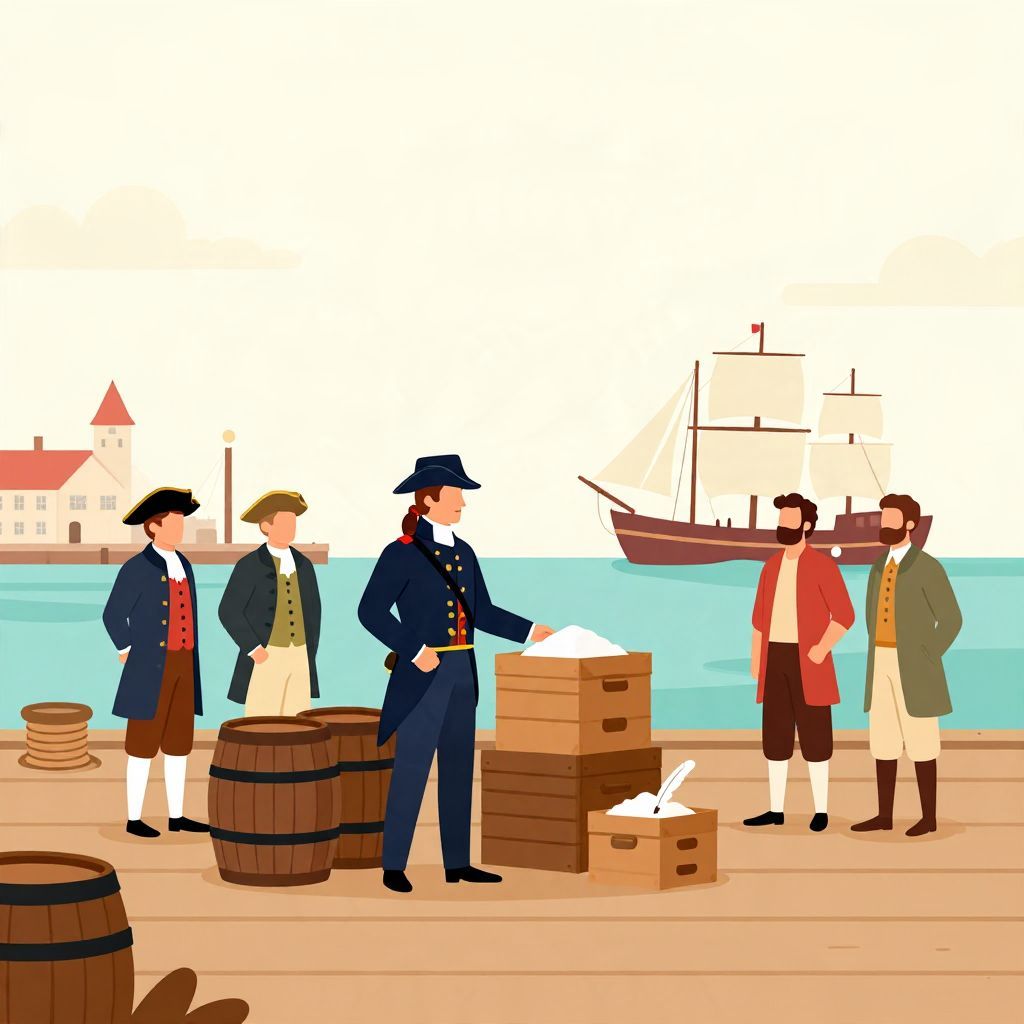
The Sugar Act was a British law passed in 1764 that taxed imported sugar, molasses, and other goods in the American colonies. It was part of Britain’s effort to raise revenue after the costly Seven Years’ War and to tighten control over colonial trade.
To many colonists, the Sugar Act was more than a tax. It marked a shift in British imperial policy and became one of the early flashpoints in the growing conflict that eventually led to the American Revolution.
What Is the Sugar Act?
The Sugar Act was a revenue law enacted by the British Parliament in 1764 that lowered the tax on molasses but strengthened enforcement against smuggling. Officially called the American Revenue Act, it aimed to increase customs collections in the colonies and regulate trade more effectively. Colonists saw it as a troubling assertion of Parliament’s power over them.
Why Did Britain Pass the Sugar Act?
Britain passed the Sugar Act because the empire was deeply in debt after the Seven Years’ War, which ended in 1763. The war had expanded British territory in North America, but it also left the government with major financial burdens. British leaders believed the colonies should help pay for imperial defense and administration.
The law also responded to widespread smuggling. For decades, merchants in New England and elsewhere had evaded older trade regulations, especially the Molasses Act of 1733, which had imposed a high duty on molasses imported from non-British colonies. In practice, that earlier tax was often ignored or reduced through bribery and lax enforcement. The Sugar Act tried to make the system work.
The Molasses Act and the problem of smuggling
The Molasses Act had set a high tariff on molasses from French and Dutch Caribbean colonies, but it was difficult to enforce and was widely bypassed. Since molasses was crucial for making rum, colonial merchants had strong incentives to keep trading with cheaper foreign suppliers. The Sugar Act lowered the official duty but increased customs enforcement, making it a more serious threat to colonial commerce.
What Did the Sugar Act Change?
The Sugar Act changed both trade rules and the way Britain enforced them. It reduced the duty on foreign molasses from six pence to three pence per gallon, but it also made collection more efficient by expanding customs oversight, authorizing stricter searches, and using vice-admiralty courts to try smugglers without local juries. These measures made the law far more effective than earlier regulations.
Main provisions of the law
- Lowered the duty on molasses imported into the colonies.
- Placed taxes on additional imports such as sugar, wine, coffee, and certain textiles.
- Strengthened customs enforcement and anti-smuggling measures.
- Used admiralty courts, which reduced the influence of colonial juries.
- Required more detailed records and tighter oversight of trade.
In theory, the lower duty should have made trade more legal and less costly. In practice, the stronger enforcement alarmed merchants, shipowners, and distillers who had grown used to a looser imperial system. The issue was not only the amount of money collected but also the principle behind it.
Why Did Colonists Oppose the Sugar Act?
Colonists opposed the Sugar Act because they believed Parliament was taxing them without their consent. Many argued that only their own elected colonial assemblies had the right to levy internal taxes. Even though the Sugar Act was framed as a trade regulation, colonists saw it as a new kind of imperial taxation that threatened their political liberties.
Merchants were especially angry because the law targeted their profits and disrupted established commercial networks. In port cities such as Boston, Newport, and New York, the Sugar Act touched everyday business. It also raised a larger constitutional question: did Parliament have unlimited authority over the colonies, or did colonial assemblies retain meaningful control over taxation?
The issue of representation
The phrase “no taxation without representation” became famous later, but the basic idea was already taking shape. Colonists did not necessarily demand direct representation in Parliament; rather, many insisted that they could not be taxed by a legislature in which they had no elected members. This disagreement became a central theme of the imperial crisis.
How Was the Sugar Act Enforced?
Britain enforced the Sugar Act through customs officers, naval patrols, and admiralty courts. These courts handled maritime and trade cases and did not use juries in the same way colonial courts did. That made convictions easier to obtain and reduced opportunities for local resistance. The government hoped this would discourage smuggling and increase revenue.
Enforcement was uneven, but the very attempt mattered. Many colonists interpreted the new procedures as evidence that Britain was willing to override local legal traditions. In a society that valued English rights and customary liberties, the use of distant courts and stricter supervision felt intrusive.
What Was the Historical Significance of the Sugar Act?
The Sugar Act mattered because it was one of the first major imperial measures to trigger broad colonial protest in the 1760s. It did not cause the American Revolution by itself, but it helped create the political climate in which later resistance grew. It showed that disputes over trade could become disputes over sovereignty, rights, and empire.
After the Sugar Act, British policy continued to harden. The Stamp Act of 1765 provoked even stronger opposition, and the sequence of imperial laws deepened colonial distrust. The Sugar Act therefore belongs to the early phase of the road to revolution, when many colonists were still trying to define their relationship with Britain rather than seeking independence outright.
How it fit into the road to revolution
- 1763: Britain ends the Seven Years’ War with major debts and a larger empire.
- 1764: Parliament passes the Sugar Act to raise revenue and enforce trade laws.
- 1765: The Stamp Act intensifies colonial resistance and broadens protest.
- 1770s: Imperial tensions continue to rise, eventually leading to revolution.
Did the Sugar Act Actually Lower Taxes?
In a narrow sense, yes: the Sugar Act lowered the legal duty on molasses. But that does not mean colonists experienced it as a tax cut. Because the law made smuggling riskier and enforcement stronger, many merchants expected to pay more in practice. The law was designed to increase actual revenue, not simply to set a lower rate on paper.
That distinction is important for understanding colonial anger. The British government was not merely changing numbers; it was changing the relationship between law and commerce. What had once been a negotiable, loosely enforced system became a more regulated imperial structure.
How Did Different Colonies React?
Reaction varied by region, but commercial colonies in New England were among the most vocal critics. Their economies depended heavily on Atlantic trade, rum production, and access to Caribbean markets. Merchants and shipowners feared that tighter customs enforcement would damage their livelihoods. In some places, protests took the form of petitions, pamphlets, and organized resistance.
Southern colonies were also affected, though often less directly. The Sugar Act became part of a wider conversation about whether Parliament could regulate colonial economies for imperial benefit. Over time, that question united many colonists who had different local interests but shared a growing suspicion of British authority.
Was the Sugar Act the First Tax on the Colonies?
No. Colonists had long lived under imperial trade regulations, and earlier duties such as the Molasses Act had already existed. What made the Sugar Act significant was not that it was the first law of its kind, but that it was enforced more seriously and combined revenue raising with a clearer assertion of parliamentary power. That combination made it politically explosive.
The Sugar Act in Historical Memory
In later American history, the Sugar Act came to symbolize the beginning of organized resistance to British taxation. It is often remembered alongside the Stamp Act, the Townshend Acts, and the Tea Act as one of the key steps toward independence. Historians generally treat it as an early but important turning point rather than a single decisive cause.
Its lasting significance lies in how it exposed a deeper conflict: the British Empire wanted tighter control and more revenue, while many colonists wanted the freedom to manage their own affairs. That conflict would only sharpen in the years that followed.
In Short: What Is the Sugar Act?
The Sugar Act was a 1764 British law that taxed colonial imports, especially molasses, while tightening customs enforcement to stop smuggling and raise revenue after the Seven Years’ War. It angered many colonists because it strengthened Parliament’s control over trade and raised the larger issue of taxation without representation. For that reason, it became an important early cause of the American Revolution.