
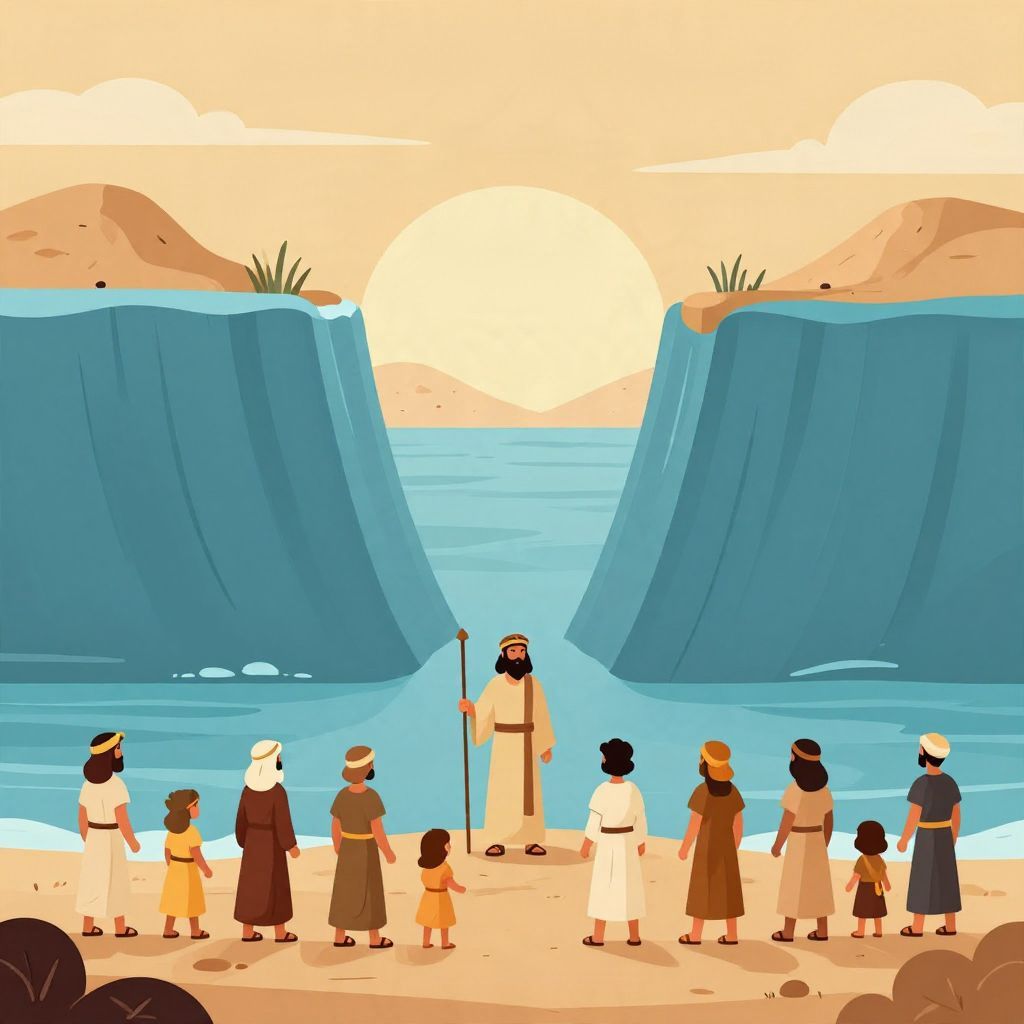
What sea did Moses part? In the biblical story, Moses is said to have parted the Red Sea, though many scholars note that the Hebrew phrase is better translated as the Sea of Reeds. That distinction matters, because it affects how historians, theologians, and readers understand the geography of the Exodus narrative.
The question sits at the crossroads of religion, history, and translation. The story is central to Jewish, Christian, and Islamic tradition, but the exact body of water, the date of the event, and even whether it reflects a historical memory or a literary/theological tradition remain debated.
What sea did Moses part?
Moses is traditionally said to have parted the Red Sea, but the original Hebrew term in Exodus is Yam Suph, often translated as “Sea of Reeds” or “Sea of Weeds.” The exact location is uncertain, and the phrase may refer to marshy waters in the eastern Nile Delta rather than the modern Red Sea itself.
The biblical name: Red Sea or Sea of Reeds?
The familiar phrase “Red Sea” comes from later translation traditions, especially the Greek Septuagint and the Latin Vulgate, which rendered Yam Suph in ways that influenced English Bibles. Many modern scholars prefer “Sea of Reeds” because it better matches the Hebrew wording and suggests a shallow wetland or lagoon rather than a deep ocean crossing.
Why the translation matters
If the text refers to a reed-filled marsh, the event may have taken place in the northeastern Nile Delta or along a chain of lakes and wetlands connected to ancient Egypt. If it refers to the Red Sea in the modern sense, the geography changes dramatically. Because the ancient text does not identify a precise modern map location, both religious tradition and historical reconstruction remain open to interpretation.
The story in its historical and religious setting
The sea-crossing episode belongs to the Exodus narrative, in which Moses leads the Israelites out of slavery in Egypt. In the biblical account, the crossing marks the decisive break between bondage and freedom and is followed by the destruction of the pursuing Egyptian force. For believers, it is a foundational act of divine deliverance; for historians, it is a text shaped by memory, theology, and national identity.
Where does the Exodus story fit in ancient history?
Scholars have long debated when, or even whether, the Exodus occurred as a single historical event. Some proposals place a possible backdrop in the Late Bronze Age, roughly the 13th or 12th century BCE, while others argue that the narrative combines memories from different periods into a later national origin story. There is no universally accepted archaeological consensus for a precise date.
What might the crossing have been?
Because the text is ancient and the geography is uncertain, historians and biblical scholars have suggested several possibilities. Some think the story preserves a memory of a natural event such as a wind-driven retreat of water, a shallow lake crossing, or a dangerous passage through wetlands. Others view the account primarily as a theological narrative rather than a report meant in modern documentary terms.
Natural explanations proposed by scholars
- Wind setdown: Strong winds can push shallow water aside temporarily, exposing a crossing point.
- Wetland crossing: The route may have passed through marshes or lagoons in the eastern Nile Delta.
- Symbolic narrative: The story may use dramatic geography to express liberation and divine power.
None of these explanations can be proven with certainty. They are attempts to interpret an ancient account that blends memory, faith, and literary artistry.
The timeline of the Moses tradition
The sea-crossing is part of a much larger narrative arc. Even though the historical details are disputed, the story has a recognizable sequence in biblical tradition and later religious memory.
- Moses’ early life: He is raised in Egypt and later becomes the leader of the Israelites.
- Confrontation with Pharaoh: Moses demands release for his people.
- Departure from Egypt: The Israelites leave, beginning the Exodus.
- Sea crossing: Waters part, allowing escape.
- Aftermath: The pursuing Egyptian force is overwhelmed.
- Wilderness journey: The people continue toward Sinai and covenant-making.
This sequence is important because the sea crossing is not an isolated miracle. It functions as the turning point between oppression and nationhood, and it frames the wilderness journey that follows.
Historical significance of the sea crossing
The story of Moses parting the sea became one of the most influential liberation narratives in world history. It shaped Jewish liturgy, Christian interpretation, and Islamic remembrance of Moses as a prophet. Over time, it also became a powerful symbol in political and cultural movements that invoked freedom from slavery or tyranny.
A story of deliverance and identity
In Jewish tradition, the crossing is tied to Passover and the annual remembrance of liberation from Egypt. The event represents the transformation of a dispersed group into a covenant community. In later religious thought, it also became a model of salvation: danger, passage, rescue, and renewal.
Impact on art, literature, and memory
Artists, poets, and preachers have repeatedly returned to the image of the sea dividing in two. The scene appears in manuscripts, paintings, hymns, films, and public rhetoric because it is visually dramatic and emotionally resonant. Few biblical episodes have had such a lasting cultural afterlife.
What historians can say with confidence
Historians can say that the sea-crossing story is ancient, central to Israelite tradition, and preserved in the book of Exodus. They can also say that the phrase behind “Red Sea” most likely refers to “Sea of Reeds” and that the exact historical location is unknown. What they cannot say with confidence is that modern maps can identify the precise spot where the event occurred.
Evidence and uncertainty
There is no direct archaeological evidence that confirms the sea crossing as described in the biblical text. That does not mean the story has no historical value. It means the evidence is indirect, and the narrative must be studied as both a religious text and a product of ancient memory. Responsible history distinguishes between what is attested, what is plausible, and what remains beyond proof.
Why the question still matters today
People still ask what sea Moses parted because the answer reveals how ancient texts travel across languages, centuries, and cultures. A single phrase can shift meaning when translated, and that shift can shape popular imagination for generations. The question also shows how history and faith interact: one asks what may have happened, the other asks what the story means.
So, the short answer is this: Moses is traditionally said to have parted the Red Sea, but the more precise historical-linguistic answer is likely the Sea of Reeds. The exact body of water remains uncertain, yet the story’s importance is unmistakable. For more on Moses’ life and chronology, see when Moses was born and how old Moses was.