
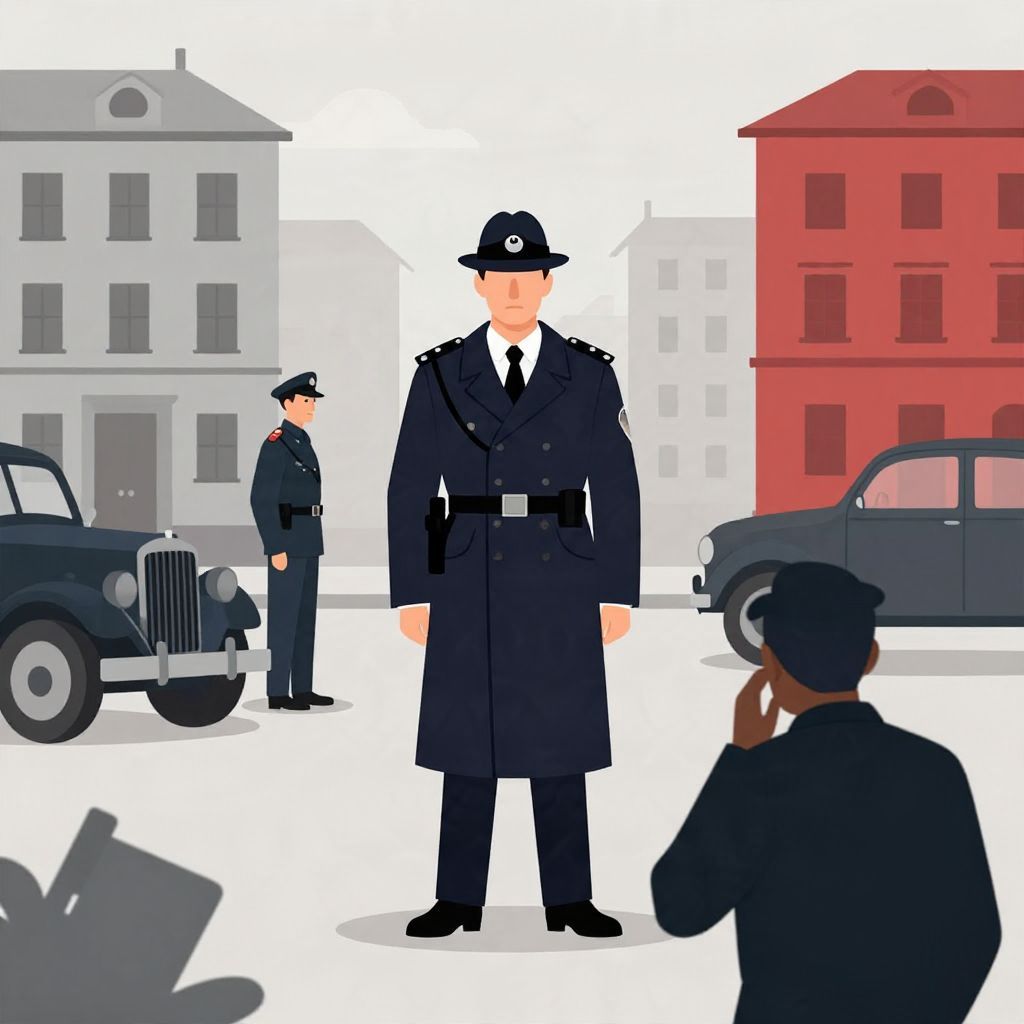
The Gestapo was Nazi Germany’s secret state police, created to identify, intimidate, arrest, and destroy political opposition. It became one of the most feared instruments of the Nazi dictatorship, helping enforce Adolf Hitler’s rule through surveillance, terror, and repression.
Its name is an abbreviation of Geheime Staatspolizei, meaning “Secret State Police.” Although often imagined as an all-seeing force, the Gestapo relied not only on officers and informants but also on public fear, denunciations, and cooperation from other Nazi institutions.
What Was The Gestapo?
The Gestapo was the Nazi regime’s political police force, responsible for hunting opponents of the state, suppressing dissent, and investigating those the Nazis labeled enemies. Founded in 1933 and later expanded across Nazi-controlled Europe, it became a central tool of dictatorship, operating outside normal legal restraints and using imprisonment, torture, and deportation.
Origins of the Gestapo
The Gestapo did not appear out of nowhere. It grew out of the political turmoil that followed the collapse of the Weimar Republic and the Nazi seizure of power in 1933. In the unstable atmosphere of street violence, anti-communism, and emergency rule, the Nazis quickly moved to build a police apparatus that could crush rivals and silence critics.
From Prussian police to Nazi control
In April 1933, Hermann Göring, then minister of the interior in Prussia, reorganized the Prussian political police into a new force. This body became the core of the Gestapo. At first, it was a Prussian agency, not yet a nationwide institution, but it was soon absorbed into the broader Nazi security system.
By 1934, Heinrich Himmler and Reinhard Heydrich were consolidating control over police and intelligence functions. The Gestapo was increasingly tied to the SS, the Nazi Party’s paramilitary organization. In 1936, Himmler was appointed chief of the German police, and the Gestapo was brought under his authority, further blurring the line between state police and party terror.
What did “Gestapo” mean?
“Gestapo” is short for Geheime Staatspolizei, or “Secret State Police.” The name reflected its role: a police force operating in secrecy to protect the Nazi state from real and imagined enemies. Unlike ordinary police, it was not meant primarily to solve common crime. Its mission was political control.
The term itself became infamous during the Nazi era and after 1945. Today, “Gestapo” is often used more broadly to describe brutal secret police systems, though historically it refers specifically to the Nazi organization.
How the Gestapo Worked
The Gestapo’s power came less from size than from authority, fear, and access to the wider Nazi apparatus. It could arrest people without normal judicial safeguards, send them to concentration camps, and coordinate with other agencies such as the SS, the criminal police, and local administrations. Its methods were designed to make opposition feel hopeless.
Surveillance and denunciation
Popular culture sometimes portrays the Gestapo as omnipresent, but historians generally stress that it depended heavily on information from ordinary people. Many investigations began with denunciations—letters, phone calls, or personal reports from neighbors, coworkers, or relatives. Fear, ideology, personal grudges, and opportunism all fed this system.
This does not make the Gestapo less dangerous. Rather, it shows how a dictatorship can use social pressure and public participation to extend state power far beyond the number of actual officers. The regime turned suspicion into a weapon.
Arrest, torture, and imprisonment
Once the Gestapo targeted someone, the consequences could be severe. Suspects were interrogated aggressively, often beaten or tortured. People could be held in “protective custody,” a Nazi euphemism that meant imprisonment without normal legal process. Many were sent to concentration camps, where conditions were brutal and deadly.
The Gestapo’s authority made legal protections fragile or meaningless. Courts, prosecutors, and police often cooperated with Nazi goals, while the regime increasingly replaced the rule of law with arbitrary power.
The Gestapo and the Nazi Police State
The Gestapo was one part of a much larger Nazi security and repression system. It worked alongside the SS, the Sicherheitsdienst (SD, the SS intelligence service), the criminal police, and the concentration camp network. Together, these institutions formed the backbone of the Nazi police state.
In practice, this meant that political policing, intelligence gathering, racial persecution, and terror were closely connected. The Gestapo was not just an ordinary police force with harsh methods; it was a central institution in a regime built on ideological violence.
Targets of persecution
The Gestapo pursued a wide range of people the Nazis considered threats. These included communists, social democrats, trade unionists, religious dissenters, anti-Nazi activists, and people accused of listening to foreign radio broadcasts or making critical remarks. It also played a role in the persecution of Jews, though the broader machinery of anti-Jewish policy involved many Nazi agencies.
As the war progressed, the Gestapo became increasingly involved in tracking forced laborers, resistance networks, and anyone suspected of undermining the war effort. Its work expanded with Nazi conquest.
The Gestapo During World War II
After 1939, the Gestapo’s role widened dramatically. Nazi occupation across Europe created new opportunities for repression, and the Gestapo helped enforce German rule in occupied territories. It targeted resistance movements, underground political groups, and civilians accused of aiding enemies of the Reich.
Occupation and collaboration
In occupied countries, the Gestapo often worked with local collaborators, informants, and other German security agencies. It was especially active in cities and strategic regions where resistance activity was strongest. Its presence was intended to make resistance seem futile by combining intelligence work with sudden, violent punishment.
Because the Nazi occupation system varied from place to place, the Gestapo’s exact influence also varied. But wherever it operated, its reputation for brutality was well earned.
Role in the Holocaust
The Gestapo was not the sole architect of the Holocaust, but it was deeply implicated in the persecution, deportation, and destruction of Jews and other targeted groups. It helped identify individuals and communities, coordinate arrests, and support deportations to ghettos, transit camps, and extermination centers. Its actions formed part of the broader Nazi machinery of genocide.
It is important to distinguish the Gestapo’s role from that of other agencies. The Holocaust was carried out through a network of institutions: party offices, civil administrators, railway systems, police units, SS leadership, and camp personnel. The Gestapo was one crucial component in that system.
Who Led the Gestapo?
Several major Nazi figures shaped the Gestapo, though its leadership changed over time. Hermann Göring played an early role in its creation in Prussia. Heinrich Himmler later brought it into the SS-controlled police structure. Reinhard Heydrich was especially important in building its intelligence and operational power.
- Hermann Göring helped establish the Prussian political police in 1933.
- Heinrich Himmler centralized Nazi police power and placed the Gestapo under SS control.
- Reinhard Heydrich organized and expanded the security police system that included the Gestapo.
These men were not interchangeable. Each contributed differently to the growth of Nazi repression, but together they helped create a system that fused state authority with ideological terror.
Was the Gestapo Everywhere?
One common myth is that the Gestapo had agents on every street corner. In reality, it was feared precisely because it did not need to be everywhere. Its power depended on a combination of selective surveillance, informants, propaganda, and the knowledge that punishment could be swift and severe.
Historians often emphasize that many Germans adapted to this environment through caution, silence, or conformity. The Gestapo’s reach was real, but it was amplified by the broader social and political climate of Nazi Germany.
How Big Was the Gestapo?
The Gestapo was influential, but it was not a huge organization compared with the population it controlled. Its effectiveness came from overlap with other agencies and from the cooperation of ordinary citizens and officials. Exact numbers varied over time and by region, and estimates can be misleading if taken without context.
What mattered most was not sheer manpower but the regime’s ability to combine police authority, ideological commitment, and public fear into a system of control.
The End of the Gestapo
The Gestapo collapsed with Nazi Germany in 1945. As Allied forces advanced, the Nazi security system disintegrated. Many Gestapo officials destroyed records, fled, or tried to hide their roles. After the war, some were prosecuted in war crimes trials, though many lower-level participants avoided severe punishment.
At Nuremberg and in later proceedings, the Gestapo was condemned as part of the criminal Nazi state. Its name became a symbol of secret-police terror and arbitrary power.
Why the Gestapo Still Matters
The history of the Gestapo matters because it shows how a modern state can turn policing into political terror. It was not simply a rogue gang or a collection of sadists, though it certainly included violent perpetrators. It was an institution built to enforce dictatorship, destroy opposition, and enable mass persecution.
Its history also warns how fear, propaganda, bureaucracy, and public cooperation can combine to erode rights. The Gestapo is remembered not only for what it did, but for what it reveals about the mechanics of authoritarian rule.
In Summary
The Gestapo was Nazi Germany’s secret state police, created in 1933 and expanded under SS control into a central instrument of repression. It used surveillance, denunciation, arrest, torture, and deportation to enforce Nazi rule at home and in occupied Europe. Understanding it helps explain how the Nazi regime maintained power and why a police state can be so destructive when law is replaced by terror and ideology. For broader context, see also what political ideology means in history.