
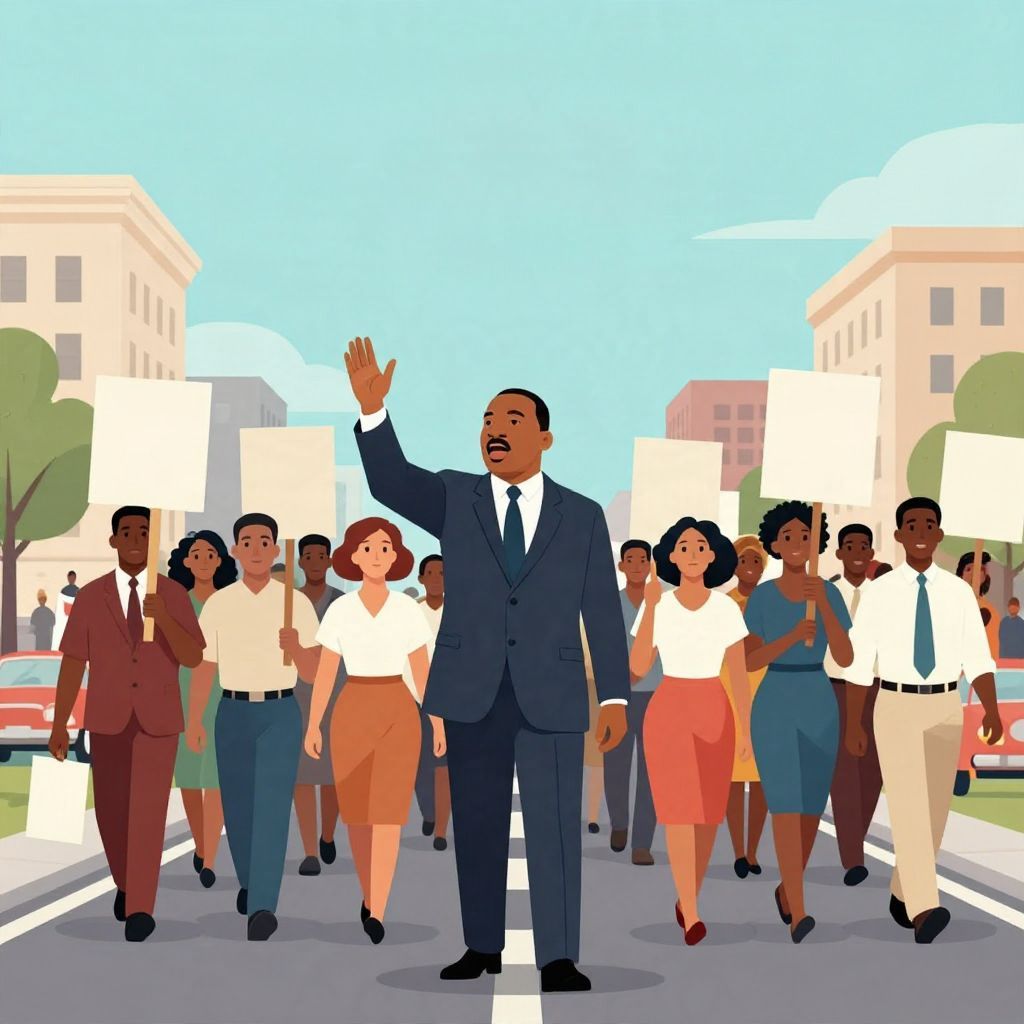
Martin Luther King Jr. changed the world by helping turn the American civil rights struggle into a powerful moral and political movement for racial equality. Through nonviolent protest, eloquent speeches, and strategic organizing, he helped push the United States toward major legal reforms and inspired liberation movements around the globe.
His influence was not limited to one country or one law. King helped redefine how many people understood justice, citizenship, and peaceful resistance in the 20th century, even as he faced fierce opposition, surveillance, and violence.
How did Martin Luther King change the world?
Martin Luther King Jr. changed the world by making nonviolent mass protest a force that could challenge segregation, win landmark civil rights laws, and inspire people far beyond the United States. His leadership in the Montgomery Bus Boycott, the Birmingham campaign, and the March on Washington helped end legal segregation in many areas and strengthened the global idea that ordinary people could demand justice through organized, peaceful action.
The historical setting: segregation and inequality in mid-20th-century America
To understand King’s impact, it helps to see the world he entered. In the 1950s and 1960s, racial segregation was still deeply embedded in much of the United States, especially in the South. Black Americans faced separate schools, restricted voting rights, discriminatory housing, unequal employment, and daily humiliation under Jim Crow laws.
These conditions were not new, but postwar America created new pressure for change. Black veterans returned from World War II having fought for democracy abroad while being denied full rights at home. At the same time, television and national media made racial injustice more visible to a broader public. King emerged in this setting as a leader who could connect local grievances to national ideals.
Why Martin Luther King became a national leader
King was born in Atlanta, Georgia, in 1929, into a Black middle-class family shaped by the Black church. He studied theology and was deeply influenced by Christian ethics, as well as by thinkers such as Mahatma Gandhi, whose ideas about nonviolent resistance helped shape King’s approach. He was not the only civil rights leader, but he became one of the movement’s most effective public voices.
Leadership rooted in organization, not just speeches
King’s importance is sometimes reduced to a few famous lines, but his real influence came from combining moral language with practical organizing. He worked with churches, local activists, lawyers, students, and community groups. He helped build coalitions through the Southern Christian Leadership Conference (SCLC), founded in 1957, which coordinated campaigns across the South.
That combination mattered. King could speak to national audiences, but he also helped sustain long campaigns that required discipline, planning, and sacrifice. His leadership was powerful because it linked ideals to action.
Key events that changed history
The Montgomery Bus Boycott, 1955–1956
King first became nationally known during the Montgomery Bus Boycott in Alabama. After Rosa Parks was arrested in December 1955 for refusing to give up her seat to a white passenger, Black residents organized a boycott of the city’s buses. King, then a young minister, was chosen as a leader of the movement.
The boycott lasted more than a year. It showed that sustained, nonviolent collective action could disrupt segregation economically and politically. The Supreme Court ultimately ruled bus segregation unconstitutional, and the boycott made King a national figure.
Birmingham and the power of televised protest, 1963
In 1963, King and other activists targeted Birmingham, Alabama, one of the most segregated cities in the South. The campaign used marches, sit-ins, and boycotts to confront local segregation. Police brutality against demonstrators, including children, was broadcast widely on television.
That media coverage changed public opinion. Many Americans who had not closely followed civil rights were shocked by the violence used against peaceful protesters. Birmingham helped create momentum for federal action and showed that King’s movement could reshape the national conversation.
The March on Washington, 1963
Later that year, King helped lead the March on Washington for Jobs and Freedom, where he delivered his most famous speech, commonly known as “I Have a Dream.” The march drew attention to both racial justice and economic inequality. It was not just a symbolic event; it was part of a broader political effort to pressure Congress and the White House.
The speech became iconic because it expressed a vision of interracial democracy in language that was both moral and accessible. But the march’s historical importance also lies in its scale and timing: it helped build support for civil rights legislation at a crucial moment.
Selma and voting rights, 1965
King’s work in Selma, Alabama, helped bring voting rights to the forefront. Black citizens in the South were often blocked from registering to vote through intimidation, literacy tests, and violence. The Selma campaign exposed these barriers to the nation.
When marchers were attacked on the Edmund Pettus Bridge in what became known as “Bloody Sunday,” the brutality again shocked the public. The result was increased pressure on the federal government and the passage of the Voting Rights Act of 1965, one of the most important civil rights laws in U.S. history.
What laws and changes did King help bring about?
King did not single-handedly pass legislation, but his leadership helped create the conditions for major reform. The civil rights movement included many people and organizations, and federal action came from political struggle, court decisions, grassroots organizing, and changing public opinion. Still, King was central to the movement’s success.
- Civil Rights Act of 1964 — outlawed segregation in public accommodations and banned many forms of employment discrimination.
- Voting Rights Act of 1965 — strengthened federal protection of Black voting rights.
- Fair Housing Act of 1968 — addressed discrimination in housing, passed after King’s assassination.
These laws did not eliminate racism, but they dismantled key pillars of legalized segregation. King helped move civil rights from a regional struggle into a national legal and moral issue.
How King changed ideas about protest
One of King’s most lasting contributions was his defense of nonviolent direct action. He argued that peaceful protest could expose injustice more effectively than violence could. In practice, this meant marches, boycotts, sit-ins, and civil disobedience designed to create tension that authorities could not ignore.
Nonviolence as strategy and principle
King’s nonviolence was both ethical and strategic. Morally, he believed violence corrupted the struggle for justice. Strategically, he understood that peaceful demonstrators facing violent repression could win sympathy from the broader public. This approach was not easy or universally accepted, even within the movement, but it proved highly influential.
His model influenced later movements around the world, including anti-apartheid activism, democratic protests, labor struggles, and campaigns for minority rights. Not every movement copied him directly, but many drew on the idea that disciplined, mass, nonviolent action could challenge powerful systems.
King’s global influence beyond the United States
King’s impact was international because his message spoke to a wider 20th-century struggle against oppression. In countries facing colonial rule, racial hierarchy, or authoritarian government, activists saw in King an example of moral leadership backed by organized pressure.
His speeches and writings circulated widely, and his assassination in 1968 made him a global symbol of both the promise and the cost of social change. Around the world, he came to represent the possibility that justice could be pursued through conscience, discipline, and collective action.
His limits, criticisms, and unfinished work
A historically balanced view should also recognize that King’s achievements were incomplete. Legal segregation was weakened, but economic inequality, residential segregation, and racial violence persisted. King himself increasingly focused on poverty, labor rights, and opposition to the Vietnam War in the late 1960s, showing that he saw civil rights as part of a broader struggle for human dignity.
He also faced criticism in his own time. Some activists thought nonviolence was too slow or too conciliatory; others believed he was too focused on national visibility. Yet these debates do not diminish his importance. They show that the movement was broad, contested, and alive.
Why Martin Luther King still matters
Martin Luther King Jr. changed the world by helping prove that moral leadership, organized protest, and public pressure could transform laws and public life. He helped weaken segregation, strengthen voting rights, and inspire later movements for justice. His legacy endures not because he solved inequality, but because he changed what people believed was possible.
For readers interested in the wider struggle for civil rights and reform, it is also useful to explore related history topics such as the broader history of civil rights movements and the global impact of nonviolent protest.