
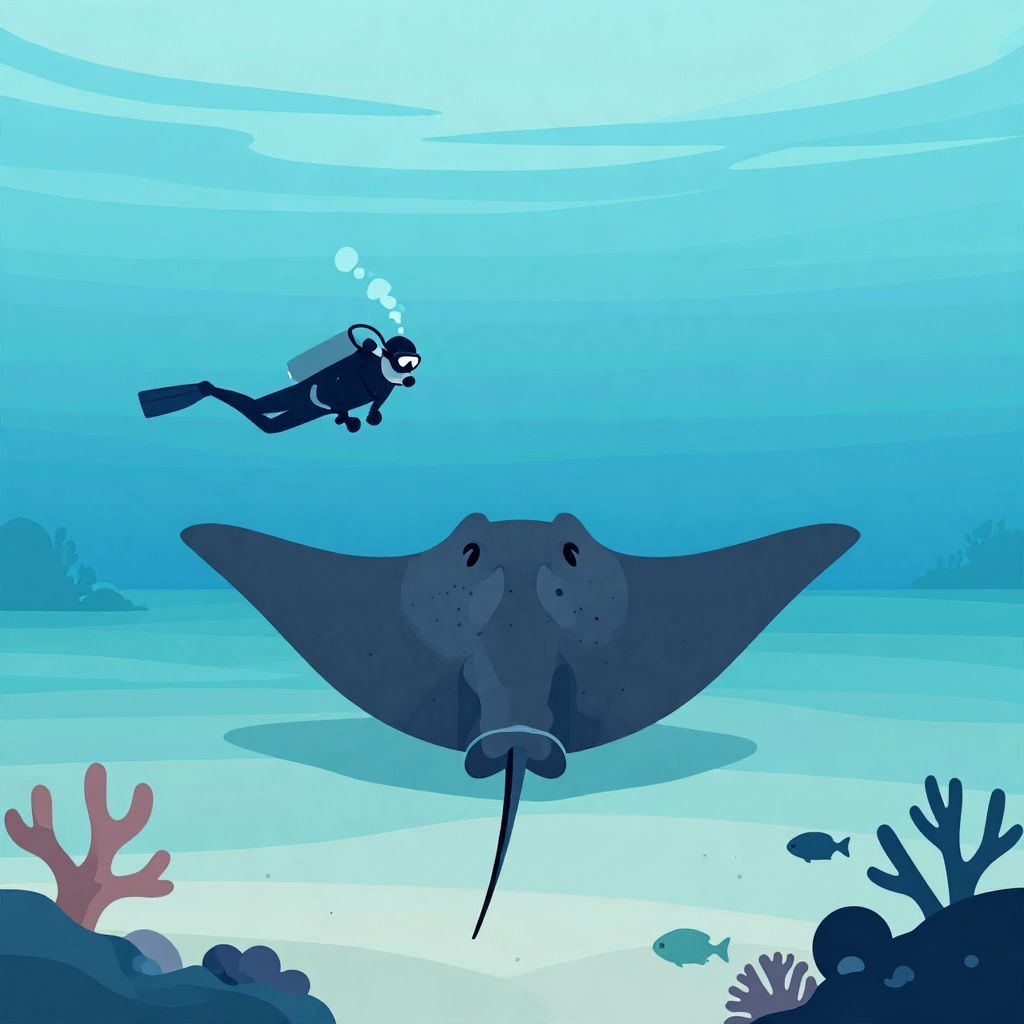
Steve Irwin’s death in 2006 prompted a global question: what kind of stingray killed him? The direct answer is that he was fatally injured by a short-tail stingray, also called a smooth stingray (Dasyatis brevicaudata), during a wildlife filming expedition off the Great Barrier Reef in Australia.
The incident became one of the most widely reported wildlife deaths in modern history, but the animal itself was not unusually aggressive. Irwin’s death was a rare accident caused by the stingray’s defensive tail spine striking his chest in a vulnerable spot.
What kind of stingray killed Steve Irwin?
Steve Irwin was killed by a short-tail stingray, or smooth stingray (Dasyatis brevicaudata). This large marine ray is native to Australian waters and typically uses its venomous tail spine only when threatened. In Irwin’s case, the ray’s barb pierced his chest and caused a catastrophic injury to his heart and surrounding tissue.
The species involved
The short-tail stingray is one of several stingray species found around Australia. It is generally broad-bodied, with a relatively short tail compared with some other rays. Like many stingrays, it has a serrated spine near the base of the tail that can inject venom and cause severe trauma.
Importantly, the species is not known as a man-eater or a predator of humans. The fatality was the result of a defensive strike under unusual circumstances, not an attack in the sense of predation.
What happened on 4 September 2006?
On 4 September 2006, Steve Irwin was filming near Batt Reef, off the coast of Queensland, Australia, for a documentary project. While swimming close to a stingray, he approached from behind and above, a position that may have startled the animal. The ray reacted defensively, whipping its tail upward and striking him in the chest.
The barb penetrated deeply and caused massive internal bleeding. Despite rapid efforts by the crew to get him help, Irwin died shortly afterward. His death was officially ruled an accident.
Why the injury was so severe
Stingray stings are usually painful and can be medically serious, but they are rarely fatal. In Irwin’s case, the barb entered his chest in a way that damaged the heart. That combination of location, force, and depth made the wound exceptionally dangerous.
Most stingray injuries affect the feet or lower legs, often when people accidentally step on a ray resting in shallow water. A chest strike is far less common and much more likely to be life-threatening.
Who was Steve Irwin, and why did this death matter historically?
Steve Irwin was an Australian wildlife conservationist, television presenter, and public educator whose work made him internationally famous. Through programs such as The Crocodile Hunter, he helped bring wildlife science and conservation to mass audiences in an energetic, highly recognizable style.
His death mattered historically because it marked the loss of one of the most visible conservation communicators of the early 21st century. It also sparked renewed public discussion about the risks of wildlife filmmaking, the behavior of marine animals, and the importance of respecting animal space in the wild.
Irwin’s public image and legacy
Irwin was known for his enthusiasm, directness, and willingness to handle dangerous animals in front of cameras. Supporters saw him as a passionate educator who inspired interest in conservation. Critics sometimes argued that his style blurred the line between education and spectacle. Both views reflect the broader tension in modern wildlife media between engagement and safety.
After his death, his family and the Australia Zoo continued conservation work, helping preserve his influence beyond the accident itself.
How stingrays defend themselves
Stingrays are not naturally aggressive toward humans. Their main defense is their tail spine, which they can use when they feel trapped, cornered, or stepped on. The spine is not a weapon for hunting; it is a protective adaptation.
Common stingray behavior
- They often lie partially buried in sand or mud.
- They usually flee rather than confront larger animals.
- They may strike if they feel threatened by sudden movement or close contact.
- Their stings can cause pain, swelling, and sometimes serious complications.
This behavior helps explain why most stingray injuries happen by accident. A person who unknowingly steps too close may trigger a reflexive tail strike.
Why the exact species was widely reported
In the aftermath of Irwin’s death, the species identification became part of the public record because it helped explain the mechanics of the injury. The short-tail stingray was identified by marine experts and reported in the media as the animal involved.
That said, the broader historical significance lies less in the species name than in the event’s impact. The incident became a global news story, a conservation moment, and a reminder that even experienced wildlife experts can be vulnerable to unpredictable accidents in natural environments.
Timeline of the incident and aftermath
- 4 September 2006: Steve Irwin is filming near Batt Reef off Queensland.
- During the shoot: A short-tail stingray reacts defensively and strikes him in the chest.
- Shortly afterward: Crew members attempt emergency assistance and transport.
- Same day: Irwin is pronounced dead from the injury.
- Following days: International coverage focuses on the rarity of the fatality and Irwin’s conservation legacy.
Historical significance of the event
From a historical perspective, Steve Irwin’s death sits at the intersection of media history, environmental education, and modern celebrity culture. He was not a political leader or battlefield figure, but his influence was substantial. He helped shape how millions of people viewed reptiles, sharks, crocodiles, and marine life.
The accident also changed public conversations about wildlife presentation. It underscored that even positive, conservation-minded media can involve real danger when humans enter the habitat of wild animals. In that sense, the event became part of the history of nature broadcasting as much as the history of Australian wildlife.
What the incident did not mean
It did not mean stingrays are inherently deadly creatures or that the species was especially hostile. Nor did it mean Irwin was careless in a simple sense. Wildlife work always involves risk, and in this case a defensive animal reaction produced a tragic and highly unusual outcome.
Bottom line
Steve Irwin was killed by a short-tail stingray (Dasyatis brevicaudata) in a rare and accidental chest strike on 4 September 2006. The event was historically significant because it ended the life of one of the world’s best-known wildlife educators and highlighted both the dangers of close wildlife filming and the defensive nature of stingray behavior.