
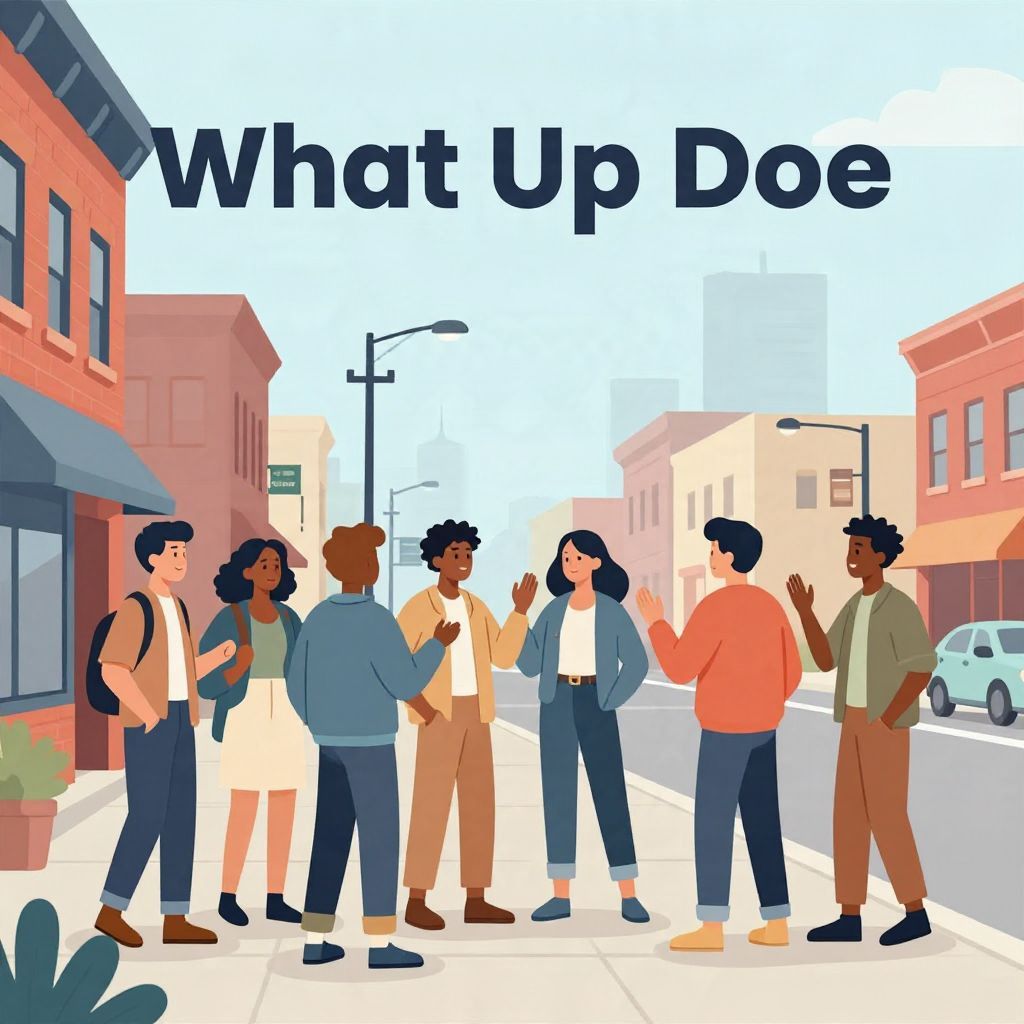
The phrase “What up doe?” is not an ancient slogan or a formal historical term. It is a modern American greeting, most strongly associated with Detroit and the wider Great Lakes region, where it emerged in Black urban speech and popular culture. Understanding it means tracing how local slang forms, regional identity, and hip-hop helped spread a phrase that sounds casual but carries social meaning.
Its history is recent, but it reflects older patterns in language: communities creating in-group expressions that signal familiarity, place, and style. In that sense, “What up doe?” is a small but revealing example of how language travels through neighborhoods, music, and the internet.
What up doe? Origins, meaning, and historical context
“What up doe?” is a regional greeting meaning something like “What’s up, though?” or simply “How are you?” It is most closely tied to Detroit, especially African American speech in the city and surrounding areas. The phrase became widely recognized in the late 20th and early 21st centuries, though its exact first use cannot be dated with certainty.
What does “doe” mean here?
In this phrase, “doe” is a colloquial spelling of “though.” It is not related to the animal. Spoken quickly, “though” can sound like “doe,” especially in casual speech. The phrase works as a friendly check-in, but it also signals local identity. To people who know the expression, it can sound warm, familiar, and distinctly Detroit.
Why historians and linguists treat it as a cultural marker
Language historians often study phrases like this because they show how speech communities define themselves. “What up doe?” is not just a greeting; it is a marker of belonging. Like many regional expressions, it can identify where a speaker is from, who they identify with, and what cultural networks shaped their language.
How did “What up doe?” develop?
The phrase likely developed gradually in everyday conversation rather than appearing at one exact moment. Its structure combines the long-established informal greeting “what’s up” with a regional pronunciation or written rendering of “though.” That blend fits broader patterns in African American English and urban slang, where speech often evolves through creativity, rhythm, and local usage.
Regional speech and Detroit identity
Detroit’s history helps explain why the phrase took hold there. The city’s 20th-century growth, industrial workforce, and large Black population created dense neighborhoods where distinctive local speech could flourish. As residents moved through schools, workplaces, churches, barbershops, and social clubs, sayings circulated and became part of shared identity.
Detroit slang has long been shaped by migration, especially the Great Migration, when many African Americans moved from the South to Northern industrial cities in the 20th century. New arrivals brought linguistic habits that mixed with local speech, producing fresh expressions that were both regional and culturally specific.
From spoken slang to written internet culture
“What up doe?” became more visible when people began writing it online, printing it on shirts, and using it in music and social media. Once a phrase is written down, it can spread far beyond the neighborhood where it began. That shift matters historically: oral slang often exists for years before becoming a recognizable public label.
The internet accelerated this process. By the 2000s and 2010s, local expressions could move quickly from city speech to national awareness. In that environment, “What up doe?” became both a greeting and a symbol of Detroit pride.
Timeline of “What up doe?”
Because slang is rarely documented at its exact birth, the timeline is approximate. Still, the phrase’s rise can be understood in stages.
- Mid-20th century: “What’s up” becomes a common informal American greeting, especially in urban youth speech.
- Late 20th century: Detroit-area speakers increasingly use “doe” as a local spoken form of “though,” helping shape the full phrase.
- 1990s–2000s: The expression gains stronger recognition in Detroit popular culture and Black social spaces.
- 2000s–2010s: Music, social media, and merchandise help spread the phrase beyond the city.
- Present: “What up doe?” is widely recognized as a Detroit-associated greeting and a marker of regional pride.
Why exact dating is difficult
Unlike a law, treaty, or military campaign, slang usually leaves few formal records. A phrase may be spoken for years before anyone writes it down. That means historians must be careful not to pretend certainty where the evidence is thin. The best-supported conclusion is that “What up doe?” emerged from late 20th-century Detroit speech and became widely visible later through popular culture.
What up doe? and Black American language history
The phrase belongs to the broader history of African American English, a rich and evolving linguistic tradition with deep roots in American history. This tradition has contributed countless words, rhythms, and expressions to mainstream American speech. Many such phrases begin in Black communities, then spread outward, sometimes losing their local meaning in the process.
Language as community memory
For many speakers, “What up doe?” is not just a casual hello. It can carry memory, neighborhood identity, and a sense of shared experience. In cities shaped by segregation, migration, and economic change, language often becomes one of the most visible ways communities preserve belonging.
That does not mean every speaker uses the phrase in the same way. Some people use it playfully, some sincerely, and some as a performance of local style. Historical meaning often changes with context, and slang is especially flexible.
Not a universal phrase
It is important not to overstate the phrase’s reach. “What up doe?” is not standard American English, and it is not used everywhere in the same way. Its history is regional, not national. That regionality is part of what gives it force: the phrase identifies a place and a cultural community, even when outsiders borrow it.
How hip-hop and media helped popularize the phrase
Hip-hop has long served as a vehicle for regional speech. Local phrases often enter wider circulation when rappers, DJs, comedians, and social media creators repeat them. Detroit artists and audiences helped make “What up doe?” recognizable beyond the city, turning a neighborhood greeting into a cultural shorthand.
From local speech to brand identity
As the phrase spread, it began appearing in clothing, slogans, and entertainment. That commercial use can be double-edged. On one hand, it celebrates local pride. On the other, it can flatten a living expression into a logo. Historians of culture often note this tension: a phrase can be both authentic community speech and a marketable symbol.
Why the phrase traveled well
“What up doe?” is memorable because it is short, rhythmic, and easy to repeat. It also sounds distinctive without being difficult to understand. Those qualities help a phrase move across social circles, especially in music-driven culture. The result is a greeting that remains tied to Detroit while being recognized far beyond it.
Historical significance of “What up doe?”
The historical significance of “What up doe?” lies less in political events than in what it reveals about modern American life. It shows how urban Black communities shape national language, how local identity survives in a mobile society, and how digital media can transform neighborhood speech into a widely recognized cultural sign.
What it tells us about place
Regional phrases often survive because they answer a human need: to say, “I am from here, and I know who my people are.” In that sense, “What up doe?” is a linguistic map. It points to Detroit, but also to the social world that produced it—working-class neighborhoods, Black cultural creativity, and the everyday life of a city with a strong sense of itself.
What it tells us about change
The phrase also shows how quickly language can move in the modern era. A greeting once heard mainly in local conversation can become a national meme, a merch slogan, or a shorthand for a city’s identity. That transformation is part of recent cultural history, especially in the age of hip-hop and social media.
Common misunderstandings
Because the phrase is informal, it is sometimes misunderstood by outsiders. A few common mistakes are worth clarifying.
- It is not “proper” English in the formal sense, but that does not make it meaningless or careless.
- It is not ancient; it is a modern regional expression.
- It is not only a joke; for many speakers, it is a genuine marker of identity and belonging.
- It is not universal across the United States; its strongest association remains Detroit and nearby cultural circles.
Why “What up doe?” still matters
Small phrases can carry large histories. “What up doe?” matters because it captures the way language grows from lived experience. It reflects migration, neighborhood life, Black cultural innovation, and the power of local speech to shape broader culture. Even a casual greeting can become a historical artifact when it reveals how people identify themselves and each other.
In short, “What up doe?” is a modern Detroit-born expression that grew out of everyday speech and became a recognizable symbol of regional and cultural identity. If you are interested in how everyday language carries historical meaning, you may also like what a Black American flag means and what “grand rising” means.