
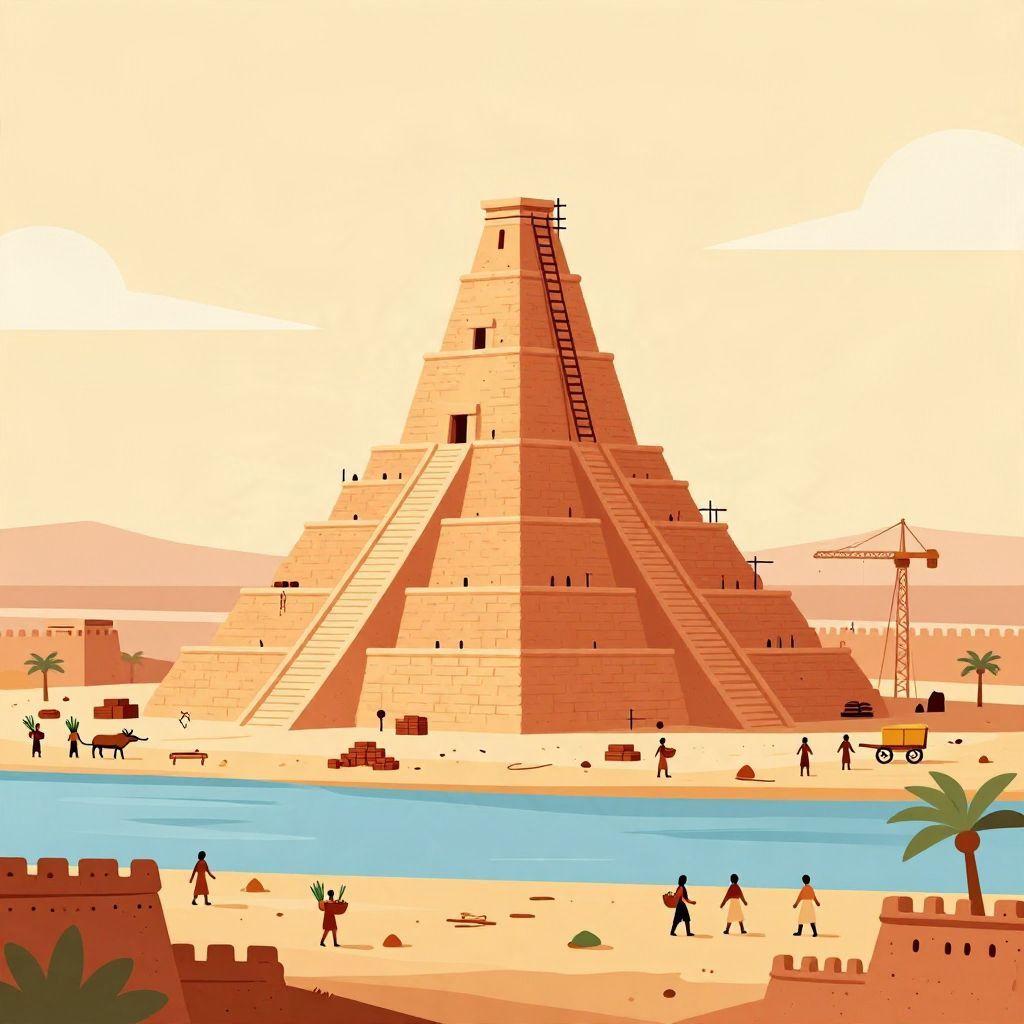
How tall was the Tower of Babel? The short answer is that no one knows, because the tower belongs to a biblical story rather than a securely documented ancient building. The Book of Genesis does not give a height, and historians cannot verify that a single “Tower of Babel” ever existed in the literal sense.
What scholars can say is that the story likely reflects memories of Mesopotamian ziggurats, especially the great temple towers of Babylon. Those structures could rise to impressive heights for the ancient world, but the Bible’s tower is best understood as a theological and cultural symbol, not a measured architectural project.
How tall was the Tower of Babel?
The Tower of Babel has no confirmed historical height. Genesis never states a number, and no archaeological evidence identifies a specific tower that matches the biblical account. If the story was inspired by Babylonian ziggurats, the tallest such towers may have reached roughly 60 to 90 meters, though estimates vary and many were lower.
Why there is no exact number
The biblical narrative in Genesis 11 focuses on human ambition, language, and divine judgment, not architecture. It says people built a city and a tower “with its top in the heavens,” but that phrase is literary and symbolic. Ancient writers often used elevated language to express grandeur rather than exact measurements.
That means modern attempts to assign a precise height are speculative. Some popular retellings imagine a colossal skyscraper-like structure, but that image reflects later imagination more than ancient evidence. The most responsible answer is that the tower’s height is unknown and probably intended to be understood as extraordinarily tall, not numerically defined.
What ancient towers may have inspired the story
Most historians connect the Babel tradition with Mesopotamian ziggurats, stepped temple towers built in cities such as Babylon, Ur, and Uruk. These were religious monuments, not homes or fortresses. Their purpose was to connect the human and divine worlds through ritual and symbolism.
The best-known candidate is the ziggurat of Babylon, often associated with the god Marduk. Later traditions linked it to the biblical Babel story, and some scholars see it as the background for the tale. Ancient ziggurats varied in size, but the largest would have been among the most imposing structures in the ancient Near East.
Origins of the Tower of Babel story
The Tower of Babel comes from Genesis 11:1–9, a text usually dated by scholars to a long process of composition and editing rather than a single moment. The story reflects ancient Israelite ideas about pride, divine authority, and the spread of nations and languages. It is not treated by historians as a straightforward architectural record.
The biblical setting
In the Genesis account, humanity speaks one language and settles in the land of Shinar, a region associated with Mesopotamia. The builders decide to make bricks and construct a city and tower to “make a name” for themselves. God disrupts the project by confusing their language and scattering them across the earth.
This narrative explains diversity of language through a moral and religious lens. Rather than asking how tall the tower was, the text asks why human unity can turn into arrogance and why languages differ. In that sense, the tower functions as an origin story for human division.
Babylon and the meaning of “Babel”
The name “Babel” is usually connected with Babylon, one of the great cities of Mesopotamia. In Hebrew, the story also plays on a word associated with confusion, which helps the tale’s message. The connection between Babel and Babylon is therefore both geographic and symbolic.
Babylon was famous for monumental architecture, imperial power, and religious prestige. For later readers, it became a natural setting for a story about human ambition reaching too far. The tower may have been imagined as a Babylonian temple tower because such structures already represented the meeting of earth and heaven.
Possible historical background: Mesopotamian ziggurats
Although the Tower of Babel itself cannot be measured, the architectural world behind the story is well known. Ziggurats were built in ancient Mesopotamia from the third millennium BCE onward. They were made of mud brick and often rose in stepped stages, with a shrine at or near the summit.
How tall were ziggurats?
Exact heights are often uncertain because many structures are ruined, rebuilt, or known only from fragments and texts. Still, historians generally describe them as substantial towers that dominated the skyline of their cities. Some may have stood around 30 to 60 meters, while the most ambitious examples may have been higher.
For comparison, these were not “skyscrapers” in the modern sense, but they were striking achievements in an ancient world where most buildings were far lower. Their scale would have made them visible from a distance and impressive to travelers, priests, and residents alike.
The Babylonian ziggurat and later memory
Babylon’s great temple tower, sometimes identified with the Etemenanki, became especially famous in later antiquity. Ancient authors described Babylon as a city of immense monuments, and later Jewish and classical traditions helped preserve the image of a giant tower reaching toward the sky.
Because the biblical Babel story emerged in a world that knew Babylon as a powerful imperial center, the tower likely drew on real memories of Mesopotamian monumental building. But memory, theology, and legend shaped the story far more than engineering records did.
Timeline: from Mesopotamian towers to biblical legend
The Tower of Babel story is not tied to one exact date, but its background spans many centuries of Mesopotamian history and later biblical interpretation. A simplified timeline helps place the legend in context.
- c. 3rd millennium BCE – Early Mesopotamian cities begin building ziggurats and other monumental temple structures.
- 2nd millennium BCE – Ziggurats remain important religious landmarks in Mesopotamian urban life.
- 1st millennium BCE – Babylon becomes a major imperial and cultural center, reinforcing its reputation for grandeur.
- Late biblical period – The Genesis account of Babel takes shape within Israelite religious tradition.
- Later antiquity and beyond – Jewish, Christian, and Islamic readers treat Babel as a powerful symbol of pride, dispersion, and linguistic diversity.
What the story meant in the ancient world
The Tower of Babel was never just about a building. It addressed questions that mattered deeply in the ancient world: Why do people speak different languages? Why do empires rise and fall? What happens when human beings try to act as if they are equal to the divine?
Human ambition and divine limits
The builders in Genesis want security and fame. Their tower is a collective project of self-exaltation. The story’s lesson is not that construction is wrong, but that pride and centralization can become dangerous when they ignore divine order and human limits.
This theme would have been meaningful in a world where kings, cities, and empires advertised their power through monumental architecture. A tower “with its top in the heavens” expresses the ancient desire to overcome ordinary limits, but the story warns that such ambition can collapse into fragmentation.
Language as a symbol
The confusion of languages is the most famous part of the tale. Historically, Mesopotamia was linguistically diverse, with Akkadian, Sumerian, Aramaic, and other languages in use across different periods. The Babel story turns that diversity into a memorable explanation for why humanity no longer speaks with one voice.
Rather than preserving a literal record of a single event, the story offers an origin myth. It explains a real human condition—linguistic difference—through narrative, theology, and moral meaning.
Why people still ask how tall it was
Modern readers often want a number because they approach the Tower of Babel as if it were a lost monument. That is understandable. The image of a tower reaching the heavens invites architectural curiosity. But the historical answer remains uncertain because the story is not built around measurement.
Scholars generally treat the tower as a literary and religious symbol rooted in Mesopotamian temple architecture. If one asks how tall the “real” inspiration may have been, the best answer is that it was probably comparable to major ziggurats of ancient Mesopotamia, not infinitely high and not precisely known.
Myth, memory, and history
The Babel story sits at the intersection of myth and history. Myth here does not mean “false” in a simple sense; it means a story that explains the world through symbolic truth. The historical background may include Babylonian towers, but the biblical narrative reshapes that background into a lesson about unity and division.
That is why historians distinguish between the story’s meaning and its measurable facts. We can study the architecture of Mesopotamia, the development of biblical texts, and the cultural memory of Babylon, even if we cannot assign a verified height to Babel itself.
Historical significance of the Tower of Babel
The Tower of Babel remains significant because it has influenced religion, literature, art, and ideas about language for centuries. It has become one of the most enduring stories about the origins of human diversity and the dangers of overreaching ambition.
In historical terms, its importance lies less in what the tower physically was and more in how later societies interpreted it. The story helped shape Jewish and Christian reflection on pride, empire, and communication, and it continues to appear in discussions of politics, culture, and language today.
Conclusion
So, how tall was the Tower of Babel? Historically, we do not know, and there is no reliable evidence that the biblical tower can be measured at all. The most defensible answer is that it was a symbolic tower inspired by the towering ziggurats of Mesopotamia, especially Babylon, and that its “height” matters more as an idea than as a statistic.
If you want to explore the wider ancient setting behind the story, you may also be interested in what happened to Babylon and where the Garden of Eden was located.