
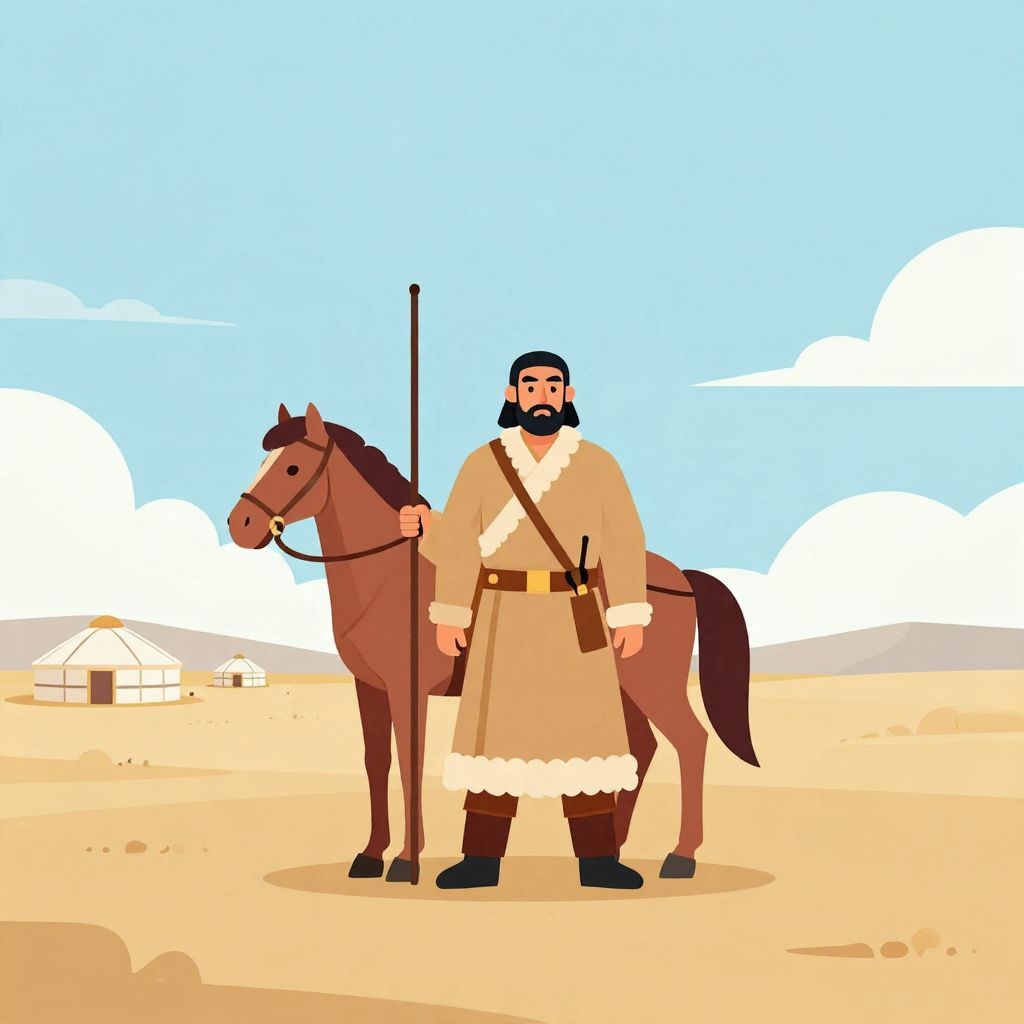
How tall was Genghis Khan? It is one of the most searched questions about the founder of the Mongol Empire, but the honest answer is that no reliable historical record gives his exact height. What survives are later descriptions, artistic traditions, and modern guesses, not a measured figure from his lifetime.
Still, historians can say something useful: Genghis Khan was likely of average or slightly above-average height for a man of his era, though this cannot be proven. His true historical importance lies not in his appearance, but in how he united the Mongol tribes and created an empire that transformed Eurasia.
How tall was Genghis Khan?
No one knows Genghis Khan’s exact height. There is no surviving contemporary measurement, and the sources closest to his life do not record one. Any specific number you may see online is speculation, usually based on later artistic portrayals or modern assumptions rather than solid evidence.
What historians can and cannot say
The most reliable conclusion is modest: Genghis Khan was probably not unusually short or extraordinarily tall. Like most medieval steppe warriors, he would have been physically hardened by riding, hunting, and warfare. But because no verified skeletal remains have been identified with certainty, his height remains unknown.
Some popular accounts try to estimate his stature by comparing him with modern Mongol populations or by reading physical details into portraits. Those methods are weak. Medieval rulers were often idealized in art, and ethnic or regional averages cannot tell us an individual’s exact height.
Why the question is so hard to answer
Genghis Khan lived in the late 12th and early 13th centuries, in a world that did not use standardized physical records for rulers. Unlike modern leaders, he was not photographed, measured, or routinely described in precise anthropometric terms. The Mongol Empire also valued military skill, loyalty, and charisma far more than physical measurements.
Who was Genghis Khan?
Genghis Khan was born as Temüjin, probably around 1162, in the Mongolian steppe region. He rose from a difficult childhood marked by tribal conflict, family insecurity, and shifting alliances. By the early 1200s, he had united many Mongol and steppe groups under his leadership and was proclaimed Genghis Khan, a title meaning something like “universal ruler.”
His empire expanded rapidly across Central Asia, northern China, and into parts of the Middle East and eastern Europe. That expansion reshaped trade, warfare, diplomacy, and state-building across a vast region.
Origins and early life
Temüjin was the son of Yesügei, a Mongol chief, and Börte Üjin. After his father’s death, his family was abandoned by their followers and left in a precarious position. This early hardship helped shape Temüjin’s political style: he relied on personal loyalty, merit, and disciplined organization rather than only on inherited rank.
He gradually built alliances, defeated rivals, and absorbed competing clans. His rise was not inevitable; it was the product of strategic marriages, military success, and a talent for turning fragmented groups into a more unified force.
Timeline of Genghis Khan’s rise and empire
Understanding his life helps explain why physical details such as height matter so little compared with his historical impact. The following timeline shows the major stages of his career.
- c. 1162 — Temüjin is born on the Mongolian steppe.
- late 1170s–1180s — His family suffers hardship after his father’s death; Temüjin begins building alliances.
- 1206 — He is proclaimed Genghis Khan after uniting many Mongol tribes.
- 1209–1215 — Mongol campaigns expand into northern China, including the Jin dynasty’s territories.
- 1219–1221 — The Mongols invade the Khwarazmian Empire in Central Asia and Iran.
- 1227 — Genghis Khan dies during a campaign against the Western Xia.
This sequence matters because it shows that the Mongol Empire was built through organization, mobility, and military adaptation. Genghis Khan’s success came from leadership and systems, not from any mythic physical trait.
What do the sources say about his appearance?
Descriptions of Genghis Khan’s appearance are limited and often indirect. Some later traditions present him as strong, broad-faced, and commanding. Others emphasize his weathered steppe lifestyle. But these descriptions are not precise enough to reconstruct an exact height.
Medieval descriptions versus modern imagination
Medieval chroniclers were more likely to describe a ruler’s authority, clothing, and bearing than his height in inches or centimeters. In many cultures, a leader’s visible power was expressed through posture, dress, and the reactions of others, not through measurement.
Modern images of Genghis Khan often reflect later national, artistic, or cinematic ideas. These portrayals can be useful for cultural history, but they should not be mistaken for evidence.
Was he short, tall, or average?
The safest answer is that he was probably around average height for his time, possibly a little above average, but this is only an educated guess. There is no dependable way to narrow it further. Any claim that he was, for example, “5’8″” or “6’2″” should be treated skeptically unless it is clearly labeled as speculation.
Why people care about Genghis Khan’s height
Questions about height often reflect a broader curiosity about how historical figures looked and how they might have seemed in person. With Genghis Khan, the question is especially common because he has been remembered as a fearsome conqueror, and people naturally want to imagine what kind of man could lead such an empire.
That curiosity is understandable, but it can distort historical priorities. In Genghis Khan’s case, his organizational genius, military reforms, and political vision mattered far more than his physical stature.
Height and power in historical memory
Many societies associate height with strength, dominance, or leadership. Yet history rarely works that neatly. Some great rulers were physically imposing, while others were not. What mattered was the ability to command loyalty, exploit opportunities, and survive political competition.
Genghis Khan’s reputation grew because he created a durable imperial system, not because of his body type. His image as a towering figure is symbolic as much as literal.
Historical significance beyond appearance
Genghis Khan’s real significance lies in the empire he founded and the consequences that followed. The Mongol conquests connected regions from China to Europe more tightly than before, even as they caused immense destruction in many places.
Military and political innovations
The Mongols were highly mobile cavalry fighters who used discipline, intelligence gathering, and flexible tactics. Genghis Khan also reorganized society through loyalty-based military units and a legal-political order that reduced some older tribal divisions.
He promoted capable followers regardless of family background, which helped him build a more effective command structure. This merit-based approach was one reason the Mongol armies were so formidable.
Trade, communication, and empire
The Mongol Empire later helped secure long-distance trade routes across Eurasia, including stretches of the Silk Roads. Merchants, envoys, and ideas moved more easily under Mongol rule than they had in many earlier periods, though this also spread disease and intensified conflict in some regions.
So while Genghis Khan’s height is unknowable, his historical footprint is enormous. He helped create a political world in which movement across continents became more connected than before.
What is the most accurate answer?
If you want the shortest possible answer to “How tall was Genghis Khan?”, it is this: we do not know. There is no verified historical measurement, and any exact number is an estimate. The most responsible conclusion is that he was probably of average or slightly above-average height for his time, but that remains uncertain.
In historical terms, his stature mattered far less than his ability to unite the Mongols, defeat rivals, and build one of the largest empires in world history. His legacy is measured in conquest, governance, and transformation, not in inches.
For readers interested in more context, you may also want to explore where Genghis Khan was buried and what Genghis Khan looked like. Together, those topics show how much about his life remains uncertain—and why his historical importance rests on much more than his appearance.