
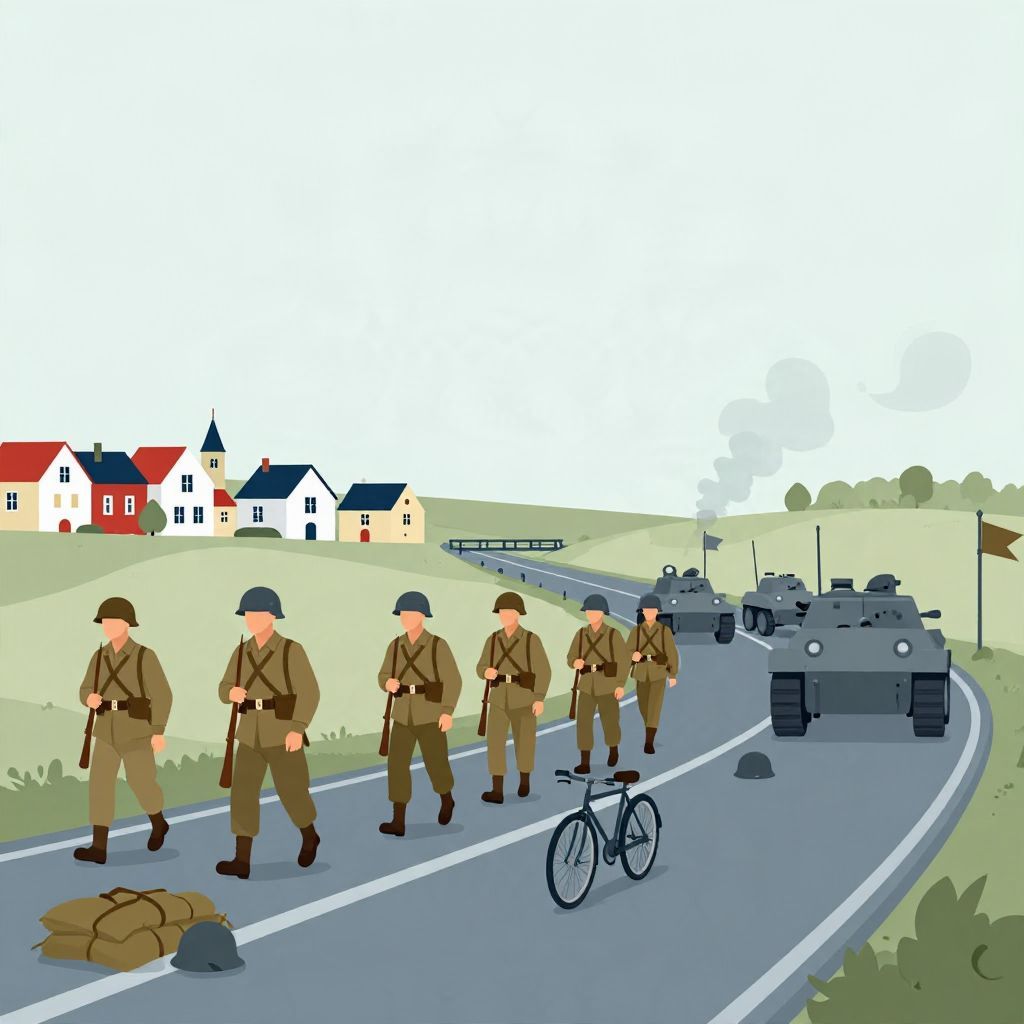
France’s defeat in 1940 was shocking because it seemed to happen so quickly. In just six weeks, German forces broke through French defenses, surrounded Allied armies, and forced the French government to seek an armistice. The fall of France was not caused by a single failure, but by a combination of military doctrine, strategic surprise, political division, and Germany’s highly effective campaign in the west.
To understand why France fell so easily to the Nazis, it helps to look beyond the myth of French weakness. France in 1940 was not defenseless or cowardly; it had one of Europe’s largest armies and powerful fortifications. But it was prepared for the wrong kind of war, while Germany exploited speed, coordination, and surprise with devastating effect.
Why Did France Fall So Easily To The Nazis?
France fell quickly in 1940 because German forces used a fast, concentrated offensive through the Ardennes, bypassing the Maginot Line and splitting French and British armies. French strategy was too rigid, command structures were slow, and political confidence was brittle after the trauma of World War I. The result was a military collapse, not an instant national surrender.
France Was Not Weak, But It Was Preparing for the Wrong War
After the devastation of World War I, French leaders expected another long, grinding conflict like the one from 1914 to 1918. That expectation shaped defense planning. France invested heavily in static fortifications, especially the Maginot Line, a chain of defenses along the German border designed to slow or stop an invasion.
The problem was not that fortifications were useless. They did protect parts of the frontier. The deeper issue was that French military thinking emphasized defense, mobilization, and attrition rather than rapid maneuver. When Germany attacked in May 1940, the war was decided much faster than French planners had anticipated.
The legacy of World War I
France had suffered enormous losses in the First World War. That experience encouraged caution, caution encouraged defensive planning, and defensive planning encouraged faith in fixed positions. Many French officers believed the next war would again be won by holding ground, wearing down the enemy, and waiting for reserves to arrive. Germany’s 1940 campaign made that assumption obsolete almost immediately.
German Strategy Exploited French Expectations
The German plan in 1940 was not simply a repeat of 1914. The main thrust, associated with the so-called Sichelschnitt or “sickle cut,” drove through the Ardennes forest in Belgium and Luxembourg, an area French commanders considered difficult for a major armored attack. German armored divisions crossed the Meuse River at Sedan and advanced rapidly toward the Channel.
This maneuver was decisive because it bypassed the strongest French defenses and threatened to encircle the best Allied armies moving into Belgium. Once German forces reached the coast, large numbers of French and British troops in the north were cut off. The evacuation at Dunkirk saved many soldiers, but it did not save the campaign.
Speed and coordination mattered
German success depended on combining tanks, motorized infantry, artillery, air support, and radio communication in a coordinated offensive. This is often associated with “blitzkrieg,” though historians note that the term is more of a later label than a formal German doctrine. Still, the underlying reality was clear: Germany moved faster, communicated better, and concentrated force more effectively than its opponents expected.
French Command Was Slow, Fragmented, and Too Rigid
France had capable officers and brave soldiers, but its command system struggled under pressure. Decisions often moved slowly through layers of hierarchy. Communications were unreliable. Once the German breakthrough began, French leaders had difficulty understanding the scale of the threat and responding quickly enough.
French strategy also relied on a plan that committed major forces into Belgium early in the war. That made sense if Germany repeated the 1914 route through northern Belgium, but it became dangerous when the main attack came farther south through the Ardennes. French and British armies advanced to meet a threat that was not the main danger, leaving the real breakthrough point underdefended.
Command confusion after Sedan
When German troops crossed the Meuse near Sedan, French units there were overwhelmed by air attacks, artillery, and armored assaults. Panic spread in some sectors, and local collapses had strategic consequences. Once the front cracked, the French high command had trouble restoring a coherent line. In a fast-moving war, delay was fatal.
The Maginot Line Was Strong, But It Could Be Outflanked
The Maginot Line is often treated as a symbol of foolishness, but that is too simple. It was a serious defensive system that did what it was designed to do in the sectors it covered. The real problem was that it did not extend in the same way through Belgium, partly because French leaders wanted to preserve Belgian neutrality and partly because they expected future fighting there to be mobile rather than fortress-based.
Germany did not need to storm the strongest parts of the line. By attacking elsewhere, it turned a major French investment into a partial solution. The fortifications were not irrelevant, but they could not by themselves stop a strategic encirclement.
Political Division and Low National Confidence Weakened France
France entered the war with serious political tensions. The interwar period had been marked by unstable governments, ideological conflict, economic strain, and deep disagreement over how to confront Nazi Germany. Some French leaders favored firm resistance; others hoped to avoid another catastrophic war at almost any cost.
These divisions did not cause the military defeat by themselves, but they made it harder to sustain a unified national response once the crisis began. As the German advance continued, fear of social collapse and civil disorder grew. That fear helped shape the decision to seek an armistice rather than continue the fight from North Africa or alongside the British.
The trauma of 1914–1918
French society was still haunted by the First World War. The memory of trench warfare, mass casualties, and occupation made many people desperate to avoid another prolonged national catastrophe. That psychological burden mattered in 1940. When defeat seemed imminent, some leaders concluded that surrendering to Germany was preferable to continuing a war they believed France could no longer win on its own soil.
The Air War and the Collapse of Morale
German air power helped the offensive by attacking roads, bridges, troop columns, and communications. The Luftwaffe did not win the war alone, but it intensified confusion and slowed French movement at critical moments. Air attacks also had a psychological effect, especially on troops already under pressure and civilians fleeing the advance.
Morale is often discussed too simplistically, as if France “lost the will to fight.” That is misleading. Many French units resisted hard and suffered severe losses. But once the front was broken and retreat became chaotic, morale problems compounded the military crisis. Soldiers and civilians alike saw the state’s ability to protect them collapse in real time.
Britain’s Role and the Limits of Allied Coordination
France was not fighting alone. Britain sent the British Expeditionary Force, and the two allies planned together. But coordination was imperfect, and the campaign moved too quickly for a stable joint response. When the German breakthrough threatened the northern armies, Allied command struggled to adapt.
The evacuation from Dunkirk in late May and early June 1940 preserved much of the British army, but it also meant that France lost a major portion of its Allied support on the ground. Britain continued the war, but France faced the German offensive increasingly on its own. That imbalance mattered greatly in the final weeks of the campaign.
Why the Defeat Was So Fast
The speed of France’s collapse is what still shocks many readers. The answer is that modern war can produce rapid strategic failure when an army loses its communications, its operational plan, and its ability to regroup. France was not conquered in a single battle. It was defeated by a sequence of linked disasters that unfolded faster than its system could absorb.
- German forces achieved surprise by attacking through the Ardennes.
- French planning misread the main threat and committed forces elsewhere.
- The breakthrough at Sedan opened the way for an armored advance to the Channel.
- Allied armies in the north were cut off, forcing retreat and evacuation.
- French command and politics could not recover quickly enough to stabilize the front.
Did France “Surrender Easily”?
Not exactly. The phrase “fell so easily” can be misleading. France’s military defeat was rapid, but it was not effortless. French soldiers fought hard in many places, and the campaign caused heavy casualties on both sides. The collapse came because the German offensive shattered the structure of defense faster than France could rebuild it.
It is also important to distinguish military defeat from national agreement. The armistice of June 1940 reflected the choices of a French government facing collapse, not unanimous French consent. Many French people rejected defeat, and the Free French movement under Charles de Gaulle continued the struggle from abroad.
What Happened After the Fall of France?
France’s defeat reshaped the Second World War. The country was divided into an occupied zone and the collaborationist Vichy regime, while the resistance gradually grew. Germany gained control over much of Western Europe, and Britain found itself fighting alone for a time. The defeat also changed military thinking worldwide, showing how quickly a modern state could be overwhelmed if it relied on the wrong assumptions.
In the longer term, the fall of France became a warning about the danger of preparing for the last war instead of the next one. It also demonstrated that fortifications, brave troops, and large armies are not enough if strategy, communication, and political resolve fail at the decisive moment.
The best answer to why France fell so quickly is that Germany combined surprise, mobility, and operational concentration while France relied on defensive assumptions shaped by World War I. The result was a military collapse that was fast, dramatic, and deeply consequential, but not simple or inevitable.