
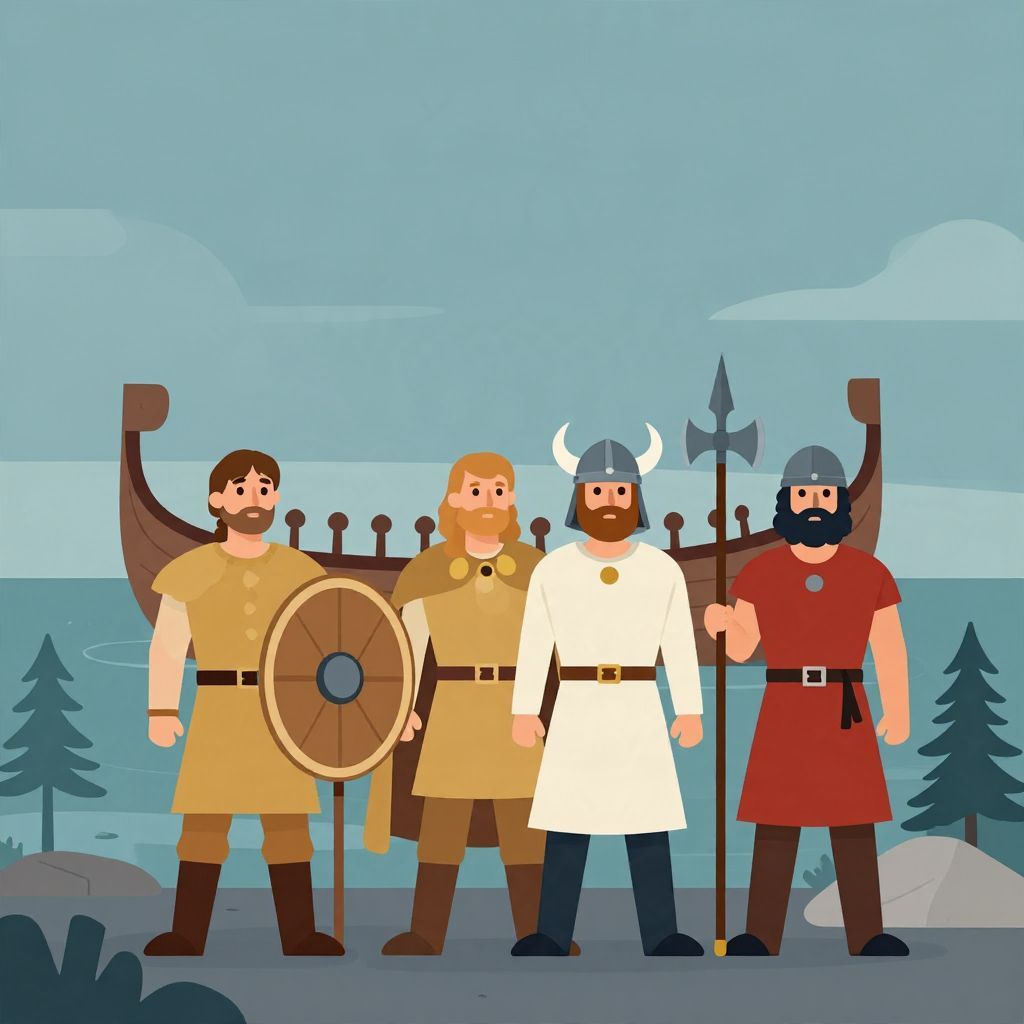
What did Vikings look like? The short answer is that they were not a single “type” of person. Vikings were people from Scandinavia during the late eighth to eleventh centuries, and their appearance varied by region, age, sex, diet, and status. Modern images often exaggerate them as huge, horned, or uniformly blond, but the historical evidence shows a more ordinary and diverse population.
Archaeology, written sources, and scientific studies together give us a clearer picture: most Vikings likely wore practical clothing, kept their hair and beards groomed, and looked much like other northern Europeans of their time. Their appearance was shaped less by fantasy than by everyday life in a harsh climate and a highly mobile world.
What Did Vikings Look Like?
Vikings were generally medium to tall for their era, with a range of hair colors, eye colors, and skin tones typical of medieval Scandinavia. Men often wore beards or moustaches, while both men and women dressed in layered wool and linen clothing suited to cold weather. The “horned helmet” image is a later myth.
Who Were the Vikings, and When Did They Live?
“Viking” was not a blanket term for all Scandinavians. It usually referred to people from Denmark, Norway, and Sweden who took part in raiding, trading, exploration, or settlement during the Viking Age, roughly from the late 700s to the mid-1000s.
Why the timeline matters
Appearance changed over time. Early Viking Age communities were not identical to later ones, and people in coastal trading towns did not look exactly like inland farmers. The Viking world also reached from Ireland to Russia, Byzantium, and North America, so “Viking appearance” can mean several overlapping populations rather than one fixed look.
How Do We Know What Vikings Looked Like?
Historians do not rely on myths or movies. The best evidence comes from graves, skeletal remains, preserved textiles, grooming tools, artwork, and occasional written descriptions from outsiders. No single source tells the whole story, so historians combine different kinds of evidence to build a careful reconstruction.
Archaeology and burial evidence
Burials sometimes preserve combs, razors, tweezers, hair pins, clothing fragments, and jewelry. These finds show that grooming mattered. Skeletal remains can also indicate average height, health, diet, and signs of physical labor, all of which help explain how Vikings may have appeared in daily life.
Written accounts
Some medieval writers described Scandinavians as striking, clean, or intimidating, but such accounts were often written by outsiders with their own biases. A hostile observer might emphasize danger, while a trading partner might notice cleanliness or fine clothing. These descriptions are useful, but they must be read critically.
Scientific research
Modern DNA studies and isotope analysis have shown that Viking Age people were not genetically uniform. There was movement across the North Sea, the Baltic, and beyond. Some individuals buried in Scandinavian contexts had ancestry from other regions, and vice versa. That means Viking communities were more mixed than older stereotypes suggest.
What Did Viking Men Look Like?
Viking men probably varied widely in build and appearance, but many were likely lean and muscular from physical work, travel, and warfare. Average height in the Viking Age was lower than today, though some individuals were quite tall for their time. Their faces and bodies would have reflected hard labor, weather exposure, and uneven access to food.
Hair and beards
Popular images often show Vikings with long, wild hair, but grooming evidence suggests many took pride in a neater appearance. Combs, razors, and tweezers are common finds in Viking Age graves. Men may have worn beards, moustaches, or trimmed hair, though styles likely differed by region and personal preference.
Clothing and accessories
Men usually wore wool tunics, trousers, belts, cloaks, and sturdy shoes. Wealthier men could display status through dyed fabrics, brooches, imported goods, and decorated weapons. Jewelry and clothing fasteners were not mere decoration; they signaled rank, wealth, and identity in a society where appearance carried social meaning.
What Did Viking Women Look Like?
Viking women also varied in appearance, but they too likely wore practical layered clothing and paid attention to grooming. Their dress was shaped by work, climate, and social status. Women’s graves often contain keys, brooches, beads, textile tools, and personal items that help historians understand their daily lives.
Dress and status
Typical female clothing included a linen underdress and a wool overdress, often fastened with brooches. Aprons, belts, and shawls were common. Wealthier women could wear imported beads, silver ornaments, or finely made fabrics. Like men, women’s appearance often communicated family standing and household authority.
Hair and head coverings
Evidence suggests women may have arranged their hair in braids, knots, or covered styles, though the exact fashions are not always certain. Head coverings were practical in a northern climate and could also reflect modesty or local custom. As with men, there was no single universal “Viking” hairstyle.
Did Vikings Really Wear Horned Helmets?
No, not in battle. The famous horned helmet is a modern invention, popularized in the 19th century and reinforced by stage costumes, art, and later film. Archaeological finds from the Viking Age do not support the idea that ordinary Viking warriors wore horned helmets into combat. Horns would have been impractical and dangerous in a fight.
What helmets did they use?
Real Viking helmets were generally simple and functional, often made of iron with a rounded or conical shape. Most warriors may not have owned helmets at all, since metal armor was expensive. Protection in battle depended heavily on shields, shields, mail for the wealthy, and disciplined use of weapons.
Were Vikings Blond, Blue-Eyed, and Fair-Skinned?
Some were, but not all. Scandinavia has long had a range of hair and eye colors, and Viking Age populations were no exception. The popular image of the uniformly blond Viking is an oversimplification. Historical and scientific evidence points to diversity within Scandinavian communities and among Viking travelers, settlers, and traders.
Why the blond stereotype became so strong
Later nationalist art, romantic literature, and modern media helped turn the Viking into a symbol of northern whiteness and physical power. That image says more about later cultural imagination than about the Viking Age itself. In reality, appearance varied, and contact with other peoples broadened that diversity further.
How Tall and Strong Were Vikings?
On average, Viking Age people were somewhat shorter than modern adults because of nutrition, disease, and living conditions, but many were robust. Men often stood around average medieval heights for northern Europe, though exact figures varied by site and period. Their strength came from daily labor rather than from some unique biological difference.
Diet and body type
People in farming communities ate grain, dairy, fish, meat, and vegetables when available. Diet affected growth and health, so wealthier or better-fed individuals may have been taller and healthier than poorer neighbors. Skeletal evidence also shows injuries and wear consistent with hard physical work, sailing, and combat.
What Clothing and Grooming Made Vikings Stand Out?
What made Vikings visually distinctive was often not an exotic body type but their style, maintenance, and social display. Clean hair, combs, jewelry, dyed fabrics, and carefully made clothing could make a strong impression. To outsiders, this combination of grooming and confidence may have seemed striking.
Practical style in a cold climate
Layering was essential. Wool insulated well even when damp, while linen was comfortable against the skin. Cloaks, belts, and sturdy footwear helped people travel and work. Bright dyes, embroidery, and imported ornaments were signs of wealth and access to trade networks, not universal everyday wear.
Did Vikings Look the Same Everywhere?
No. The Viking world stretched across seas and river systems, and appearance changed with local customs and mixed populations. A person in Norway, a settler in Iceland, a trader in Dublin, or a warrior in the Baltic could all be called “Viking” in a broad sense, yet their clothing and appearance might differ noticeably.
Settlement and cultural mixing
As Vikings settled in places such as England, Ireland, Normandy, and parts of the North Atlantic, they interacted with local populations. Over generations, this produced new identities and blended material cultures. Viking appearance was therefore not static; it evolved through migration, marriage, trade, and conquest.
Why the Viking Look Matters Historically
Understanding what Vikings looked like helps correct myths and shows how history is reconstructed from evidence. Their appearance reveals everyday life, social hierarchy, craftsmanship, and contact between peoples. It also reminds us that “Viking” was an activity and identity, not a single race or costume.
From legend to evidence
The real Vikings were neither fantasy warriors nor simple caricatures. They were farmers, traders, raiders, craftspeople, and settlers whose appearance reflected the realities of medieval Scandinavia. The more carefully we study them, the more human they become: diverse, practical, and deeply connected to their world.
So, what did Vikings look like? They looked like real people of the early medieval North: varied in height and features, often well-groomed, dressed for utility and status, and far less theatrical than later legend suggests. If you want to explore more about the Viking Age and medieval Europe, a broader history overview at HistoryOrg can be a useful place to continue.