
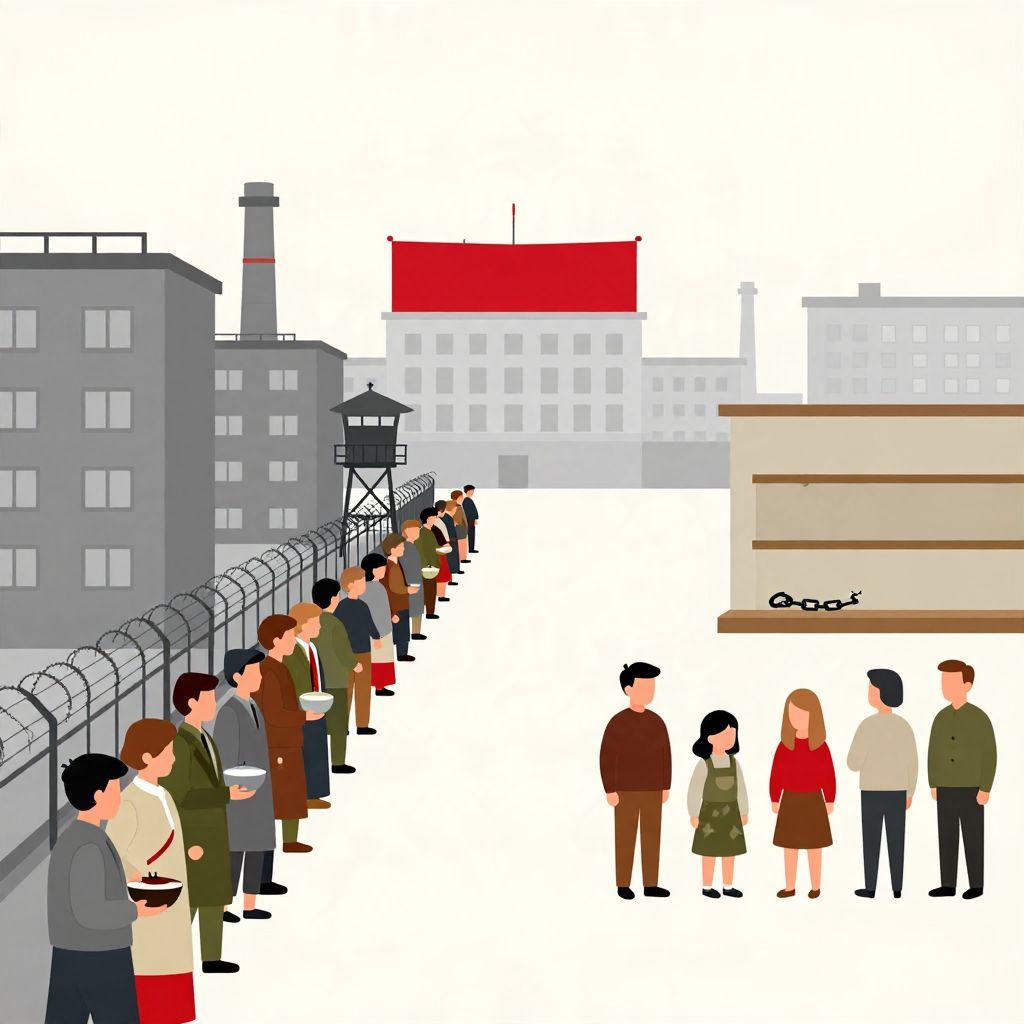
Why is communism hated? The short historical answer is that, in the 20th century, communist governments were often associated with dictatorship, repression, shortages, violence, and the loss of political and religious freedom. Those experiences shaped public memory far more than the theory itself.
At the same time, communism has never meant exactly one thing. It has been a political ideal, a revolutionary movement, and in practice a range of very different states and regimes. To understand why so many people came to fear or dislike it, you have to look at both the ideas and the historical record.
Why is communism hated?
Communism is often hated because, in many countries, it was linked to one-party rule, secret police, censorship, forced collectivization, labor camps, and mass suffering. During the 20th century, communist revolutions and regimes in the Soviet Union, China, Cambodia, Eastern Europe, and elsewhere produced outcomes that many people experienced as coercive and destructive rather than liberating.
What communism promised, and why that mattered
Communism began as a theory of social and economic equality. In the writings of Karl Marx and Friedrich Engels in the mid-19th century, communism was presented as a future classless society in which private ownership of the means of production would disappear and exploitation would end. For workers living through industrial poverty, that promise was powerful.
In theory, communism aimed to solve real problems created by industrial capitalism: low wages, dangerous labor, inequality, and concentrated wealth. That is one reason it attracted supporters across Europe, Asia, Latin America, and Africa. But the gap between the ideal and the historical reality became one of the main reasons it was later hated.
How communist revolutions turned into authoritarian states
In practice, many communist movements took power through revolution, civil war, or foreign-backed conflict. Once in power, they often argued that opposition had to be crushed to defend the revolution. Over time, this logic frequently produced centralized party rule, limited elections, censorship, and punishment of dissent.
The Soviet Union
After the Russian Revolution of 1917, the Bolsheviks promised land, peace, and bread. But the new Soviet state soon became highly centralized. Under Joseph Stalin, especially in the late 1920s and 1930s, the regime carried out forced collectivization, rapid industrialization, political purges, and widespread terror. Millions died from famine, imprisonment, execution, and forced labor. For many observers, this became the defining image of communism itself.
China under Mao
In the People’s Republic of China, founded in 1949, communist rule also brought major social transformation, but at enormous human cost. The Great Leap Forward (1958–1962) led to one of the worst famines in modern history. Later, the Cultural Revolution (1966–1976) brought political chaos, persecution, humiliation, and violence against millions. These events deeply damaged the reputation of communism worldwide.
Cambodia and other cases
Under the Khmer Rouge in Cambodia (1975–1979), an extreme communist regime attempted to remake society by force, emptying cities and targeting intellectuals, minorities, and perceived enemies. The result was genocide and mass death. Elsewhere in Eastern Europe, communist governments often ruled through surveillance, censorship, and police power, even when they did not produce catastrophe on the same scale.
Why repression became so common
Communist regimes often claimed they represented the “working class” or “the people” as a whole. That claim made opposition easy to portray as treason. If one party says it alone speaks for history, then critics can be treated not as fellow citizens but as enemies of progress. This helped justify repression.
There was also a structural problem. In many communist systems, the state controlled the economy, the media, and political life. That concentration of power made abuse easier and accountability harder. When the same institution controls jobs, food supplies, information, and police power, ordinary people have few ways to resist.
Economic failure and everyday hardship
Another reason communism is hated is that many people experienced it through shortages and stagnation. Central planning aimed to replace markets with state decisions, but in practice it often struggled to match supply with demand. This could mean poor-quality goods, long queues, housing shortages, and weak incentives for innovation.
To be fair, communist states did sometimes achieve real gains in literacy, industrialization, public health, and women’s access to education and work. But these gains were often overshadowed by inefficiency, corruption, and the lack of consumer choice. For ordinary citizens, daily life could feel controlled and frustrating rather than equal and secure.
Fear of losing freedom
For many people, the deepest objection to communism was not economic but political. In communist states, opposition parties were often banned, independent newspapers restricted, and religious institutions pressured or suppressed. Travel could be limited, speech monitored, and private organizations absorbed into state control.
This made communism especially unpopular among those who valued civil liberties, religion, private property, or local autonomy. Even people who supported social reform often rejected communist systems because they seemed to demand obedience in exchange for equality.
The role of the Cold War
Communism’s reputation was also shaped by the Cold War, the global rivalry between the United States and the Soviet Union after 1945. In that conflict, anti-communism became a major political force in the West. Governments, newspapers, schools, and propaganda often emphasized Soviet repression and communist expansion.
At the same time, communist states portrayed the West as exploitative and imperialist. Both sides used ideology to justify themselves. But in many countries, especially those that experienced Soviet domination in Eastern Europe or anti-communist violence in Asia and Latin America, the memory of communism became tied to fear, occupation, and lost sovereignty.
Why some people still defend communism
It is important to distinguish between communism as an idea and communist states as historical regimes. Some people continue to admire communism because they see it as a critique of inequality, exploitation, and corporate power. Others point out that many atrocities were committed by regimes calling themselves communist, but not necessarily by every person who ever supported socialist or Marxist ideas.
There is also a difference between communism and broader left-wing politics. Social democracy, labor reform, and public welfare states are not the same as revolutionary communism. In fact, many reformers who wanted redistribution and social justice explicitly rejected one-party rule and political terror.
Common reasons communism became so unpopular
- Political repression: censorship, secret police, prison camps, and persecution of opponents.
- Mass violence: purges, famines, executions, and forced relocations in some regimes.
- Economic shortages: weak consumer supply, poor incentives, and planning failures.
- Loss of freedom: limits on speech, religion, travel, and political competition.
- Propaganda and fear: Cold War messaging amplified negative images of communism.
- Mismatch between theory and practice: the promised equality often became elite rule by a party bureaucracy.
Why the historical memory is so strong
People often judge political systems by lived experience, not by theory. For millions who endured famine, imprisonment, surveillance, or forced conformity under communist governments, hatred of communism is rooted in memory and trauma. In countries that transitioned away from communism, public debate often centered on truth, justice, and whether the old regime should be condemned or remembered more carefully.
At the same time, the historical record is uneven. Some communist states lasted decades and changed society in lasting ways. Others collapsed quickly. Some people benefited from expanded education or social services, while others suffered terribly. That complexity matters, but it does not erase why so many came to reject communism so strongly.
The historical bottom line
Communism is hated not simply because it is a different political idea, but because its 20th-century history is closely associated with coercion, authoritarian rule, and human suffering. The theory promised equality; the practice often delivered fear and control. If you want to place communism in a broader historical context, it helps to compare it with other political ideologies and to understand how a police state can shape everyday life under authoritarian rule.