
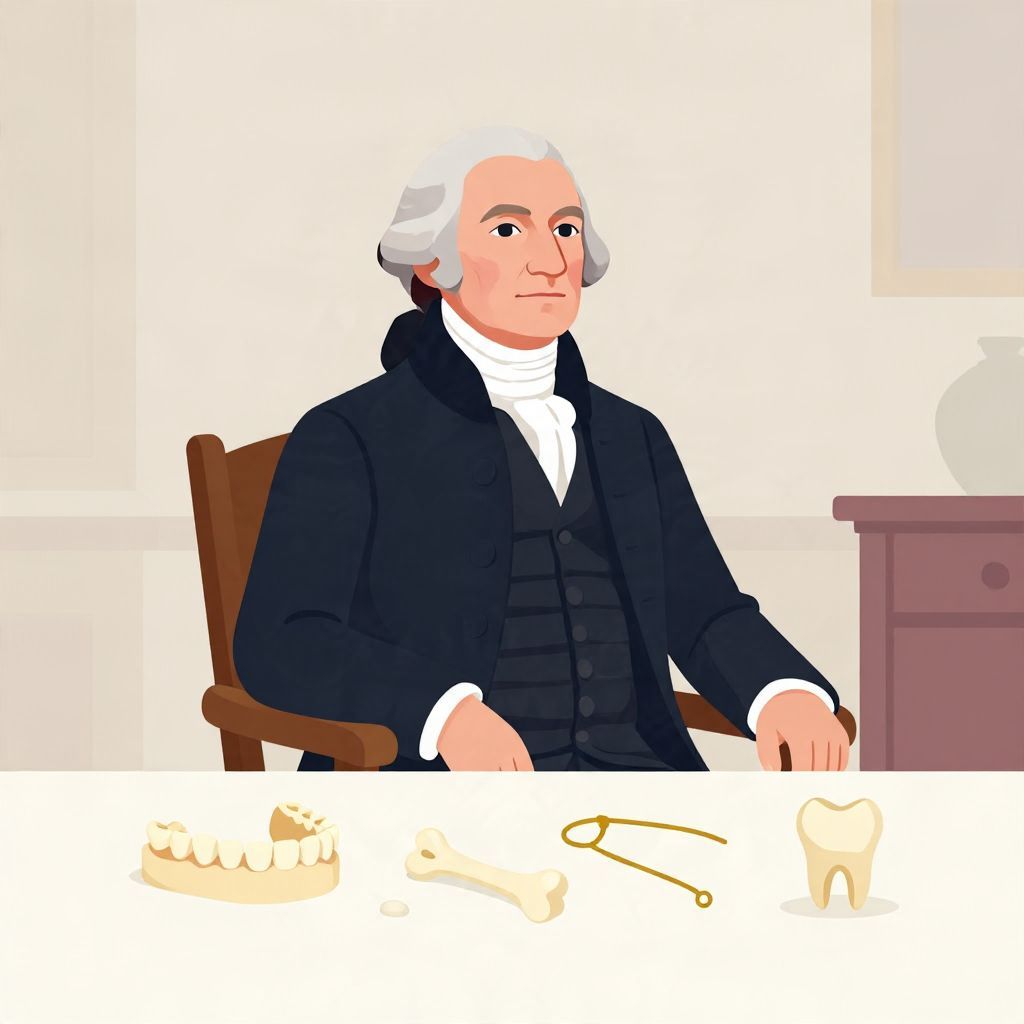
George Washington’s teeth were not made of wood, despite a long-lasting myth. They were mostly fashioned from a mix of materials common in 18th-century dentistry: human teeth, animal teeth, ivory, metal fasteners, and perhaps other substances used by dentists of the period. His dentures were uncomfortable, expensive, and handmade, reflecting the limits of early modern dental care.
The story of Washington’s teeth is famous because it reveals both the realities of elite medicine in the Revolutionary era and the power of legend. His dentures were real, but the “wooden teeth” tale is not. Understanding what they were actually made of helps explain how dentistry worked in the late 1700s and why Washington’s smile became part of American folklore.
What were George Washington’s teeth made of?
George Washington’s dentures were made from a combination of materials, including human teeth, animal teeth, ivory, and metal components. They were not wooden. Surviving records and examinations of his dentures indicate that 18th-century dentists used whatever durable materials they could obtain, and Washington’s false teeth likely reflected that practical, mixed-material approach.
The truth behind the “wooden teeth” myth
The wooden-teeth story is one of the best-known myths about Washington, but it is false. Wood would have absorbed moisture, warped, and broken down quickly in the mouth, making it a poor choice for dentures. The myth probably stuck because Washington’s teeth looked unnatural and because people in later generations simplified the story into an easy-to-remember image.
Why the myth spread
Washington wore dentures for much of his adult life, and his mouth often appeared tight or strained in portraits. That unusual look helped fuel speculation. Over time, the idea of “wooden teeth” became a shorthand for old-fashioned dentistry, even though no reliable evidence supports it.
What materials were actually used in 18th-century dentures?
In Washington’s era, dentures were handcrafted from a range of materials. Dental technology did not yet include modern plastics or reliable porcelain systems. Instead, dentists assembled dentures from materials that were available, durable, and aesthetically acceptable, even if they were uncomfortable and imperfect.
Human teeth
Human teeth were sometimes used in dentures, especially front teeth, because they looked more natural than other substitutes. They could be purchased from donors or obtained through extraction from the dead, though practices varied and were often unsettling by modern standards. Washington’s dentures may have included some human teeth, though the exact quantity is not always certain.
Animal teeth and ivory
Ivory, especially from elephants or hippopotamuses, was a common denture material in the 18th century. It could be carved into a shape that resembled teeth and gums. Animal teeth were also used, though they wore down and stained over time. Ivory was popular because it could be shaped relatively easily, but it also darkened and cracked with use.
Metal springs, wires, and fasteners
Washington’s dentures were held together with metal parts, including springs and wires. These mechanical pieces helped the upper and lower sections stay in place. They also made the dentures bulky and difficult to wear. The pressure from these springs could be painful, and Washington’s surviving correspondence suggests that he struggled with discomfort throughout his life.
Possible additional materials
Some historians and dental experts have suggested that Washington’s dentures may also have included lead, brass, or other metals in the framework. The exact composition of each set is difficult to reconstruct because Washington had multiple dentures made over time, and not all survive in perfect condition. What is clear is that they were handmade assemblies, not a single standardized product.
Why did George Washington need dentures?
Washington suffered from poor dental health long before he became president. He lost his first tooth as a young man and continued losing teeth throughout his adult life. By the time he became president, he had very few natural teeth left. Dental disease, extractions, and the limitations of 18th-century treatment all contributed to his reliance on dentures.
Tooth loss in the 1700s
Tooth loss was common in the 18th century. People lacked modern anesthesia, antibiotics, and preventive dentistry. Fillings existed in limited forms, but serious decay often led to extraction. Sugary diets, inherited dental problems, and the general state of medical care made dentures a practical necessity for many wealthy adults.
Washington’s own dental history
Washington’s letters and accounts from his life show that he dealt with constant dental pain. He had repeated extractions and consulted dentists over many years. His dentures were not a cosmetic luxury alone; they were an attempt to restore function, speech, and appearance in an age when dentistry offered only partial relief.
How were Washington’s dentures made?
Washington worked with dentists and craftsmen who built custom sets for him. These dentures had to fit his mouth as closely as possible, but the process was still rough and imprecise by modern standards. The result was often heavy, awkward, and painful, even when made by skilled hands.
Handmade and custom-fitted
Each set was individually crafted from molds, measurements, and adjustments. Because the materials were rigid and the fit imperfect, Washington sometimes had trouble speaking and eating comfortably. The dentures also changed the shape of his face, which may explain the tight-lipped expression seen in some portraits.
Not all of his dentures were the same
Washington did not wear one single set for his entire life. He had several sets made at different times, and they may have varied in material and design. That is one reason historians are careful not to describe his dentures too simplistically. The surviving evidence points to a sequence of dental appliances rather than one fixed object.
Who made George Washington’s dentures?
Several dentists and craftsmen worked on Washington’s teeth over the years, most notably John Greenwood, one of the best-known American dentists of the Revolutionary era. Greenwood is often associated with Washington’s dentures, though other practitioners also played a role. These men combined dental knowledge with mechanical skill in an age before dentistry became a fully standardized profession.
John Greenwood and early American dentistry
Greenwood was a pioneering dentist in New York and later attended Washington. He is especially important because he helped preserve and document the president’s dental appliances. His work shows how dentistry in the late 18th century depended on craftsmanship, experimentation, and patronage from elite clients.
What did Washington’s dentures look like?
Washington’s dentures were large, complex, and visibly artificial. They were designed to replace missing teeth and support his jaw, but they did not look natural by modern standards. The materials likely gave them a pale, ivory-like appearance rather than the clean white of modern dentures.
Why portraits can be misleading
Artists often softened or idealized Washington’s features, but some portraits still hint at the strain caused by his dentures. His mouth appears compressed in several images, and his expression can seem rigid. That visual evidence has helped keep the myth of wooden teeth alive, even though the real explanation is more interesting.
What does the story of Washington’s teeth tell us about history?
Washington’s dentures are more than a quirky detail. They show how medicine, craftsmanship, and status worked in the 18th century. Wealthy people could commission custom dental appliances, but those appliances were still primitive, painful, and imperfect. The story also shows how later generations turn historical facts into simplified legends.
Medicine before modern dentistry
Before the 19th century, dentistry was a rough trade. Skilled practitioners could extract teeth and build replacements, but they could not prevent decay the way modern dentists can. Washington’s experience was typical of elite patients who had access to the best care available yet still suffered considerable discomfort.
How myth can outlast fact
The wooden-teeth myth survives because it is vivid and easy to repeat. The real story—human teeth, ivory, metal, and craftsmanship—is less tidy but historically accurate. It reminds us that popular memory often favors simple images over complicated truths.
Why Washington’s dentures mattered in his public life
Washington was acutely aware of his appearance. As a public figure, he wanted to project authority, composure, and dignity. His dentures helped him function in public, but they also affected how he looked and perhaps how he felt. In a political culture that valued restraint and honor, even a president’s teeth could become part of his image.
The personal cost of public leadership
His dental problems were private suffering behind a public role. They did not define his presidency, but they did shape daily life. That human detail makes Washington less mythic and more real: a famous leader who endured pain, used the best technology of his day, and still could not escape the limits of his time.
So, what were George Washington’s teeth made of? Most likely a combination of human teeth, animal teeth, ivory, and metal—not wood. The myth is memorable, but the historical reality is richer, and it reveals a great deal about 18th-century medicine, craftsmanship, and the making of American legend. For more context on his appearance and public image, see what George Washington looked like.