
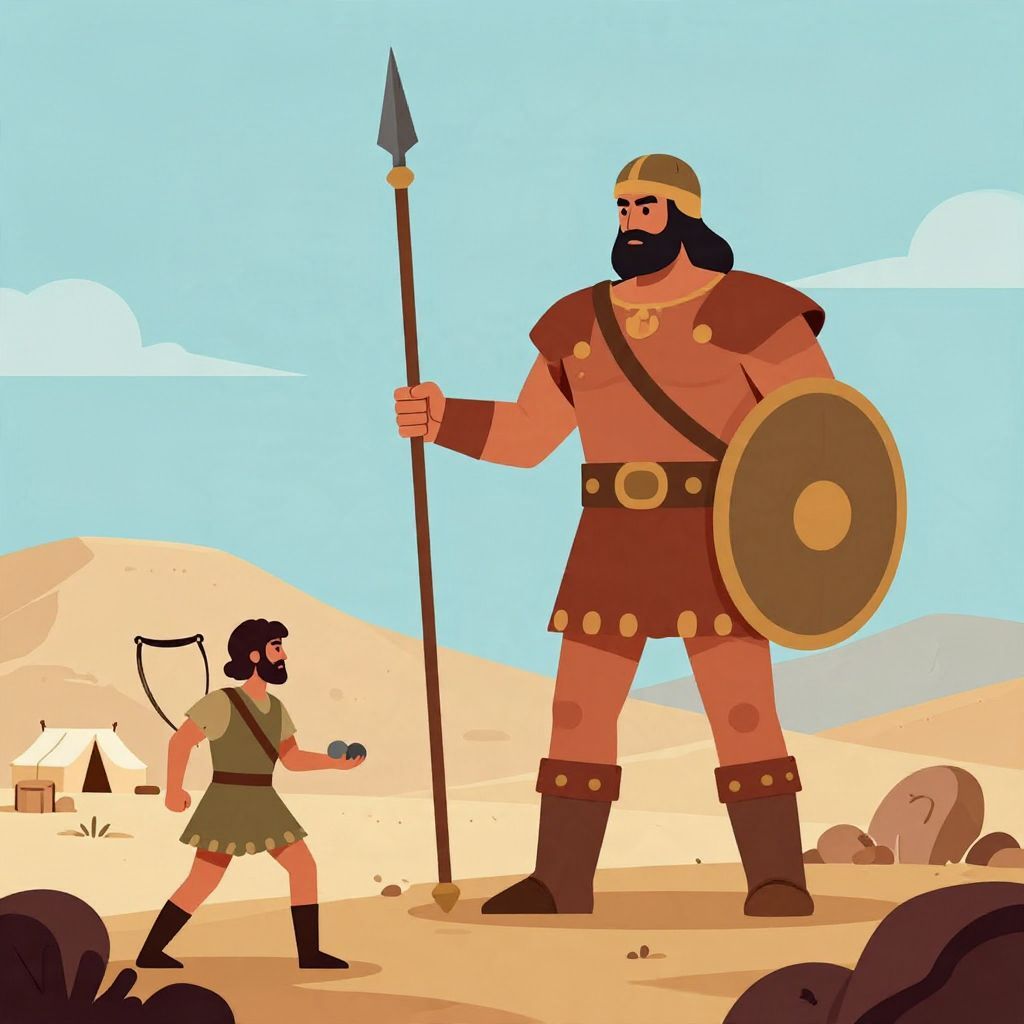
How big was Goliath in the Bible? The short answer is that the biblical text gives him a height of “six cubits and a span” in the Masoretic Text, which is usually understood as about 9 feet 9 inches (roughly 2.97 meters). But some ancient manuscripts preserve a shorter reading of “four cubits and a span,” closer to 6 feet 9 inches (about 2.06 meters).
That difference matters because Goliath is not just a giant in a story; he is also a window into how biblical texts were copied, transmitted, and interpreted over time. The question of his size sits at the intersection of scripture, ancient warfare, and textual history.
How big was Goliath in the Bible?
In the best-known Hebrew version of 1 Samuel 17, Goliath is described as six cubits and a span, which would make him exceptionally tall by ancient standards. However, some early textual witnesses, including the Greek Septuagint and a Dead Sea Scroll fragment, support four cubits and a span. That means scholars cannot say with certainty that the original figure was nearly 10 feet tall.
What the biblical text says
The story of David and Goliath appears in 1 Samuel 17, set in the period of the early Israelite monarchy, likely remembered from traditions about the 11th century BCE but written and edited much later. Goliath is presented as a Philistine champion from Gath, armed for single combat. His height is part of the narrative’s dramatic force: he is physically overwhelming, heavily armed, and intimidating to Israel’s army.
The measurement in ancient terms
A cubit was an ancient unit based roughly on the length of a forearm, and a span was about half a cubit. Because ancient cubits varied, exact modern conversions are approximate. Still, the difference between the two readings is large enough to change how readers imagine Goliath:
- Six cubits and a span = about 9 feet 9 inches, or 2.97 meters
- Four cubits and a span = about 6 feet 9 inches, or 2.06 meters
Either way, Goliath is unusually tall. The first reading makes him a near-giant; the second makes him a very large warrior, but still within the range of extraordinary human height.
Why do different Bible manuscripts give different heights?
The variation likely comes from textual transmission. Ancient scribes copied biblical books by hand, and small changes could enter the text over time. In this case, the shorter reading appears in some of the oldest surviving witnesses, while the longer reading became standard in the later Hebrew textual tradition.
Major textual traditions
Scholars usually compare several streams of evidence when studying a passage like this:
- The Masoretic Text, the medieval Hebrew text that became the basis for many modern Old Testament translations, reads “six cubits and a span.”
- The Septuagint, the ancient Greek translation of the Hebrew Bible, reads “four cubits and a span” in many manuscripts.
- Dead Sea Scroll evidence includes a fragment from 1 Samuel that also supports the shorter reading.
Because the shorter reading appears in older textual traditions, many scholars think it may be closer to the earliest form of the story. That does not prove it beyond doubt, but it does make the “four cubits and a span” reading historically significant.
Was Goliath really a giant?
Historically, the story should not be read as a modern biographical report. It is an ancient literary and theological narrative shaped to show David’s courage and God’s favor. Goliath may reflect a real warrior tradition, but the story also uses exaggeration and symbolism common in ancient literature.
Ancient warfare and heroic storytelling
Single combat between champions was a familiar motif in the ancient Near East and the wider Mediterranean world. A larger-than-life enemy made the hero’s victory more impressive. In that sense, Goliath’s height serves the story’s purpose: he embodies Philistine power, military confidence, and human intimidation before divine reversal.
Even if the shorter height is original, Goliath would still have stood out. A man around 6 feet 9 inches would have been remarkable in the ancient world, where average adult male height was generally lower than in many modern populations. If the longer reading is original, then the text presents him as nearly monstrous in stature.
Historical context: Philistines, Israelites, and the early monarchy
The David and Goliath story is set against the backdrop of conflict between the Israelites and the Philistines, a people associated with the southern coastal plain of Canaan. The narrative likely reflects memories from the Iron Age, when small regional polities competed for land, security, and influence.
Who were the Philistines?
The Philistines were one of the major groups in the southern Levant during the early Iron Age, roughly the 12th to 10th centuries BCE. They established powerful city-states such as Gaza, Ashkelon, Ashdod, Ekron, and Gath. Archaeology shows that they were part of a dynamic coastal culture with distinct material traditions, though they also adopted many local Canaanite practices over time.
Goliath is identified as coming from Gath, one of the best-known Philistine centers. That detail gives the story geographic realism, even if the narrative itself is shaped by later theological and literary aims.
What does Goliath’s size mean in the story?
Goliath’s height is not just a physical detail. It signals the imbalance between the two sides and sets up the central theme of the story: apparent weakness can defeat apparent strength. David is younger, less armored, and less imposing, yet he wins through speed, skill, and the story’s theological framing.
Symbolic significance
The biblical author uses Goliath’s size to heighten the contrast between human power and divine support. The giant’s armor, weapons, and stature make him seem invincible. David’s victory overturns those expectations and becomes one of the Bible’s most enduring examples of reversal: the small defeating the mighty.
This is why Goliath’s exact height matters less than the narrative effect. The text wants readers to feel the danger before the victory. His size helps create suspense, but the story’s deeper message is about trust, legitimacy, and divine intervention.
How later tradition shaped the image of Goliath
Over centuries, Goliath became a cultural symbol far beyond the biblical text. In art, preaching, literature, and modern speech, “David and Goliath” came to mean any struggle between a weak underdog and a powerful opponent. That popular use often assumes Goliath was a literal giant, even though the textual evidence is more complex.
Later readers also tended to harmonize the story with the more dramatic height reading. As a result, the idea of a nearly 10-foot Goliath became deeply rooted in tradition, even though older manuscript evidence suggests a shorter figure may have stood behind the text.
So what is the most historically careful answer?
The most careful answer is that the Bible’s main Hebrew text describes Goliath as about 9 feet 9 inches tall, but older textual evidence may point to a height of about 6 feet 9 inches. Because the story survives in multiple manuscript traditions, historians and textual scholars treat the exact measurement as uncertain.
What is certain is that Goliath was meant to appear extraordinarily formidable. Whether he was imagined as a near-giant or simply a very tall champion, his size helped make the David story one of the Bible’s most powerful narratives about conflict, courage, and reversal. For readers interested in the wider setting, related topics include the history of David and Goliath and the ancient Philistines.