
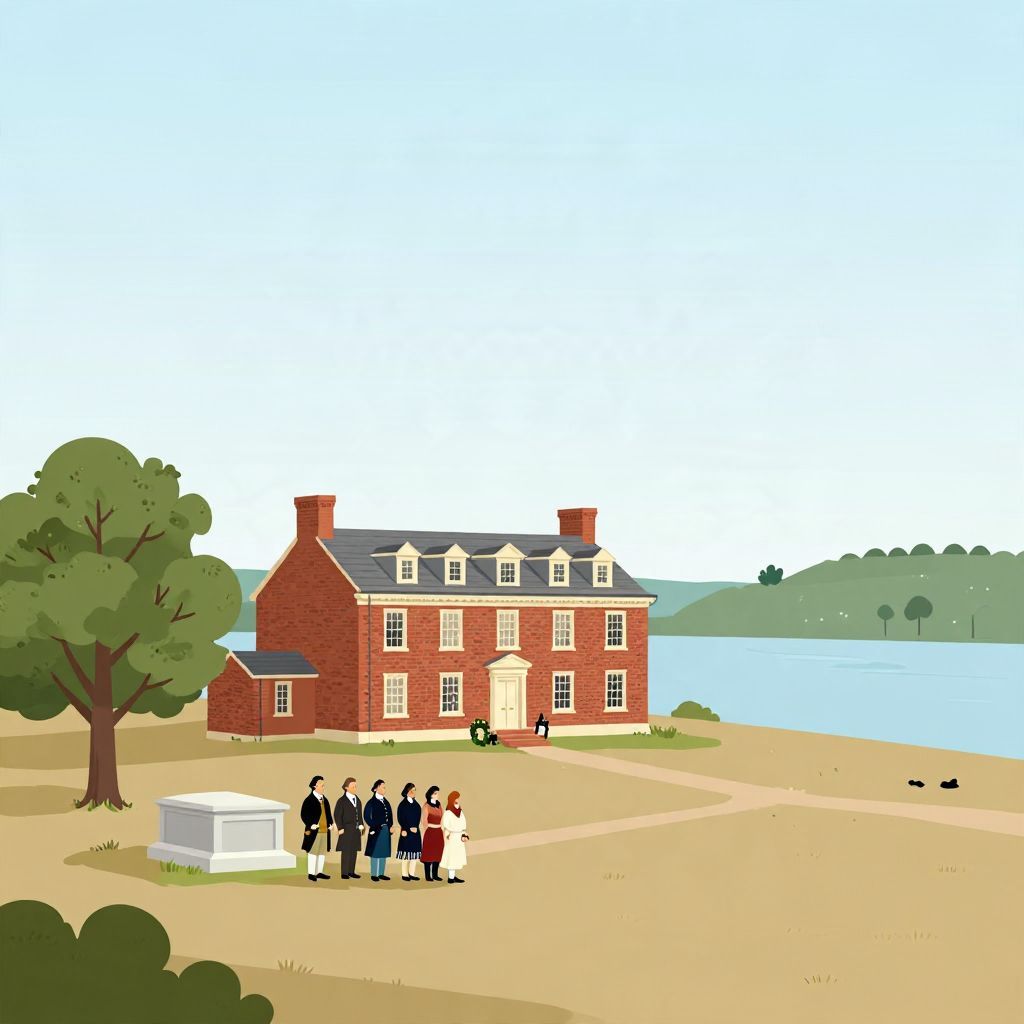
Where is George Washington buried? The first president of the United States is interred at his family estate, Mount Vernon, in Fairfax County, Virginia. His tomb is one of the most visited historic burial sites in the country and reflects both Washington’s own wishes and the nation’s early efforts to honor him after his death in 1799.
Understanding the burial place also helps explain how Americans remembered Washington: not just as a military commander and president, but as a symbol of the new republic. His grave became a place of national memory, family heritage, and public reverence.
Where Is George Washington Buried?
George Washington is buried at Mount Vernon, his plantation home on the Potomac River in Virginia. He was laid to rest there in the family tomb after his death on December 14, 1799. The burial site is on the grounds of the estate, where visitors can still see the tomb and the surrounding memorial area today.
The Burial at Mount Vernon
Washington died at Mount Vernon after a brief illness, and his burial took place there rather than in a national cemetery or the capital city. That choice was consistent with his attachment to the estate, which he had made his home for much of his adult life. The tomb is located near the mansion, in a designated burial enclosure that also holds the remains of members of the Washington family.
Why Mount Vernon?
Mount Vernon was more than a residence. It was Washington’s private home, working plantation, and the place he had spent long stretches of his life before and after the Revolution. Burial there connected him to family tradition and to the landscape he knew best. In the late 18th century, it was also common for prominent landowners to be buried on family property rather than in public cemeteries.
What happened after his death?
After Washington died, his remains were placed in the original family vault at Mount Vernon. Over time, the burial site became a place of pilgrimage. In the 19th century, as Washington’s reputation grew into that of a national founder, Americans increasingly treated Mount Vernon as a shrine to the early republic.
How Washington Died and Was Buried
Washington became ill in early December 1799 after exposure to severe winter weather. He died on December 14 at age 67. Contemporary accounts describe a rapid decline, though medical treatment in the period was limited and often harmful by modern standards. His burial followed soon afterward at Mount Vernon, in accordance with his wishes.
His final wishes
Washington had expressed a desire to be buried at Mount Vernon. He did not want elaborate public display or a burial far from home. This preference reflected both personal modesty and the customs of elite Virginia families. It also meant that the nation’s most famous leader was laid to rest in a private setting rather than in a state monument.
The original tomb and later improvements
The burial vault that held Washington’s remains was not always the more elaborate memorial visitors see today. The family tomb and surrounding structures were improved over time as Mount Vernon became a historic site. The current tomb area is associated with the original burial location, even though the estate’s memorial features were refined in later decades.
Is George Washington’s Body Still at Mount Vernon?
Yes. George Washington’s remains are still at Mount Vernon. His tomb, along with the burial site of Martha Washington and other family members, remains at the estate. The site has been preserved so that visitors can pay respects at the place where Washington was actually buried, not merely at a symbolic memorial.
Martha Washington’s burial
Martha Washington was also buried at Mount Vernon, in the same family burial area. Her interment beside George Washington reinforced the estate’s role as the Washington family’s resting place. The couple’s burial together has long been part of the site’s historical significance.
Why His Burial Site Matters in American History
Washington’s burial at Mount Vernon shaped how Americans remembered him. Rather than being buried in a capital city or a grand national mausoleum, he remained tied to the Virginia estate that represented his private life. This made Mount Vernon both a family burial ground and a national memorial, blending personal history with public memory.
A symbol of republican virtue
In the early United States, Washington’s refusal to seek kingly honors was part of what made him so admired. His burial at home rather than in a dynastic monument fit that image. To many Americans, it suggested humility, restraint, and service to the republic rather than to personal glory.
Mount Vernon as a place of memory
Over the 19th century, Mount Vernon became one of the most important historic sites in the United States. Visitors came not only to see Washington’s home but also to stand at his grave. The burial site helped turn the estate into a living memorial to the founding era.
Common Questions About George Washington’s Burial
Was George Washington buried in Washington, D.C.?
No. Although the nation’s capital was later named for him, George Washington was not buried there. His remains stayed at Mount Vernon in Virginia, where he had requested to be interred.
Was he buried in a national cemetery?
No. National cemeteries were not part of the American landscape in 1799, and Washington was buried on private family land. His tomb predates the later practice of burying major national figures in formal public cemeteries or monuments.
Can the public visit his grave?
Yes. Mount Vernon is open to visitors, and the tomb area is one of its central historic features. The site is preserved as part of the estate’s broader interpretation of Washington’s life, family, and legacy.
The Historical Background of Mount Vernon
Mount Vernon was originally a plantation estate that expanded over Washington’s lifetime. He inherited the property through family connections and gradually transformed it into one of the most recognized estates in colonial America. Its importance today comes from both its association with Washington’s public career and its role as his home and burial place.
From plantation to memorial site
After Washington’s death, Mount Vernon did not immediately become a national shrine. Its transformation took decades, as later generations of Americans increasingly sought physical places to connect with the founding era. The grave became central to that process, giving the estate a powerful emotional and historical draw.
Preservation and public memory
The preservation of Mount Vernon reflects a broader American interest in historic sites tied to the Revolution and the early republic. Washington’s tomb is especially significant because it is not an abstract monument. It is the actual burial place of a major historical figure, which gives the site a strong sense of authenticity.
George Washington’s Burial in Context
Washington’s burial at Mount Vernon was shaped by the customs of his time, his own wishes, and the limited ceremonial culture of the early republic. Unlike later national leaders, he was not buried amid a fully developed system of state funerals and monuments. Yet his grave became one of the most important memorial places in the United States.
That is why the answer to Where is George Washington buried is both simple and historically rich: he rests at Mount Vernon, in Virginia, where his home, family, and public memory meet. For readers interested in Washington’s image and legacy, see also what George Washington looked like and when the Washington Monument was built.