
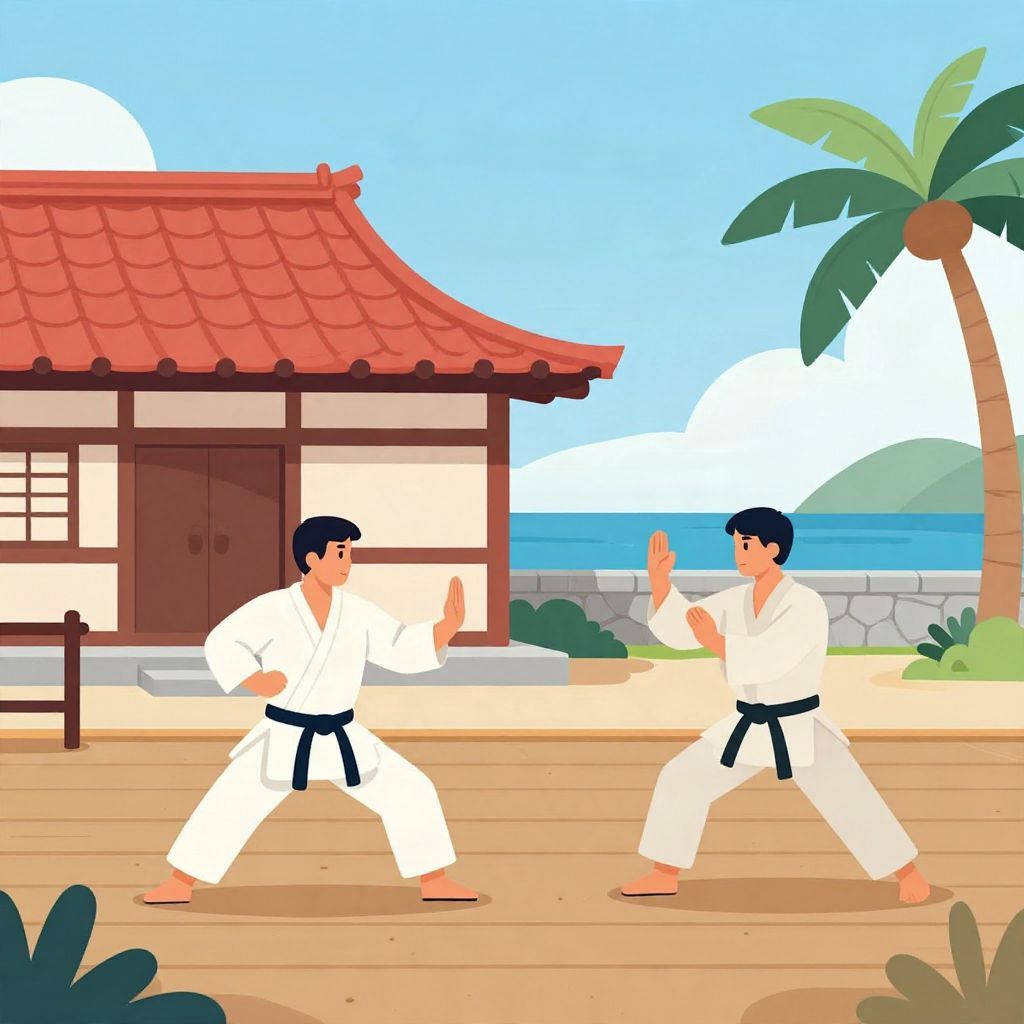
Karate is from the Ryukyu Islands, especially Okinawa, in present-day Japan. Its roots lie in a long exchange of local fighting traditions with Chinese martial arts, shaped by trade, diplomacy, and political control over several centuries.
So the short answer to “where is karate from” is: Okinawa. But the deeper history is more layered than a single birthplace. Karate developed there as a practical unarmed fighting system and later spread to mainland Japan and the world, where it was standardized, renamed, and transformed into a modern martial art.
Where Is Karate From?
Karate originated in Okinawa, the largest of the Ryukyu Islands, which are now part of Japan. Its earliest forms emerged from local Okinawan combat methods and were influenced by Chinese martial arts introduced through trade and cultural contact. The art was later systematized in the late 19th and early 20th centuries and then popularized in Japan and beyond.
The Okinawan Origins of Karate
Karate did not appear suddenly as a finished system. It grew out of Okinawa’s unique history as a maritime crossroads between Japan, China, Korea, and Southeast Asia. Because the Ryukyu Kingdom maintained diplomatic and commercial ties with China, Okinawan fighters and scholars encountered Chinese boxing traditions over many generations. These influences blended with local self-defense practices to form what was once called te, meaning “hand.”
Local fighting traditions before “karate”
Before the word karate became common, Okinawans practiced several related hand-to-hand methods. Historians often refer to these as te or “Okinawan te,” though the exact structure of these early systems is not fully documented. They were not a single unified art, but a family of practices that varied by region and social setting.
These methods were shaped by everyday needs: personal defense, law enforcement, and the realities of life in a small island kingdom. Over time, practitioners in different towns developed distinct approaches, which later became associated with major lineages of karate.
Chinese influence and the “China hand” connection
One of the most important influences on karate came from Fujian and other parts of southern China. Okinawan envoys, merchants, and students traveled to China, while Chinese residents and visitors lived in Okinawa. This contact introduced techniques, training ideas, and forms that influenced Okinawan martial practice.
The term karate originally used the characters for “China hand” in some contexts, reflecting that Chinese connection. Later, Japanese writers and teachers changed the characters to mean “empty hand,” a shift that helped present karate as a distinct Japanese martial art rather than a foreign import.
Why Okinawa Was the Right Place for Karate to Develop
Okinawa’s location made it ideal for cultural blending. It sat between major East Asian powers and functioned as a trading hub rather than a military empire. That meant ideas, goods, and people moved through the islands with unusual freedom. Karate grew in this environment of exchange, adaptation, and practical necessity.
Political pressure and weapons restrictions
Popular stories often say karate was created because weapons were banned in Okinawa. There is some truth in this, but the story is more complicated. The Ryukyu Kingdom and later Japanese authorities did impose restrictions on weapons at various times, especially after the Satsuma domain’s control of Okinawa in the early 17th century. However, karate was not simply invented overnight as a response to a single ban.
Instead, restrictions on weapons likely encouraged interest in unarmed methods and made existing practices more important. Karate’s development was gradual, shaped by social status, policing, self-defense, and elite education as much as by prohibition.
From village practice to elite instruction
By the 18th and 19th centuries, martial instruction in Okinawa was associated with teachers who trained local elites, officials, and young men. Some of the best-known early figures included Sokon Matsumura, often linked with the Shuri tradition, and Kanryo Higaonna, associated with strong Chinese influence in Naha. Their students helped preserve and refine the art.
These teachers did not all teach the same style. Rather, they transmitted lineages that later became the foundations of modern karate styles such as Shuri-te, Naha-te, and Tomari-te. The differences among them reflected local practice, training emphasis, and outside influence.
How Karate Became a Modern Martial Art
Karate’s transformation into the art known today happened in the late 19th and early 20th centuries. During this period, Okinawa was incorporated more fully into the Japanese state, and educators began presenting karate as a disciplined physical practice suitable for schools and public training. This was a major turning point in its history.
Gichin Funakoshi and the move to mainland Japan
The best-known figure in karate’s spread beyond Okinawa is Gichin Funakoshi. In 1922, he demonstrated karate in Tokyo and helped introduce it to a wider Japanese audience. His efforts, and those of other Okinawan instructors, helped karate move from a regional tradition to a national and eventually international martial art.
As karate entered Japan, it was standardized in new ways. Training became more formal, uniforms and ranking systems became common, and the art was adapted to fit modern educational and cultural expectations. This process helped karate spread, but it also changed how it was practiced and understood.
The change from “Chinese hand” to “empty hand”
One of the most symbolic changes in karate’s modern history was the shift in written characters from “China hand” to “empty hand.” This change is often associated with early 20th-century efforts to make karate more acceptable in Japan, especially during a period when nationalism and cultural assimilation were strong.
The new spelling emphasized unarmed combat and philosophical discipline. It also reduced the visible link to China at a time when Japanese institutions often preferred to frame karate as part of a broader Japanese martial identity.
What Makes Karate Okinawan, Japanese, and Global?
Karate is best understood as Okinawan in origin, Japanese in modernization, and global in reach. Each of those labels captures part of the story. Okinawa provided the birthplace and early traditions. Japan provided institutional recognition and standardization. The wider world turned karate into an international practice with many styles and interpretations.
Major styles and their historical roots
Modern karate includes several major styles, many of which trace back to Okinawan lineages. Common examples include:
- Shorin-ryu, linked to lighter, faster movements and older Okinawan traditions.
- Goju-ryu, which reflects strong Chinese influence and combines hard and soft techniques.
- Shotokan, associated with Funakoshi’s teaching and later Japanese development.
- Wado-ryu, which blends karate with other Japanese martial ideas.
These styles show how karate evolved from a regional practice into a family of related systems. They also remind us that karate has never been one single unchanging method.
Karate in the 20th century and beyond
After the Second World War, karate spread rapidly through Japan, the United States, Europe, and many other parts of the world. American military personnel stationed in Japan and Okinawa often encountered karate and brought it home. International tournaments, schools, and organizations then helped make karate a global martial art.
As it spread, karate took on new meanings. In some places it became a sport with rules and competition. In others it remained a traditional self-defense art or a way of personal discipline. These modern forms are all connected to Okinawa, but they are not identical to the older island traditions.
Common Myths About Karate’s Origin
Because karate is so widely practiced, several myths have grown around its beginnings. Sorting myth from history helps explain the art more accurately.
Myth: Karate was invented by one person
There is no single inventor of karate. It developed over centuries through the work of many teachers and communities. Individual masters were important, but they inherited, adapted, and transmitted older traditions.
Myth: Karate began in mainland Japan
Mainland Japan played a major role in karate’s modernization, but not its origin. The art’s roots are in Okinawa, not Tokyo, Kyoto, or Osaka. Japanese institutions helped popularize it, yet the foundational history is Okinawan.
Myth: Karate came only from China
Chinese martial arts strongly influenced karate, but karate is not simply a copy of Chinese boxing. It emerged from a local Okinawan context, where imported techniques were reshaped into something distinct. Its identity is therefore mixed, not one-dimensional.
Why the Question “Where Is Karate From” Has More Than One Layer
The question seems simple, but the answer depends on what aspect of karate you mean. Geographically, it is from Okinawa. Culturally, it grew from Okinawan and Chinese exchange. Institutionally, it was standardized in Japan. Globally, it now belongs to a wider martial arts world shaped by migration, war, education, and sport.
This layered history is what makes karate so significant. It is not just a fighting style; it is a record of how ideas travel, change, and take root in new places. Karate’s story reflects the history of the Ryukyu Islands themselves: small in territory, but large in cultural influence.
Conclusion
Karate is from Okinawa, in the Ryukyu Islands of present-day Japan, where local fighting traditions developed under strong Chinese influence and later evolved into the modern martial art known worldwide today. Its history is a story of exchange, adaptation, and reinvention. For related cultural history, see what is haka and why the Silk Road was important.