
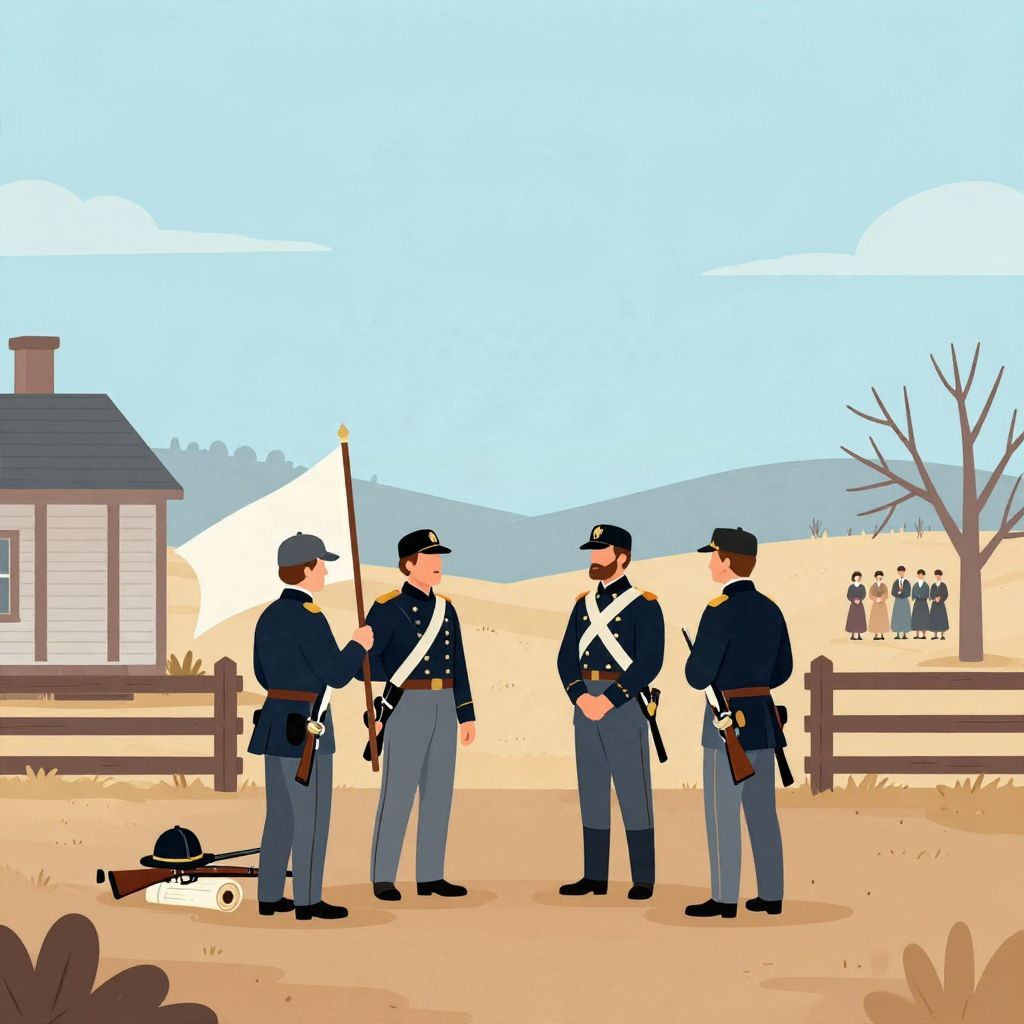
The American Civil War ended in 1865. Most historians mark the war’s practical end with Confederate General Robert E. Lee’s surrender to Union General Ulysses S. Grant at Appomattox Court House on April 9, 1865. Other Confederate forces surrendered in the weeks that followed, but that April date is the most widely recognized turning point.
The war did not end all at once in every place, and the final legal and military closures came later. Still, if you are asking what year the Civil War ended, the clear answer is 1865.
What year did the Civil War end?
The American Civil War ended in 1865, with the decisive surrender at Appomattox on April 9. While scattered Confederate armies continued to lay down arms after that, the war’s outcome was effectively settled that spring, and 1865 is the standard historical answer.
The short answer and why historians use 1865
Historians use 1865 because that is when the Confederacy’s main military resistance collapsed. The surrender at Appomattox did not instantly end every fight, but it marked the beginning of the Confederacy’s final defeat. By late spring and early summer, the remaining Confederate armies had largely surrendered as well.
This is also the year Abraham Lincoln was assassinated, slavery was abolished nationwide by the Thirteenth Amendment, and the United States entered the difficult era of Reconstruction. In other words, 1865 was not only the year the war ended; it was the year the nation’s political order began to change dramatically.
Timeline of the Civil War’s end
The end of the Civil War followed a rapid sequence of military defeats and surrenders in 1865. Here is the basic timeline:
- April 2, 1865: Confederate forces evacuate Richmond, the Confederate capital.
- April 9, 1865: Robert E. Lee surrenders the Army of Northern Virginia at Appomattox Court House, Virginia.
- April 26, 1865: Confederate General Joseph E. Johnston surrenders to Union General William T. Sherman in North Carolina.
- May 4, 1865: Confederate troops in Alabama, Mississippi, and Louisiana begin surrendering.
- May 10, 1865: Confederate President Jefferson Davis is captured in Georgia.
- June 2, 1865: The last major Confederate field army in the Trans-Mississippi region surrenders.
This sequence shows why the war’s end is sometimes described as a process rather than a single moment. Appomattox was the symbolic climax, but the Confederacy’s final collapse took several more weeks.
Why Appomattox mattered so much
Lee’s surrender mattered because the Army of Northern Virginia was the Confederacy’s most important and respected army. It had defended Richmond, fought in major battles in the East, and symbolized Southern military resistance. Once that army surrendered, the Confederacy’s ability to continue the war was badly weakened.
Grant’s terms were also significant. He allowed Confederate soldiers to return home, kept the surrender relatively generous, and aimed to reduce the chances of continued guerrilla warfare. The meeting at Appomattox Court House became a powerful symbol of reunion, even though the broader political and social conflict over slavery and citizenship was far from over.
Was the war officially over on April 9, 1865?
Not in a strict legal sense. April 9 is the date most people associate with the end of the war because it marked the decisive surrender of the Confederacy’s largest army. But other Confederate units remained in the field after that, and the final surrenders came later in April, May, and June. So April 9 is the best-known end date, while 1865 is the correct year.
What happened after the major surrender?
After Lee surrendered, Confederate resistance quickly unraveled. Many soldiers went home, while some commanders tried to continue fighting for a short time. The collapse of Confederate military power made further resistance impractical, especially as Union armies controlled key cities, railroads, and supply lines.
Jefferson Davis briefly fled with members of his government, but the Confederate national government was effectively disintegrating. By the time the last major armies surrendered, the Confederacy no longer had the means to function as an independent nation. The war’s military end was therefore closely tied to the collapse of the Confederate state itself.
Important facts about the Civil War’s end
A few key facts help explain why 1865 stands out in American history:
- The Civil War began in 1861, after the secession crisis and the attack on Fort Sumter.
- The Confederacy’s defeat came after years of enormous casualties and economic strain.
- Lincoln lived to see the war’s end only briefly; he was assassinated on April 14, 1865, five days after Appomattox.
- The Thirteenth Amendment, which abolished slavery, was passed by Congress in 1865 and ratified later that year.
- Although the war ended in 1865, Reconstruction and the struggle over civil rights continued for decades.
These facts show that the end of the war was not just a military event. It also marked a constitutional and social turning point in U.S. history.
Why some people ask whether the Civil War ended later
Sometimes people wonder whether the Civil War ended in 1866 or even later because the aftermath was so complicated. That confusion is understandable. The fighting stopped in stages, and the political consequences continued long after the last shots were fired. In some regions, especially in the South, the transition from war to peace was slow and uneven.
However, historians still place the war’s end in 1865 because that is when organized Confederate military resistance collapsed. Later events belong more properly to Reconstruction, not to the war itself.
The Civil War’s legacy after 1865
The end of the Civil War did not bring immediate equality or peace in a broad social sense. The Union had preserved the United States, but the nation now faced the challenge of rebuilding the South, defining freedom for formerly enslaved people, and deciding how much power the federal government should have over the states.
Reconstruction became one of the most contested periods in American history. The war’s end in 1865 opened the door to emancipation and constitutional change, but it also exposed deep divisions that would shape the country for generations. The conflict over race, citizenship, and federal authority did not disappear when the armies surrendered.
Answer in one sentence
The Civil War ended in 1865, with the most famous turning point coming on April 9, 1865, when Robert E. Lee surrendered at Appomattox Court House.
If you want to understand the war’s human cost or the leadership behind its final months, you may also want to read about how many died in the Civil War and when Lincoln was president. The year 1865 ended the fighting, but its consequences reshaped the United States for decades to come.