
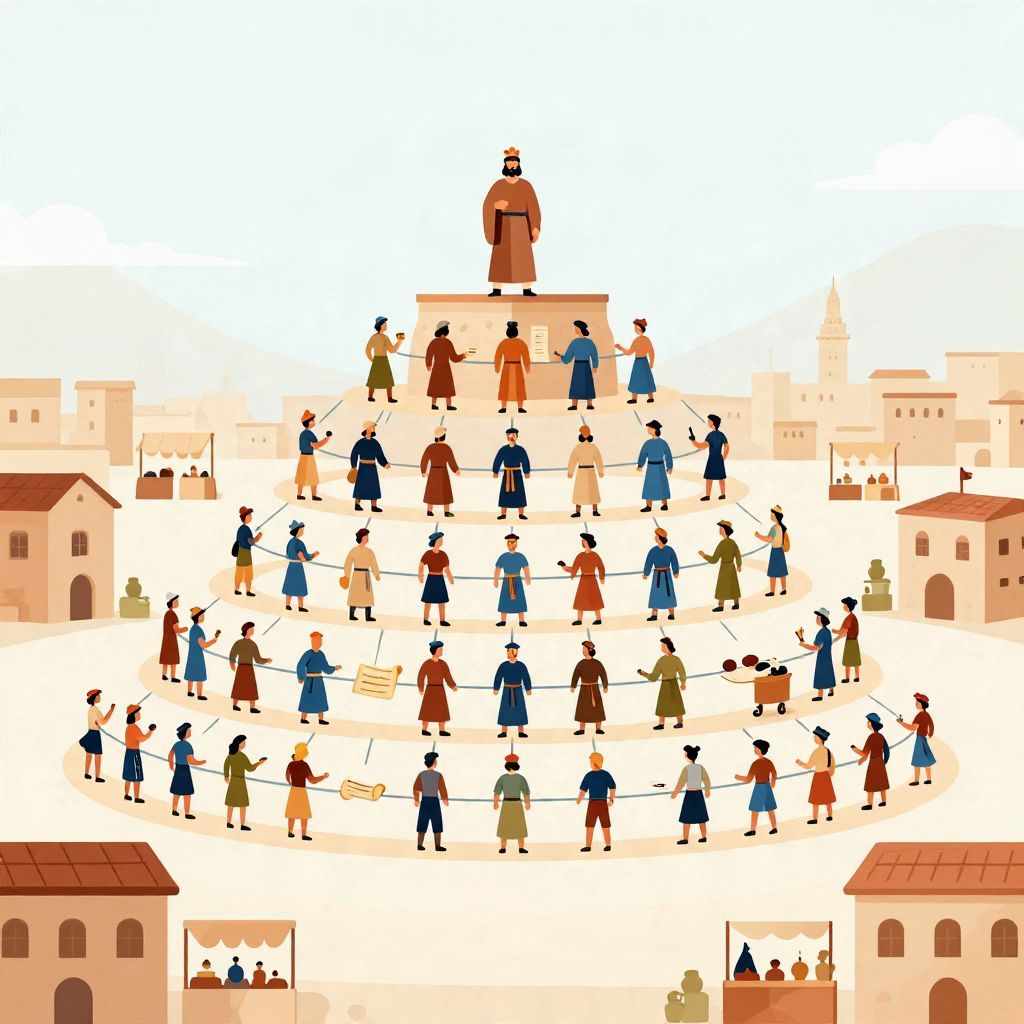
What is hierarchical diffusion? In history and geography, it is the spread of an idea, practice, style, or innovation from people or places of high status to others below them in a social or spatial hierarchy. It often begins in major cities, political centers, or elite institutions before reaching smaller towns, rural areas, and wider populations.
This pattern helps explain how fashions, religions, technologies, political movements, and cultural trends have moved through societies over time. Rather than spreading evenly in all directions, hierarchical diffusion follows rank, influence, and connection.
What Is Hierarchical Diffusion?
Hierarchical diffusion is the spread of an idea or innovation through levels of authority, wealth, or importance, usually starting with influential people or major centers and then moving outward or downward. Historians and geographers use the term to describe how power and prestige shape the way culture travels.
Origins, Meaning, and Historical Background
The concept is modern, but the pattern is old. People have long adopted customs from courts, capitals, religious centers, and elite circles before they became common elsewhere. The term itself comes from the study of cultural diffusion, especially in human geography in the twentieth century, when scholars began classifying how cultural traits spread across space and society.
Why “hierarchical” matters
The word hierarchical refers to a ranked order. In this kind of diffusion, influence does not move randomly. It tends to pass through systems where some places or people have more power, visibility, or prestige than others. A capital city may adopt a new style first, then provincial cities, then smaller settlements.
How historians use the idea
Historians do not usually claim that every cultural change follows one neat model. Instead, hierarchical diffusion is one tool for understanding broad patterns. It is especially useful when studying empires, nation-states, global trade, mass media, and modern consumer culture, where elite endorsement can accelerate adoption.
How Hierarchical Diffusion Works in History
Hierarchical diffusion usually begins when a powerful group, institution, or place adopts something new. Because elites, officials, merchants, clergy, and urban centers often have outsized influence, others pay attention and imitate them. The spread may be deliberate, as with government policy, or indirect, as with fashion or language.
Common historical pathways
- Courts and capitals: Royal and political centers often set trends in dress, architecture, and etiquette.
- Religious institutions: Major temples, churches, mosques, or monasteries can help spread beliefs and rituals.
- Urban networks: Large cities often adopt innovations earlier than rural areas because they are connected to trade and administration.
- Elite imitation: Lower-status groups may copy high-status behavior to gain prestige or social acceptance.
- Mass media and technology: In the modern era, newspapers, radio, television, and the internet can amplify hierarchical spread.
Examples of Hierarchical Diffusion in History
Hierarchical diffusion appears across many periods and regions. The specific examples differ, but the underlying pattern is similar: influence moves through centers of power before reaching broader society.
Fashion and court culture in early modern Europe
European royal courts often acted as trendsetters. Styles of clothing, manners, and architecture associated with powerful monarchies were imitated by nobles and then by wealthier urban groups. This did not mean everyone copied the court immediately, but elite approval gave certain styles prestige and visibility.
Religious spread through political authority
Religions have often spread hierarchically when rulers, state officials, or major religious centers endorsed them. In some cases, conversion at the top encouraged wider adoption below. This could happen through patronage, law, education, or the symbolic power of a ruler’s choice. At the same time, local communities often adapted new beliefs to existing traditions.
Modern consumer culture
In the nineteenth and twentieth centuries, advertising and mass production made hierarchical diffusion more visible. A product or style might first appear among elites or in major cities, then spread through magazines, department stores, and later broadcast media. The process was no longer limited to court society, but prestige still mattered.
Political ideas and reforms
Political reforms can also spread hierarchically. A new administrative practice may begin in a central government and then be imposed on provinces. Likewise, revolutionary ideas may first circulate among educated urban groups before reaching wider populations. However, political diffusion is often uneven because resistance, censorship, and local interests can slow the process.
Hierarchical Diffusion Compared with Other Types of Diffusion
To understand hierarchical diffusion clearly, it helps to compare it with other diffusion patterns used by historians and geographers. These categories overlap in real life, but each highlights a different route of spread.
Relocation diffusion
Relocation diffusion happens when people physically move and carry their culture with them. A migrating group may bring language, religion, foodways, or customs into a new region. By contrast, hierarchical diffusion does not require migration; it depends more on influence from higher-status places or groups. For a related overview, see what relocation diffusion is.
Contagious diffusion
Contagious diffusion spreads rapidly from person to person or place to place, often like an infection. It usually does not depend on rank. A rumor, a fashion, or a disease can spread this way as contact increases. Hierarchical diffusion, however, is shaped by social or spatial hierarchy rather than simple proximity alone.
Stimulus diffusion
Stimulus diffusion occurs when the underlying idea spreads, but the original form changes significantly. For example, a writing system, religious practice, or technology may be adapted to local needs. Hierarchical diffusion can include stimulus diffusion, but the two are not the same. One describes the route of spread; the other describes how much the idea changes.
Why Hierarchical Diffusion Has Been So Important
Hierarchical diffusion matters because power is not distributed evenly. Throughout history, some people and places have had greater prestige, resources, and communication networks than others. That means cultural change often begins where influence is concentrated. Understanding this helps explain why some ideas spread quickly while others remain local for centuries.
Power, prestige, and imitation
People often copy those they admire or depend on. In many societies, elites are seen as models of success, refinement, or authority. This can make hierarchical diffusion especially effective. A new style adopted by a ruler, celebrity, or major institution may seem more desirable simply because of who uses it.
Urban centers as cultural engines
Cities have long been major sites of hierarchical diffusion. They concentrate government, wealth, education, and trade, which makes them powerful transmitters of new ideas. From ancient capitals to modern global cities, urban centers often serve as launch points for innovations that later reach smaller places.
Limits and Criticisms of the Concept
Although useful, hierarchical diffusion is not a complete explanation for every historical change. Real societies are complex, and cultural spread rarely follows a single route. Local resistance, economic inequality, colonial power, religion, and chance all shape outcomes. Historians therefore use the term carefully, as one model among several.
Not every spread starts at the top
Some innovations begin among ordinary people and later move upward. Folk traditions, grassroots political movements, and local inventions can gain elite approval only after they have already become widespread. In those cases, hierarchical diffusion may describe a later phase rather than the beginning of the process.
Influence can move in both directions
Hierarchy does not always mean one-way flow. Elites may adopt customs from lower-status groups, especially in music, food, language, or dress. What matters is the direction of prestige at a given moment, not a fixed rule that culture always moves downward from the top.
How to Recognize Hierarchical Diffusion in a Historical Case
When analyzing a historical example, ask a few practical questions. Did the innovation appear first in a major political, religious, or economic center? Did elites or institutions adopt it before the wider public? Did adoption follow a chain of influence rather than simple geographic closeness?
- Identify the original center of adoption.
- Check whether high-status groups were early adopters.
- Look for spread through institutions, cities, or administrative networks.
- Compare the timing in urban and rural areas.
- Consider whether other diffusion types also played a role.
Why the Term Still Matters Today
Hierarchical diffusion remains relevant because modern societies still have centers of influence. Governments, universities, corporations, media platforms, and cultural industries can all accelerate the spread of ideas. Even in a highly connected world, prestige and authority continue to shape what people notice, trust, and imitate.
From empires to social media
In earlier centuries, courts and capitals were especially important. Today, the same logic can appear in different forms: a trend may emerge among celebrities, large brands, or influential online accounts before reaching a broader audience. The technology has changed, but the social pattern is familiar.
Conclusion
Hierarchical diffusion is the spread of culture through ranked networks of influence, usually from powerful centers or elite groups to wider society. It helps explain how ideas have moved through history, from royal courts and religious institutions to modern cities and media systems. To explore related concepts, you may also want to read about cultural diffusion and relocation diffusion.